 | To find details about my new book on the Titanic crew's return to England and the tales they told about their experiences, please look here |
by Dr.Paul Lee
With thanks to Brian Hill, Alan Ruffman and Rolf-Werner Baak.
It is widely believed that the winter of 1912 had been unusually warm, resulting in a greater than normal amount of icebergs and field ice breaking loose from the Arctic circle and drifting into the North Atlantic on the southerly setting Labrador Current. For the first few months of the year, this ice was a nuisance to vessels off the north-eastern Canadian coast as it was confined to a region off the Grand Banks of Newfoundland ... but the ice soon began to be reported by vessels much further south, heading to ports on the Eastern seaboard of the United States. By April, the ice had affected ships heading towards Boston, Portland, Saint John (New Brunswick) ... and New York. This latter destination was of course the point towards which the new White Star Line ship Titanic was heading. Only a few days away from completing the outward leg of her maiden voyage, the ship was steaming at about 22.5 knots (25.9 mph). Whether because of apathy, overconfidence, or the presence of the White Star Line chairman on board stimulating the need for extra speed, many radioed ice warnings received by the new leviathan were all but ignored. A token delay her in change of course, bringing her slightly south of her intended track, failed to prevent the inevitable meeting of steel and ice.
Before we continue, a misconception needs to be demolished. A fable of the Titanic story is that the ice had never been so far south, but this is wrong. As the British Inquiry reported later, "it is quite incorrect to assume that icebergs had never before been encountered or field ice observed so far south, at the particular time of year when the "Titanic" disaster occurred; but it is true to say that the field ice was certainly at that time further south than it has been seen for many years." Other people's opinions are of interest; Captain Moore had been traversing the Atlantic for 27 years and had never known the ice so far south; but his observations were, naturally, limited to his time in that area, perhaps only a few days each month. Lightoller testified in London that he had no recollection of ice as far south as 42N, but only days before in the US he stated that the disaster was the first time he had seen field ice on the Grand Banks in his 9 years of voyages to New York, although he had seen icebergs. Captain Dow of the Carmania told the New York Times on April 15th and 16th that he had never seen so much field ice so far south before. As we shall see soon, his vessel was severely hindered in its crossing by the ice conditions.

Above: "The Syren and Shipping" magazine of April 24th 1912 displays the extent of the ice reported in the many decades preceding the Titanic disaster. In the legend box, the numbers after the hyphens are the heights of observed icebergs, where known.
Please click on the image for a larger version
When one considers all the data, as the British Inquiry inevitably
must have done, they rightly concluded that the extent of the ice was unusual but was certain bereft of being "a record." The extent
of the icefield prompted one paper ("The Hull Daily Mail" of April 18th) to announce that the Titanic was far south of what the
charts define as the ice limit, 75 to 100 miles if the paper's estimate is correct.
In 2014, a re-assessment of the evidence in the journal "Weather" forced the conclusion that "iceberg calving rates were high, but not exceptionally so." This will no doubt sit uncomfortably with some enthusiasts who posit the scenario that "everything was against" the Titanic, from technical matters through to supernatural considerations.
In the March 2014 Journal of the British Titanic Society, Brian Hill and Alan Ruffman analysed the matter further and used 42N as a criterion for expected normal southerly limit of ice, with an emphasis on Captain Smith's service record. During his years of service from 1880 to 1911, in only two years (1881 and 1910) icebergs did not cross the 42nd parallel. By restricting themselves to only analysing the ice data until the end of April in those years, Hill and Ruffman added 7 more years. The authors write, "by sticking to the recommended shipping lane, icebergs could be expected to be encountered in seven out of ten years up to the end of April, and pretty well every year during the iceberg season." Furthermore, by analysing extant iceberg records, it was demonstrated that, of out Smith's 31 years in service, ice had been seen in 15 of them.
To normalise their data (as the number of ice reports vary from year to year), the authors considered years for which the number of records was similar to 1912; that is, greater than 2000 reports. They obtained 180, 1896 and 1899, with the latter data set being similar to the year the Titanic went down. The resultant plots show that 1912 was not an excessive year for icebergs. Indeed, Hill and Ruffman note that in 1903 and 1905, the westbound shipping lane was moved 60 miles further south; they speculate that the mention of "1904" as another lane-shifting year was a mistake in the records as the ice was not as extensive. Previously, alterations to the lanes had also been made in 1896 and 1897. In their final coup de grace, the authors dismiss the oft-repeated but never verified claim that the "record" number of icebergs was due to a warm winter causing excessive calving of icebergs; in actual fact, 1912 was one of coldest on record in the northern hemisphere and globally; it was also the second coldest recorded in the mainland US! Their joint paper is available here
One must also consider the opinion of the US Hydrographic Office. They said (New York "Evening World" of April 15th) that the ice packs were in no way unusual. Reports from shipmasters of ice packs between British Ports and New York showed 63 in April 1911, as opposed to 13 up to April 13 1912, the last report being from the Carmania on April 11th. The only report of unusual ice conditions was from Captain Jacobean of the Armenian. In addition to the reports of an "unusual quantity of large and small icebergs and field and pack ice" (see below), he said "The southern limit of the ice appears to extend from latitude 42.36 to longitude 49.36 running in an east-northeast direction. Changed ship's course south to clear the ice."
Away from this impressive and definitive latter day debunking, popular wisdom, imprinted in the mind of historians, describes a massive ice field, 3 or 4 miles wide, and some 55 miles in length (or even more - account vary) lying in a roughly north-south direction directly in the Titanic's path, and surrounded by huge icebergs. But there are many accounts of ice, dotted all over the ocean, preserved in contemporary documents (for instance, see this link), and unknown to Titanic scholars, possibly because many of them were from ships that did not possess wireless and had to report them verbally when they arrived at their port; they would not therefore appear in the "immediate" press reports of the loss of the Titanic. This page attempts to explore the ice warnings and the impact they had on navigation.
Although an excellent discussion of the Titanic's intended route to New York can be found here, the basic details can be repeated here for the sake of completeness. From the south-west coast of Ireland, and after a brief stop at Queenstown, the Titanic headed roughly west-south-west on a "Great Circle" course. This course, when plotted on a Mercator map, is not a straight line. Due to the sphericity of the Earth, the shortest route is a curve when depicted on such a map. The "Great Circle" route forms a plane which intersects the centre of the Earth. However, when a location, called "The Corner" is reached, the heading is changed from south-west to a more westerly course. This is known as a "rhumb" course. The Titanic would then head towards the Nantucket Shoals Lightship and then to the Ambrose Lightship. Other ships also manoeuvred towards the corner before altering course; the Californian and the Mount Temple (though her actual course led her more to the south and west to avoid ice).
Between January and August, westbound vessels headed for a position known as "The Corner", at 42 N 47 W before changing course almost due west to New York. On the eastbound leg, ships aimed for a point 60 miles south of this co-ordinate at 41 N. Between August and January, with the risk of ice minimised, ships were permitted to travel further north, hence reducing the journey time and distance. Although these routes were customary, some ships did not follow them. Boxhall later said of "La Touraine" at the US Inquiry, "You will understand these French boats do not keep the recognized tracks we do. French boats are always to be found to the northward." Interested readers are directed to the Titanic Inquiry project where the routes of the various ships are discussed in detail.

Above: "The Shipping World" magazine of August 21st 1912 displays the four shipping routes pre-Titanic.
Please click on the image for a larger version
The Titanic calamity forced a change to these routes. At the US Senate Inquiry, Captain Knapp, the hydrographer of the Bureau of Navigation, Navy Department in Washington, D. C. informed the investigators that,
April 16, the steamship companies in New York announced that they had shifted their route to cross 47 west., in latitude 41 north, westbound, and to cross 47 west, in latitude 40 10' north, eastbound.
April 18, having received the approval of the Secretary of the Navy, the office directed Lieut. Grady, in charge of the branch Hydrographic Office at New York, to confer quietly with the steamship companies and urge a still farther southward shifting of the steamship lane. Lieut. Grady found the companies entirely open to suggestion; they cabled to their European houses, and, by common agreement, the tracks were laid to the southward, as follows: April 19, westbound, great circle to latitude 38 north, longitude 45 west; then to latitude 39 north, longitude 50 west; then to Nantucket Shoals Lightship; then to Ambrose Lightship.
Eastbound, Ambrose Lightship to latitude 40 north, longitude 70 west; then to latitude 38 20' north, longitude 50 west; then to latitude 38 20' north, longitude 45 west; then great circle to Bishops Rock. A complete list of Knapp's catalogue of shiiping routes can be found here.
Lloyd's Weekly Shipping Index for May 16th reports that westbound crossing was to reach longitude 45 and 50 N in latitude 38 N; and eastbound, to reach 45 and 50 N at 37 40 N.
The westbound routes are depicted in the following diagram. The uppermost red line indicates the Titanic's anticipated route; the next line denotes the new, more southern track used after the Titanic went down. The bottom red line shows the dogleg that forced ships to miss the ice reports from April 18th onwards. This change of route was a necessity. On May 2nd, 1912, the White Star Liner Cedric left Liverpool, arriving in New York 9 days later. A New York telegram from this liner reported that "after leaving Queenstown, [she] went as far south as 39 7 N, and the following day an ice field was sighted directly ahead."
Even after the drastic revision to the shipping lanes, icebergs were still seen, and one can see references to sightings and near misses littering the newspapers of the day. A familiar name in Titanic-lore, the Rappahannock, reported by wireless that on June 7th, she narrowly missed an iceberg while in fog; she later docked in Halifax 3 days later. The Burmez Prince, en route to Boston also encountered fog (on June 2nd?) and when it cleared at 8am the next day, the crew saw icebergs on all sides, four of which were described as "monsters." And on the approach to New York on July 16th, the Adriatic sighted an iceberg in her path near where the Titanic sank. Avoiding action was taken, and a warning was wirelessed to ships. The Mauretania slowed down and passed through the area later without seeing the iceberg. But, it has to be said, that those tasked specifically with searching for icebergs had no success; the scout cruiser Birmingham stated (The New York Sun on June 10th) that it had spent three weeks from 39 to 42 N and 45 to 50 W and had not seen a single iceberg. Another scout cruiser, the Chester, had similar luck and only sighted 3 icebergs in nearly three weeks of observations (The New York Times 22nd June 1912). Given that the Parisian ran into a field of fourteen icebergs ("the largest number ... sighted ... for many weeks") as she approached Boston (again, after fog dispersed), we can only conclude that the icebergs had been constrained to an area closer to the Grand Banks (The New York Times 23rd July 1912).

The adoption of these new routes seem to have been immediate (except presumably for ships having no wireless and already enroute to New York or Europe). In the New York Times on April 20th, 1912, the Cunard SS Mauretania was reported to have sailed "to the south of the ice packs," the longer route delaying her arrival until April 19th. Data presented in the Appendix to this page, shows this ship was at 40.56 N 48.41 W on April 17th, where she saw an iceberg 4 miles to the north, well to the south of the Titanic's route. The Mauretania had received the news of the disaster a few hours after it occurred on the 15th, but its passengers were not informed of the tragedy until wednesday when it was relayed in the on-board newspaper. The generous passengers then organised a collection for the bereaved. The Kent and Sussex Courier of May 3rd, 1912 is illuminating in graphically describing the impact that the ice floes were having on sea-faring traffic, as it printed extracts from a letter and a diary from Mr.J.R.Elliott, who returned to Canada on the Allan Liner "Corsican". On April 11th, thick fog necessitated a reduction to half speed and about 9pm, another ship was seen to starboard stuck in ice, and they blew threw blasts on her whistle, prompting the Corsican to go full speed astern, "shaking the whole ship from stem to stern." A solid wall of ice rose straight up ahead of them, and they ran into a huge field of ice. They manoeuvered around for two or so hours and then lay to for the night. The next day revealed "as far as one could see nothing but thick ice, fringed with large icebergs." Four other boats were also in sight - a huge Hamburgh [sic] American, The President Lincoln etc., all having laid to for the night. The Corsican turned tail and started to steam East again, and then took a southerly course for 70 miles, taking 5 hours to clear the pack. She docked in Halifax early on the 14th.
Interestingly, the reports on this page claim that the President Lincoln arrived a day early! The exploits of another ship that encountered ice, the Carmania, can be found on the reliable New York Times website. She was also forced to stop and crawl through the thickening ice. Like the Corsican, this was on April 11th. Interested readers are encouraged to search the New York Times archives, such as this page which describes the plight of some of the other vessels, such as the Niagara, which was holed below the waterline twice on April 10th and docked in New York 5 days late partially due to fog.
What of the other ships? How was their navigation affected? This author has, researched ships for whom starting locations and dates could be ascertained via an internet search and could be found in Lloyd's publications; this would determine which direction the vessels were travelling. Such information could be obtained from websites such as Findmypast which lists passenger carrying vessels leaving the British Isles.
One caveat is that I assume that the coordinates printed in Lloyd's publications and the New York Maritime Register are correct! However, where more than one set of latitude and longitude are printed, a reasonable deduction of ship's course can be obtained. For others, doubt lingers, but without the navigational logs of the ships, this is all we have to work with. The collated data will be discussed presently.
The path of ice over time can be display using an appropriate programme, such as the bespoke Java Applet below. However, since no one was tracking each individual piece of ice, there is no way of knowing whether a berg seen one day was the same seen 'x' number of miles away the next day. And, if no ships happened to follow a route where ice had drifted, obviously this would lead to seeming "bald patches" on a chart. Still, the charts are useful for showing what was seen, where and when. The "where" has a caveat in that we have to implicitly assume that the location of the ships are accurate. The "when" also has a condition too: in most cases, there is no mention of the time of day that a sighting occurred. It is possible that, for example, an iceberg seen at one co-ordinate at 6.00am is the same seen 12 miles away at 6.00pm.
Hopefully, the usage of the Applet is self explanatory. The user can select a region with a mouse button pressed down, and the main viewing panel will resize to show a zoomed-in region; the arrows on the perimeter of the chart allow the user to move to a selected region. Additionally, the time increment between days can be specified; the default value is 2 seconds; a lower number may not allow the data to be redrawn on screen properly.
The data are colour coded as follows:
The orange lines indicate the routes undertaken by vessels from the 42 N 47 W "Corner". The uppermost line goes to St.John's, Newfoundland; the next line counterclockwise goes to Halifax; the next to Sable Island, and thence to St John, New Brunswick; the next line goes to Portland, Maine. The next yellow line traverses the route to Boston, and the most southerly line, south of 42 N, goes to New York.
Please activate Javascript and download the Java Runtime Environment.
The Applet has a number of issues outstanding, which are being worked up. When zooming in, the lines of latitude do not always show up; the ability to pause and then restart from the stopped time does not function at present (you have to "stop" the simulation, and re-start it from the beginning). Also, the "tooltips" facility does not work: this would allow the user to be presented with a box displaying information pertinent to the area the mouse cursor is placed over. If you have any more suggestion, please mail me .
As afore mentioned, we can now make a determination of the movements of the ships in the area for the month of April, 1912. For reasons detailed above, we have many such data with which to work. What they tell us is conflicting and confusing, and in some instances, controversial. I have only dealt with ships that traversed the route to/from Europe and the North Eastern coasts of America and Canada. The only ships that encountered ice or wreckage whilst travelling east were; the Portsmouth, from Gulfport (April 16th) to Cardiff (April 30th), sighting wreckage on April 20th; the Manchester Engineer, from St John, New Brunswick (April 18th) to Manchester (May 2nd), sighting ice on April 23rd; the Riverdale, from New Orleans (April 10th) to Hamburg, sighting ice on April 22nd; the Talisman, from Mobile (April 9th) to Liverpool (May 1st), sighting ice on April 21st; the Harlseywood, from Mobile (April 9th) to Manchester via Nofolk, Virginia (April 16th), sighting ice on April 23rd.
Of these, the following can be said: the Portsmouth, passed right through the disaster area; the Manchester Engineer
was slightly to the south and well to the east when she sighted "her" ice - seemingly heading roughly towards
the slightly modified "corner" announced on April 16th.
The Riverdale encountered ice slightly to the south but well to the east of the wreck site; again, she seems to be heading
towards a more southerly corner than the Titanic did. The same can be said for the SS Talisman, as can the Harlseywood.
It is interested to note that, with the exception of the Manchester Engineer, none of the vessels were heading east from
north eastern coast USA/Canada ports encountered ice (as far as we know). These ships seem to have bypassed the massive
congregation of ice to the west. The Manchester Engineer, if heading for a corner at 40 10 N 47 W from St John would have
just skirted to the south of the accepted ice at 50 W, before meeting ice close to her turning point. If one views
the applet for the date of sighting (April 23rd), one can see a cluster of reports at the rough area of this corner for both
east and westward ships. Ships that did not possess wireless (these ships are not listed in this report for June 1912; it seems likely that they did not have wireless installed in April) and did not communicate with other ships via morse lamp,
and left port too late to have learned of Captain Knapp's declaration of altered shipping lines would have headed on their
old, prescribed courses. What is interesting is that three of these ships had courses from ports well to the south of
New York's latitude. These courses may have prevented them from engaging in icy conditions.
A knowledge of ship's movements, and the reported ice locations throws up a few navigational surprises, most of which are dealt with at the end of this page, but here are a few of the more outstanding examples:
Of interest is the Amerika, which was well to the north of her anticipated Eastbound route (see below) and the Almerian, which again, was at a point north of her expected path. Likewise the Bremen and the Rhein, which were heading westward. If they were on the expected route, they should have been south of 42 N at 49 W.
The Megantic, another eastbound ship, presents some problems. A White Star Line vessel, she left Portland, Maine on the morning of April 14th. She did have wireless and did receive the Titanic's frantic calls for assistance. Since she had arrived from Liverpool, which she left on March 30th, she would have been making the return journey. On April 18th, she saw bergs between 47.59 N 46.08 W and 48.27 N 45.15 W, and saw a growler at 49.01 N 43.23 W. When connecting these points, the line makes a north-easterly route, consistent with a journey to Europe. But it is totally inconsistent with making a course to the corner, and then turning north-east; indeed, this is already hundreds of miles to the north of it! The latitude is even further north than her Portland origin, and is more-or-less the same as St.John's, Newfoundland! Was the Captain of this ship "cutting corners" (excuse the pun). The distance between Portland and the western-most coordinate is some 1038 nautical miles. According to this website, she had a maximum speed of 16 knots. She could have traversed the distance in 2.7 days, but did so in about 4 days. Sadly we know nothing more about her navigation.
Another White Star mystery is the SS Laurentic (used in the pursuit of Dr.Crippen), from Liverpool (13/4/12) to Portland, and then to Quebec. Her position on April 18th is in the region of 48 N 45 W, heading south west, seemingly on a course for Halifax. She is well off-track, if our assumptions of ships courses are correct.
The White Star Line vessel Cymric left Liverpool on April 10th, heading for Maine (Portland?). On the 16th, she encountered ice. Her positions are listed as being between 48.36 N 43.43 W and 47.31 N 45.24 W, and also at 47.31 N 46.20 W. Initially heading south-east, she seems to have then turned to the west, but she is still too far north and east for the 42 N 47 W corner. Indeed, she is still well to the north of any Portland docks. She seems to have been heading for the corner but took a detour to avoid the ice in her path. This is not too far from the mysterious route undertaken by the Megantic, discussed above. Why was the Cymric on this route? The New York Times for April 25th perhaps gives a clue: due to the national coal strike, this ship took on stranded passengers from another White Star ship, the Teutonic, and possibly sailed a northern route because of the lack of coal! If this is the reason, he may have taken this route partially for safety reasons; by April 16th, there were very few reports of ice in the area that he was traversing. The shorter route may also have preyed on the mind of the passengers of the SS Adriatic; they demanded (The New York Times, April 18th) that she takes the southern route! Was she taking, or had planned to take the northern route?
Although many of the ships' routes are almost right, with deviations caused by current, and changes in navigation causing some of the courses to be slightly off by a few miles, some of them cause problems in our analysis. They do not seem to conform to the accepted routes.
One such example is the SS Zeeland, on the Antwerp to New York route. On April 14th, she is in a region to the north of the corner, heading on a route roughly to the location of New York, before diverting to the south east to avoid a huge ice field. What was she doing so far north? The Zeeland did have radio in June 1912; she may have diverted to avoid the ice on her rhumb course to the corner. The New York Times of April 25th mentioned that she was surrounded by field ice at some point in her crossing and no open water could be seen.
A minor mystery that can be explained is that of the Rappahannock; she encountered ice on April 11th. She is reported to have been on the Halifax to London route, except that she is on a direct course between the corner and St Johns, New Foundland! If one peruses the ice warnings for March 1912, one learns that she was heading to St.Johns; a possible explanation is that she was steaming for Halifax via St. Johns. The Rappahannock is, of course, one of those ships intertwined with the Titanic story and David Gittins has analysed her story on his webpage.
But this is, as said, a minor mystery; of those ships identified in Lloyd's List, many are off-course, bypassing the 42 N 47 W corner completely; some may be due to the advance ice warnings, but the amount of deviation (hundreds of miles in some cases) is significant. But this cannot explain all these cases, as not all the vessels were equipped with wireless. It could be that they deviated to avoid unrecorded ice sightings, but why not report them to Lloyd's or any other authority? Or were they trying to save time by cutting out the "unnecessary" Corner waypoint? A discussion of all these cases is omitted, for reasons of tedium and repetition. Of course, there are instances were Lloyd's have reported, or been given, wrong coordinates, but these are discussed later on this webpage; and in any matter, single instances of ice are verified by later sightings of bergs and field ice, often by the same ship, reinforcing the author's opinion of the correct nature of many positions.
A probable conclusion is that in some, but not all cases, the ships were making a shorter route, whether by company's orders or by the whims of the captains. Most of the ships that met ice were westbound vessels, and many of those were sailing from British ports ... could the spectre of the national coal strike have forced an economic decision to save coal? This cannot be the whole story, as the end of the strike was announced on April 6th, 1912, and even then, ships were still cutting off the corner ... and even after, in some instances, after the routes were changed following the Titanic catastrophe.
Regarding the lay of the icefield near the Titanic, what can we say? The afore mentioned Captain Knapp produced this map for the US Senate Inquiry:

It is inaccurate though. The data from the Trautenfels, which encountered the ice very early in the morning on April 14th, has been merged with the Titanic's distress location (which we now know was wrong), some 18 hours later. Indeed, the lay of the field is taken directly from the Trautenfels. The SOS location is well to the west of the western edge of the icefield, which was found by the Mount Temple to be 50 9.5 W at about 7am on April 15th. Clearly, between the Trautenfels encounter and the Titanic's collision, the ice had drifted. I have assumed that the Trautenfels reported location is correct. By mixing up this ship's report of ice with that of the Titanic, it places the White Star leviathan to the east of the icefield, which is incorrect.
Fortunately, another map, drawn by Captain Stulping of the Russian steamer, the SS Birma, appeared in The Daily Telegraph on April 25th, 1912. How accurate this chart is, is a source of debate.
 |
 |
I have superimposed the location of the Trautenfel's ice on this chart in green; after steaming for 25 miles, the field was cleared. If one accepts the southermost latitude of the Trautenfels field, and equates it to the south-westernmost tip of the Birma's field, the mean direction of it can be ascertained (the red arrow). The southwest-northeast layout of the ice is rougly matched between the two datasets. From Captain Stulping's report, housed at the UK National Archives, we know that he cleared the southern boundary of the field and encountered the Carpathia at about 12.00pm. The southernmost tip of the Trautenfels ice, at 41.40 N at 5.40am + the steaming time of the Birma to skirt the ice, is now at about 41 20 N at about midday. In somewhat less than 18 hours and 20 minutes, the ice had drifted 20 miles south; a maximum of 1.1 knots. The map (above right) shows the inferred layout of the Mesaba's route in orange (see below).
More evidence comes from the the Mesaba. She encountered an ice field at 42 N 50 W at 2pm and travels south for about 20 miles (so to about 41 40 N), and then seems to have headed west south west to 41 35 N and 50 30 W, presumably hugging the eastern extremity of the field where it was cleared at 4pm. In 20 hours (to midday) of a 1 knot southerly drift, this would bring this lower portion of the ice to 41 10 N, which is reasonably close to the 41 20 N value in the above paragraph, allowing for rounding errors, and mistakes in estimating the position of the ice etc.
Further evidence comes from the a report written by ss Asian's Marconi Operator Howard for his employers. His ship was en route to tow an oil tanker, the Deutschland, that lay helpless in mid Atlantic due to a shortage of coal. The Asian made for the tanker and headed on a course of N70E "in order to bring the Asian in the same latitude as the Desutschland. This course was continued till 3am 75th meridian [New York] Time time April 14/12 when the captain again altered the course to S70E as he expected the Deutschland to drift southerly. Eventually the Deutschland was sighted at 7am..." which was at 40 42 N 55 11 W.
Additionally, at 10.35am, the Olympic received a message from the Parisian, stating that the field ice extends to 41 22 N. The ice extended to the north-west. Further communication was obtained at 12.50pm when the Olympic enquired about navigating in the area of the disaster:
"Safe from field ice to 41.22. 50.14; as the ice was yesterday, you would need to steer from that position about northeast and north to about lat. 41.42 and 50, then approach his position from the westward, steering about west north-west. My knowledge of the Titanic's position at midnight was derived from your own message to New York, in which you gave it as 41.47, 50.20; if such were correct, she would be in heavy field ice and numerous bergs."
The Parisian was at 41 42 N, 49 55 W at 8:00 p.m; to find the southernmost tip of the field ice, she would have had to steam south. This would be from a latitude of 41 42 to 41 22; a distance of 20 miles. At a speed of about 12 or 13 knots, it would take over an hour and a half to reach this location; this is the minimum time since we do not know her longitude when she left the ice behind. Furthermore, the correspondence with the Olympic makes it clear that the ice was at this latitude "yesterday" (ie - on the 14th, at a time after 9.30pm). Obviously this would not be the same position at noon the next day. But as I have tabulated below, the Parisian said she encountered medium and large icebergs and numerous growlers between 4.30pm and 8.00pm. The reports do not mention field ice, and the ice was between 41 55 N and 41 42 N. If we simplistically assume a 1 knot southerly current and that the ship's locations are correct, by the time the Parisian encountered the Titanic's rough location (ie 8pm), we can make an estimate of the southern edge of the icefield at this time. The Birma's "rude sketch" puts the lower boundary at about 41 15N at 12 noon on the 15th. Working back 16 hours, the edge is 41 31N. But the Parisian was 11 miles north and should have been in the ice! It seems unlikely that the Parisian could be so off course due to the current she experienced during the day.
Safely docked in port on April 21st, Captain Gambell of the SS Virginian gave his account of the Titanic to the press. "We passed the place where the Titanic sank at a distance of six or seven miles. I had to go around an ice field. The ice was closely packed between us and the position of the Titanic when she went down, and there would have been great danger in going nearer. No boats, packages, or wreckage were to be seen." He provided more details to The Western Times (23rd April 1912): "At 11am I sughted field ice and bergs and at 11.20am in lat 42 3 and long 50 30 I came up with a large field of heavy ice with enormous bergs stretching N and S as far as could be seen. I passed round this to the S and SW and rounded the southern edge in lat 41 20 long 50 02 and steering east true, finally got clear of the ice in lat 41 20 and long 49 50."
The Virginian picked up the distress call at at 1.02am New York Time, when she was 170 miles north of the Titanic. She turned around and proceeded to the wreck, her top speed being 18 knots. By the time he picked up a message from the Carpathia instructing him to resume her voyage (because she had picked up the lifeboats), the Virginian had travelled 162 miles. This would be at 10.02am, close to Gambell's time of "10am". According to Lloyd's, his ship was in the area of "42 3 N, 50 20 W and 41 19 N, 49 50 W, where she saw numerous bergs and growlers" (cf his account above). This report does not mention the icefield, but his interview with the press did. The co-ordinates in Lloyd's journal therefore gives the boundaries of the field. By this account, the lower extemity of the ice is 41 19 N or 41 20 N using his press account; close to the Birma's chart value of 41 20 N. The Virginian data tells us that the icefield was 43 or 44 minutes, or 43-44 nautical miles long.
Further evidence can be inferred from the SS Mount Temple. When she picked up the Titanic's plea for help at 12.11am, she was at 41 25' N., 51 14' W and turned back. Until sometime after 3am, she never encountered any ice. The Mount Temple had modified her original course based on warnings, and met "her" corner at 41 15 N, 50 W. By working backwards, based on course and speed, she would have been at this location at 7.15pm. At this point, it would have been light enough to see, and given the Mount Temple's dimensions, she would have been able to see some 7 miles to the horizon. Therefore, the ice, which was invisible, was still to the north of 41 22 N.
How far north did the ice stretch? The SS Californian's controversial location places the ice in (at least) 42 05 N, and stretched as far north and south as the eye could see. The SS Lena, which docked in Portland, Maine a few days later gave some more details. In the New York Times on April 25th, Chief Officer Elias is interviewed. He says that the Lena passed within 34 miles to the north-east of the wreck position and that the night "was clear as a bell"; he surely would have mentioned ice if any had been seen? If so, 34 miles north-east of the SOS position would be a latitude of 42 10 N. The Lena would be heading slightly to north of west. By the time she arrived at the Titanic's longitude, she would therefore be even further north. And yet, by inference, nothing had been seen.
How does the drift compare with other estimates? The Californian was reported to have left the Titanic's wreckage at 41 33 N 50 01 W at 11.20am; this was based on her noonday position of 41 33 N 50 09 W at midday and working backwards. The Frankfurt's navigational data corroborates this latitude; the data supplied by Captain Knapp to the US Inquiry says the Frankfurt saw the Californian "near" 41 35 N 50 15 W, and this was after the latter ship had left the icefield to resume her trip. But, there is one dissenter. Third Officer Groves says that the flotsam was left at 10.40am. If we use the estimate of speed from the previous values, the wreckage is now left at 50 53 W. The Titanic, as we now know, sank at 2.20am at 41 44 N 49 57 W. We therefore can deduce two values for the speed and direction of current; namely, 1.26 knots to the south-south-west (195.22 degrees) or 1.37 knots to the south-south-east (164.78). Both these values are slightly more than that inferred from the Trautenfels/Birma data.
The Californian placed the wreckage in a latitude of 41 33 N about 9 hours after the disaster. Among the next reports of wreckage and/or bodies (which provides a position) is from the SS Portsmouth, which, on April 20th "passed through a quantity of wreckage, apparently not long in the water; cabin fittings and white painted woodwork and teak, one cabin sofa, upholstered and one lifebelt, white, hardly discoloured." This was at a position to the north and east of the wrecksite. Also, the Rhein and the Bremen also observed debris on this date not far from the Portsmouth's location. Unfortunately there is no data between the 15th and the 20th as to how the wreckage dispersed. The Prinz Adalbert passed right through the area and while she reported icebergs which appeared in Lloyd's journals, she is silent on the issue of debris (at 4am on the 16th, the Adalbert was at 42 N 49 W steering a course of 257 degrees; four hours later, she was at 41 31 N, 49 59 W, where she met the huge icefield; Alan Ruffman suspects that this latitude may be a misreading for 41 51 N as this location is far more plausible for a vessel on the afore mentioned course.)
So, with the wreckage seemingly caught in the Gulf Stream, can it be traced any further in its progress across the ocean? Sadly not. A long and laborious search through Lloyd's journals reveals no more sightings after May. It is tempting to think of the ironic possibility that scattered fragments of the great liner wound up on the coast of Ireland, her country of birth, some 5 or 6 months after the sinking. This is not to say that of the numerous mention of debris at sea (most notably "logs"), none came from the Titanic. It is simply that there is no way of identifying the source of many of the pieces of flotsam.
Abandoned Titanic lifeboat, collapsible A was encountered by
the White Star Liner Oceanic on May 13th, with three bodies still on board the damaged raft. It was reported in The New
York Times (on May 17th), that the boat had travelled 7 3/4 nautical miles per day. This relates very nicely to information
from the New York Sun (17th May 1912), where 3rd Officer Withers reports that the boat had drifted southeast 222 miles, or 7.9 miles per day.
There is, unfortunately, a flurry
of different locations given for the recovery of this boat. The Cork Examiner (16th May) gives the location at 39 56 N 47 01 W as does the Bisbee Daily Review (17/5/12).
This information comes from Reuters. The New York Times is unsure whether the latitude is 30 56 N or 39 56 N. The Bisbee Daily Review of May 17th provides a hybrid location of "lat 30 56 N 47 01 S [sic]". In 1983, researchers Eaton and Haas
provide a location of 47 01 N 42 29 W, but in their book "Triumph and Tragedy" three years later, they give it
as 47 01 N 30 56 W both of which are well to the north-east of the wrecksite and which contradicts the known information
that shipping lanes were by that time already well to the south of their pre-Titanic routes. Given
the distance that the boat had travelled in 28 days, and the much more southerly route undertaken by the Oceanic,
a latitude of 39 56 N seems the more plausible, but this is only 182 nautical miles from the traditional sinking location; it is 209.6 statute miles but it seems unlikely that a nautical man would give distances in "land" miles. The log from the Oceanic shows that on May 13th (time unknown), she was at 38.55N, 46.40 W; on the next day she was at 39.28N, 55.58W at which point she was travelling almost due west - therefore it seems likely that the latitude was about 39o north.
Thus, despite much of the wreckage and bodies being caught in a north-easterly
heading current, here is one item that got caught in a south-easterly current. Most of the operations to recover
bodies were confined to the north and east of the wreck; what a pity they didn't search to the south too, but as one
commentator says "they could hardly search the whole North Atlantic," and had to rely on reports from passing steamers.
If no steamers passed any bodies in their shipping lines, they obviously would not be reported.
[On an unrelated note, the recovery of collapsible A must have been particularly troubling to one Oceanic passenger. For she carried one Mme Navratil. Her estranged husband had kidnapped her two children a month later, taking them to a new life in America. Monsieur Navratil, travelling under the pseduonym "Mr.Hoffman" had booked passage on the Titanic. And, while he did not survive, his children did, and now Mme Navratil was coming to New York to collect them. Interestingly, Titanic survivor Frank Prentice, a storekeeper, signed on to the Oceanic on July 10th, 1912 and he recalled that he was on board when one of the Titanic's lifeboats was found drifting in mid-Atlantic. If he is right, this can't possibly be boat "A"; the Oceanic left Southampton post-disaster on May 8th. Prentice arrived back in England on the Lapland on April 29th and would have had a deposition taken. It is highly likely that he would have been compelled to remain in England to give testimony at the British Inquiry which started a few days afterward. Ultimately he wasn't called. Lloyds records do not mention the Oceanic encountering any lifeboat mid-Ocean in July 1912.
Update: A transcription of Walter Lord's interview with Prentice, written by Charles Pellegrino in 1994 claims that it was collapsible A, recovered by the Oceanic, which was seen. This seems slightly dubious but then again, he wrote to Ed Kamuda that, "...I joined her [Oceanic] immediately on my return to U.K. after the sinking of Titanic & served in her until we were sunk off the Faroe Is."Update: Collapsible A may have been seen by the Adriatic on May 5th, 1912. If this is correct then the Labrador current may have pushed this boat into the southerly, eastbound shipping lanes before encountering the north-east heading Gulf Stream which pushed the craft into the nornern, westbound track towards America.
Update: "The Daily Herald" of May 20th, 1912 reported, "Passengers arriving at Plymouth by the American liner 'Philadelphia' on Saturday [18th] report passing an empty lifeboat of the 'Titanic' last Tuesday [14th]. Mrs and Miss Doling, survivors of the 'Titanic' disaster arrived at Plymouth by the 'Philadelphia'."
Upturned Collapsible B is one that sometimes appears in the reports from passing ships; her capsized status makes her very distinctive and identifiable as boat "B". Cable laying ship, the Mackay Bennett, involved in operations to recover the dead, saw this boat at 41.55 N 49.20 W on April 23rd and she was also apparently seen by the Bremen three days before, only a few miles to the north; nearly a month later (May 16th) the SS Paul Paix reports seeing it at 41 51 N 42 29 W, "a large white painted boat bottom up apparently a ship's lifeboat, not long in the water, very clean and showing no damage about the bottom". The distance between these two points is 306 nautical miles, or a rate of 13 nautical miles per day. Unlike boat A, this boat was to the north-east. The two had drifted off the Titanic as the great ship sank. Despite them being in close proximity to each other in the aftermath, they had wound up in very different locations. It is likely that boat B, the wreckage and the bodies became caught in the North Atlantic Drift, which converged with the colder, southerly flowing Labrador current only a few miles from where the Titanic went down. The rate of drift is about right. [Note that Eaton and Haas say the Paul Paix's sighting occurred on May 29th; the ship left Swansea on May 9th, and her top speed was 11.5 knots; it would take her about 7 days to traverse the distance to the wrecksite, so May 16th is a more plausible date. The Culberton Searchlight newspaper of May 31st 1912 reports this incident but gives no date other than the Paul Paix was in dock in New York when the paper went to press. Certainly, her date of arrival in New York (23rd May or 24th, according to Ellis Island) give credence to the earlier date, bearing in mind that the Paul Paix was a day late in arriving probably due to ice conditions. Lloyd's records show that the Paul Paix left New York on May 29th.]
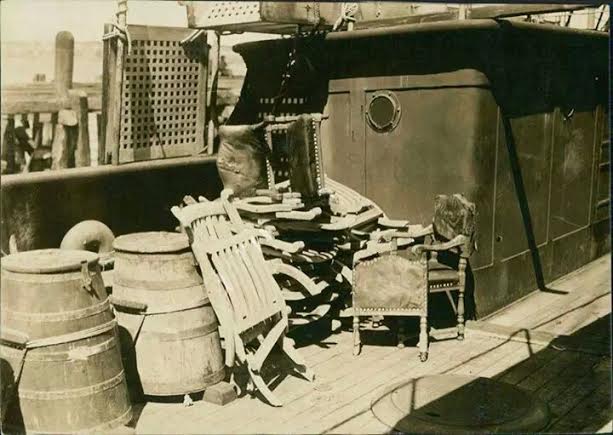
click for a larger version
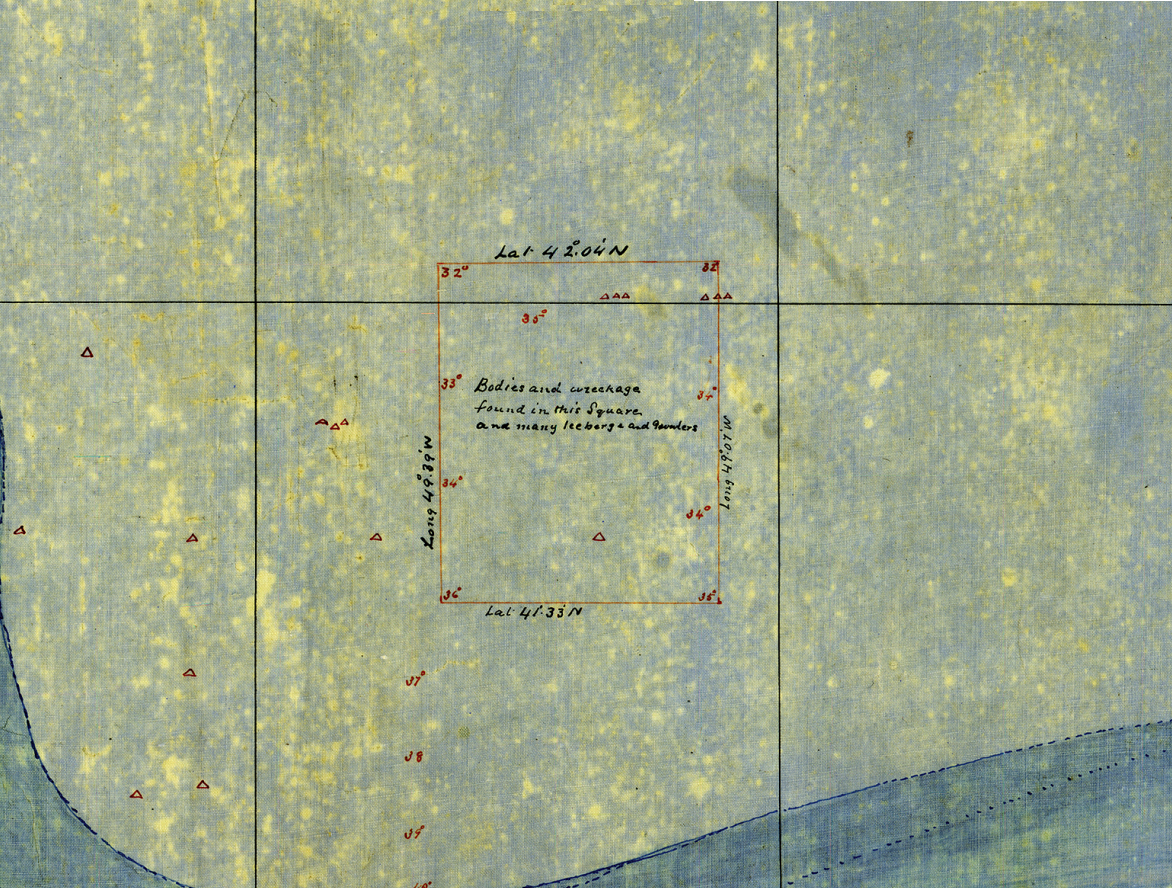
Is there a way to postulate where the boundaries of the Labrador current were on the afternoon or evening of April 15th? We have water data from the Californian and the Titanic. For the former ship, there is an indication of a drop of temperate of 11 degrees during the afternoon at about 48 degrees W. The water data from the Titanic is not so dramatic; the information that we do have was taken at about the time the sun set, and so water temperature was dropping anyway. But there is a hint of a drop at double the previous value beteen 7.30 and 8pm, in the vicinity of 48 W. Water has a very high specific heat capacity and one of its properties is that it takes a comparitively long period of time for water to relinquish its absorbed heat content, even after the source of energy (the sun) has been removed. The sun had indeed set at 7.30pm but it was still light enough to perform stellar observations for navigation (one needs to see the horizon and the stars to perform this). It would be surprising if the water temperature had dropped by such an amount in half an hour.
This is summarised in the following diagram, showing the water temperatures and locations for
the Titanic and the Californian during their journeys.

This leads this author to posit that the bodies and wreckage drifted south in the Labrador current, until, at some point, they were caught in the easterly North Atlantic Drift. This explains why so many pieces of flotsam were seen to the east. There are very few reports of field ice around 50 W after April 15th. This may be due to the shipping lanes having been shifted south, but there are still instances of ships passing very near to the Titanic's grave. The last report of field ice in this vicinity is from the SS Cestrian, who reported it between 41 50 N and 41 42 N. Thereafter, there are instances of small, broken chunks of ice in the area. A possibility is that the field ice had been broken up and dispersed by the North Atlantic Current (though the Cedric reported, as given above, that it saw an ice field well south of the disaster area; given the distances involved, it is unlikely that this is the field that the Titanic would have encountered had she not hit the iceberg). The icebergs themselves continued drifting south. The furthest south ice reports that I could glean were dated between May 8th-10th, 1912 from many ships (Amerika, La Savoie, Carmania, Pretoria, Monmouth, Merian, Mechanicia, George Washington, Mannheim et. al.) who all describe large and small icebergs in the area of 39 N, 47 W. but no field ice at all. It may be salient at this point to recount what Captain Knapp included in a memorandum to the US Senate Inquiry:
1. The Labrador Current, which brings both berg and field ice down past Newfoundland, sweeps across the banks in a generally south to southwest direction, flowing more westerly on its surface as it approaches the warm Gulf Stream water in about latitude 43, with a set of about 12 miles a day. The speed of the Gulf Stream drift at its northern edge is only about 6 miles a day at the fiftieth meridian and its depth is probably less than 300 feet.
2. An ice-field arriving at the edge of the Gulf Stream drift finds itself impelled less and less to southward and more and more to eastward and north-eastward; but a deeply floating iceberg may continue to plow southward into the warm east-flowing current and end its career south of latitude 40; by melting and breaking up. The reason for this is that the cold, south-moving current actually under-runs the warm surface water.
3. The southward progress of icebergs across the Grand Flanks is estimated to be a degree in five days, or about 12 miles a day; but it seems to slack up as the warm current near the tail of the bank is approached (lat. 42 to 44N., long. 49 to 51 W.) Here the icebergs are reported with greatest frequency. This may be because the largest number of passing steamers travels the region or because the bergs loitering that vicinity owing to the commingling of the two ocean currents above named.
4. The course of an iceberg in that region could be predicted if the following factors in the problem were known: (a) Vertical section below water. (b) what ratio of the vertical section is in each current (polar and Gulf Stream), (c) direction of each current. (d) velocity of each current. What these factors are must be estimated in each case, varying with each berg according shape and size, and varying with the location and date to some extent. 5. Not much is known regarding the subsurface current. This should be studied during a hydrographic survey of the banks: at the same time careful observations are needed of the surface currents (direction, velocity, meeting points, temperature, color, etc.). A thorough study of the question is desirable; and it would be possible for a naval vessel to gain much useful information by a season's work in that vicinity (April to August, inclusive). She could also record direct observations of ice movements, and act an a radiotelegraph station to warn other ships.
Therefore, it is possible that icebergs, which "penetrate" much deeper in the water and hence are more prone to deeper currents, travel in different directions to items located at or near the surface of the water; field ice, wreckage and bodies, for instance. An excellent contemporary discussion on the currents can be found on the New York Times website.
Sam Halpern's article in the Titanic Historical Society Commutator (issue 181), entitled "We Could Not See One Body" (a quotation from the Carpathia's Arthur Rostron on the morning of the disaster) speculates that a "cold water eddy", a counter clockwise circulatory current had prevailed on April 15th, and for the next few days. This current is some 55 miles in diameter. This explains why there were reports of bodies and wreckage well to the north-east of the wreck a few days afterwards, and then, to the south-east a few days hence. This may be so, but it does not explain the other cases of bodies and wreckages being seen, nor does it explain the huge variation in number of bodies and type of flotsam seen; those seen on, say, April 25th may not have been the same as on April 20th. A much more likely explanation is that the wreckage had been dispersed into islands by competing eddies between the Gulf and Labrador Currents.
For the sake of completeness, the reports of wreckage and bodies after April are included here:
The Chicago Tribune (3/8/12), reported that, "The body of W. F. Chiverton, the chief steward of the Titanic, was found on June 8 in latitude 49.06 north, longitude 42.51 west, by the British steamship Ilford. The finding of the body was reported by the chief officer of the Ilford, which arrived in this port yesterday. The body was buried at sea." The Sun newspaper of New York (20/6/12) erroneously reports that three steward were retrieved 370 miles from the scene of the disaster. [Eaton and Haas put this at
40 06 N 42 29 W which is too far south for a ship travelling from Galveston (23/5) to Hamburg (18 or 19/6) via Norfolk (Va) (1/6); at 42 degrees West, the ship would be on a Great Circle route, and well to the north of 40 N. Even so, the Chicago Tribune's location is not 370 miles away, but 538 nautical miles.]
The tanker S.S. Ottawa picked up the body of 2nd class steward W.T.Kerley on June 6th, 1912. The ever useful Encyclopedia Titanica provides the location: 44-16N, 38-21 W. A note by 3rd Officer Cook, stored at NARA says "picked up body of a man with life belt supposed to be Asst Steward of TITANIC from papers in pocket. Man was buried."
Lloyd's Journals said that German tank steamer Clio reported on May 6th, at 41 25N, 41 43 W: "saw an iceberg which the captain thinks is the same that sank the Titanic. It was 130 feet high and bore appearances of having been run into, one end being broken. It was surrounded by a steamer's saloon fittings of white painted wood and mahogany, plush cushions, deck chairs, fancy handbags and innumerable small pieces of wreckage. The captain does not report having seen any bodes." [Note that Titanic authors
Eaton and Haas put this sighting on April 29th; this date is confirmed by the El Paso Herald of May 7th, 1912 which says that
the iceberg had one end broken as if by collision. The location is put at 41 25 N, 48 43 W; The Gazette Times also gives these details
in its May 7th edition. The Clio left the Tyne on April 20th and arrived in Philadelphia on May 4th, indicating that, for once, Lloyd's date is wrong. Also, given the two longitudes and the 10.5 knot speed of the ship, the 48 43 W location is more plausible, and it is
closer to the known location of the other debris at this time than 41 43 W. The other reports from this ship about this date place it about 48 W rather than 41 W.]
The following intriguing report of bodies being seen on an iceberg is tantalising, but it does not provide any information to categorise the data, either in terms of location or date. Even its veracity is suspect. The report was printed in the Montreal Weekly Witness of 30/4/12 and originated from New York four days before: the steamer Prinzess Irene intercepted a wireless message on Wednesday (presumably 24th April) that said that 50 miles from the scene of the disaster, bodies of more than a dozen men, all wearing lifebelts and huddled together at the base of a berg, were seen by an unidentified ship. The opinion was that the men had climbed on to the iceberg and had frozen to death as they were "swept southward." If this is correct, on April 24th or before, this iceberg was seen at a latitude of 40 56 North. But, there is no other data to confirm or refute this story.
Another fascinating report comes from the recovery ship Minia, commanded by Captain William deCarteret, but his letter dated May 8th, 1912 does not list the individual locations where "their" 17 bodies were found. However, it does localise them into an area. He wrote, "My operations [between April 26th and May 3rd] covered Longitudes 49 30'W. to 48 00'W., and Latitudes 41 20'N. to 42 30'N. and no field ice was seen at any time; but at first a large number of icebergs were seen, from the lofty berg to the growler; then they disappeared, and only one was seen on the return trip. It is my opinion that few bergs remain in Latitudes 41 30' to 42 00'N. in the longitudes between 48 00' and 49 00'." This would seemingly contradict the data presented below, which lists numerous bergs on April 30th unless this is a deferred or delayed report from a few days previously. However, deCarteret is clear that after a while, there was no ice to be seen. This letter also confirms that the bodies and wreckage (including a newell post, a panel from the lounge and a railing from one of the 1st class staircases) had drifted to the east and to the north and south of the Titanic disaster scene. Indeed, the Minia picked up "part of a door" at 41 42 N, 49 20 W during her excursions. The Minia's report of May 3rd said that "pieces of the grand staircase [were seen], most of the wreckage from below decks. It must have been an awful explosion as some of the main deck planking 4ft thick was all split and broken off short...[we] also saw pieces of a saloon wall."
The very last body seen was reported in the Chicago Tribune on 21st July 1912 thus: "Philadelphia, Pa., July 20—The body of a man lashed to a spar was sighted about seventeen miles from the scene of the Titanic disaster by the British steamship Hudson, which just arrived here. The body was unrecognizable." A similar report was filed in the Shreveport, Louisiana "The Caucasian" on the 23rd of that month except that it said the ship was for New York, and the body was only seven miles from the wrecksite. It added the small detail that the fingers of the body were grasping the ropes.
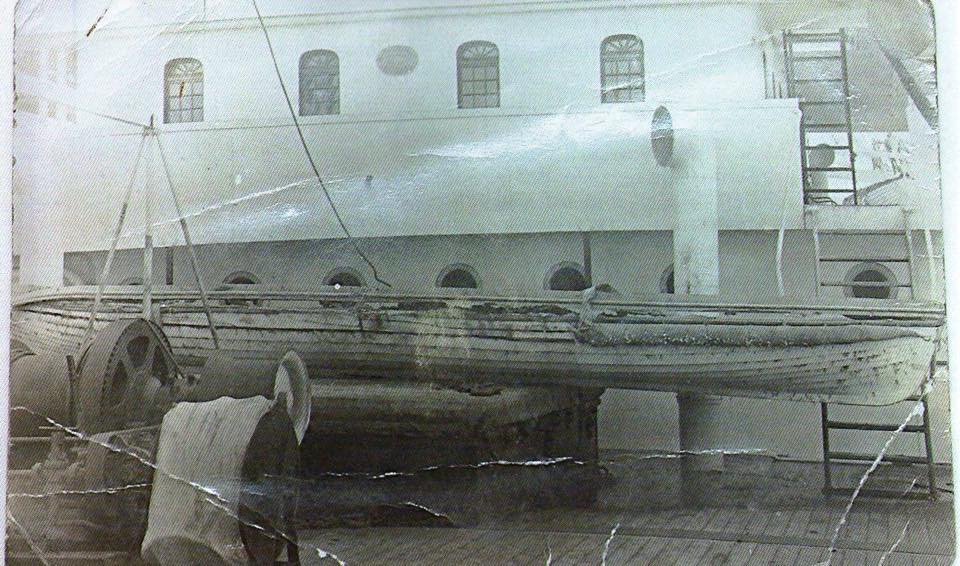
The Lord-Macquitty collection held at the National Maritime Museum in Greenwich, London has an intriguing item:
"Photograph of a TITANIC collapsible recovered in the Bahamas 18 months after the disaster by RMS Port Kingston. Together with an explanatory letter from Herbert Hill, n.d. Given to Walter Lord by William MacQuitty."
The photograph, in the form of a postcard, looks like one of the Titanic collapsibles, albeit the canvas sides seem to be missing. Being a collapsible, it lacks the "Titanic" nameplate and lifeboat designation. There is no way to ascertain if the boat really does come from the "Titanic": the Bahamas is well to the south-west of the wrecksite, so it seems unlikely that the boat was carried there by the current. It is possible that the boat was caught in the North Atlantic Gyre (a huge circulating current), before reaching the area of southern Europe, and then travelling back west to the area of the Bahamas on the North Equatorial Current. This is possible, but I have no other information on whether to determine whether the boat is from the "Titanic." The currents and circulatory currents in the North Atlantic are complex and chaotic, and one can only speak of gross trends in direction and speed rather than subtleties. One need only look at how the derelict schooner "Fannie E Wolston" meandered around the ocean for many years, trapped by the whims of eddies and whorls. An excellent discussion on early research into ocean currents can be found in the New York Times and some good data has been gathered using bottles deliberately cast adrift, and then determining their eventual landfall; indeed, some released from the US eastern seaboard have reached the Azores and European shores. But one should be careful of a mindset being tainted by dubious data. On July 15th, 1920, a lifebelt from the Lusitania, bearing a strand of faded blonde hair and covered in barnacles was found 100 miles upstream from the capes in the Delaware River. The belt was marked "Life Belt" on one side and "Lusitania" on the other. While the afore mentioned New York Times article accepts it as genuine and even posits a plausible route ("from the Irish Sea, around the north of Scotland, down the North Sea, crossing the English channel, down the coast of France and Spain and Africa where it was carried across the Atlantic and captured by the Gulf Stream and headed north, ending up in the Delaware, perhaps with assistance from a steamship's propeller"), today people have more suspicious minds. If the White Star Line is any indication, Cunard would not have marked a vessel's inventory with the name of the ship as this would prevent the free transfer of such material to other craft in the event of shortages (and indeed, no Titanic lifebelt, piece of cutlery, crockery etc. is adorned with the name of the ship). The lifebelt is rightly regarded with suspicion; but, to be fair, the Merseyside Maritime Museum has a life-ring of seemingly excellent provenance with the name "Lusitania" emblazoned upon it, so who really knows? The Lusitania is not the only vessel to be associated with dubious flotsam. In 1893, the White Star ship Naronic disappeared without trace. 4 bottles were later found, each one describing a grim plight on board ship. Two of them were found in the US, one in the Bay Ridge area of New York, the other in Ocean View, Virginia; the other two ended up on the other side of the Ocean, in the Irish Channel and the River Mersey respectively. The first two had meandered south-west, and the other two eastward. These bottles are generally regarded as hoaxes, too. For more information on the loss of the Naronic, see this website.
Away from our own little soujourn (!) into the topic of ocean currents, the letter about the Bahaman lifeboat indicates that it was found approaching Turk's Island, at the entrance to the Carribean Sea, and wound up in Avonmouth, where the picture was taken. This may be the source of an anecdote in Michael Davies' book, where the headline in the first edition of the Titanic Enthusiasts of America journal (a.k.a. The Titanic Historical Society) The Marconigram (later renamed The Titanic Commutator) in September 1963 was "Bristol has Titanic lifeboat". Davies notes that the story was "wrong."
A further addendum to this story comes from author and researcher Campbell McCutcheon who informed me that, "there are a couple of reasons why the ship is likely not to be an Imperial Direct Line [the line to which the "Port Kingston" belonged] vessel in that all of their ships had been sold and the line closed down by 1911, and, more importantly, because the vessel concerned, on which the lifeboat is photographed, was built by Workman Clark of Belfast. I have an original 1913 postcard of this image and it clearly shows the builder's plate. I would guess that while the photograph's owner has the timing correct, he has the ship incorrectly named. I'd conjecture that the ship was an Elders & Fyffes vessel, which, by 1913 had taken over the Kingston-Avonmouth run and had numerous vessels built by Workman, Clark, including Pacuare, Patia and Chirripo." theshipslist.com confirms this, and notes that in 1913, the "Port Kingston" had been renamed "Tahiti" and furthermore, Lloyd's records show that this ship was on the North America to Australia route in October 1913. Sadly, the number of Elders and Fyffes vessels in operation at the time (approximately 21) and the vagueness of the dates prevents any further resolution to this mystery, for the present at least.
If these stories are true, of the 7 lifeboats set adrift, 2 have been accounted for, one possibly (the Bahaman craft) and maybe a fourth, if Frank Prentice's recollections are right. But what of the others? The "Cherbourg-Eclair" of 21st October 1912 notes that "Captain Malo of the three-master "Cap-Liban", landing on Oct. 16 in Granville from Newfoundland, reports having logged that by 50 longitude W. and 45 5 latitude N., he came across a large lifeboat that read: "Titanic - 15 - Liverpool". The lifeboat was quite close to an iceberg, and was absolutely empty." This story is intriguing but one wonders, with two major currents in the area of the sinking - one going south, and one going east, how this boat ended up hundreds of miles to the north of the wrecksite? While at first glance it seems implausible, both the Kursk and the Vlieland saw debris to the north of the Titanic within two weeks of the tragedy. The mention of the ship's name - "Cap Liban" - is a problem, too, as there is no such vessel listed in the registers. Presumably it is a misprint for the Granville registered 3 masted wooden schooner "Cap Lihou"? If this is so, Lloyd's registers do not mention this ship's passage across the Atlantic, as it seemingly falls into an exclusion category exempting the journal from describing the movement of coasters, yachts, sailing ships etc. This is, to say the least, frustrating.
Then there is this mention: "The Derry Journal" of 2/7/1913 reported, "The steamer Eisenach, on arriving at Baltimore, passing a lifeboat; covered with barnacles, floating keel upwards, near where the Titanic foundered." The Ottumwa tri-weekly of June 12th 1913 (amongst others) mentions this story but gives few other details other than the sighting was on the morning of June 4th, the Eisenach carrying 1302 immigrants at the time and that "the officers ... said that from its apeparance [sic] it must have been at the mercy of the waves for at least twelve months" and that it was at almost the exact spot where the Titanic foundered." However, I could find no mention of this in the otherwise reliable Lloyd's List.
As seen below, in the ice reports, the Royal George came across a Titanic lifeboat on April 23rd; the previous day, the Royal George was reported to be in (at least) 50 06 W and still heading west, from Bristol to Halifax where she arrived on the afternoon of April 25th, as reported in the Salt Lake Tribune and other papers of that same day. So here is one boat that had drifted west, against the normal currents ... if the stories are true that is. If they are, what boat could this have been? Collapsible B was encountered by the Mackay Bennett on the 23rd, but well to the east of the Royal George's report. It must refer to a different boat.
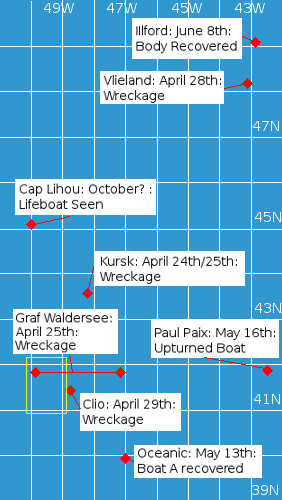
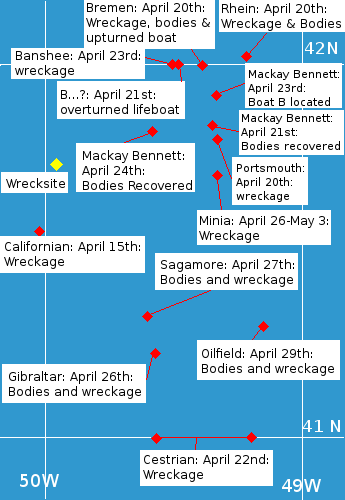
It is possible to plot all these different reports of debris and bodies, but no obvious correlation in the data can be seen. The residue from the ship ended up in all manner of directions at different times. The data is represented in the charts belows; the one to the left shows a depiction of the more widely dispersed items, the one to the right highlights the area bordered in yellow by the first plot. The second plot is unfortunately cluttered due to the close clustering of the various reports in the first few weeks (it also omits the Graf Waldersee's reports; this is due to clarity). The positions and times are best estimates where contradictions exists and have been largely extracted from Lloyd's journals unless compelling evidence exists that their data is wrong (eg. in the case of the date of the Clio's report).
 |  |
The majority of these data come from the entries in the New York Maritime Register, which have been transcribed here. The problem with the Register entries is that they very often don't include the name of the ship, or shore station reporting the data (these have been denoted by "???"). These entries have been supplemented by data from "The Shipping Gazette and Lloyd's List" and "The Lloyd's Weekly Shipping Index" held at the Guildhall Library and the National Maritime Museum, both in London; indeed the reports in these latter two publications, which do contain ship's names have often corroborated the seemingly incomplete data from the New York Maritime Register.
Other ice reports have been found in the New York Times and other newspapers, as well as websites ( in particular, the Titanic Inquiry Project ), books ( such as "Titanic:Triumph and Tragedy" by John P. Eaton and Charles A. Haas ) and other documents (e.g. Captain Lord's 1959 affidavit). Brian Hill has access to a huge repository of ice reports from various sources and these account for much of the data here; I am very much obliged to him for sharing his data.
One thing to be wary of is that often there is no differentiation about when icebergs were seen; for instance, see the Lackawanna's reports. The mentions in journals seems to be of the kind (for instance); "April 10: 51.20N 47.34 W, April 11: 51.20W, 49.50 W saw 57 icebergs and some field ice." There is no way to distinguish the two sets of co-ordinates from the data resulting in some inevitable and inescapable duplication of data. Also, one should also note that, where multiple sets of data exist for the same ship on the same day, these have not been arranged into chronological order; consequently latitude and longitude may seem to switch about.
To help with my visualisation of this data, I had attempted to identify the extent of the observed ice. So, if an account says, for instance, "[we saw an] ice field extending NNE to horizon", I have estimated the distance of the ice to be at least 8 miles, which seems reasonable given the dimensions of the ships in the list (the height above the waterline determines how far one can see to the horizon).
I have also only included data where a specific data is mentioned. The Mount Temple's captain was asked about ice
reports during the British Inquiry. He told the court that he was warned of ice between 42 15' N. 49 48 W. and 41 25 N.,
50 20' W. This report came from a steamer called the "Corinthian" and the Mount Temple received it on April 13th. We
don't know when the ice was actually seen, though. I have also only included date where a specific location is referred to. As an example, the "Sheffield Evening Telegraph" of 27th April 1912 reports that the "Empress of Britain" had encountered an iceberg the previous Wednesday 240 miles east of the Titanic's wreck (despite the dense fog, the lookout saw the berg, the engines were reversed and the ship swung off barely escaping it; fortunately the ship had been proceeding slowly). This is frustratingly imprecise and seems dubious as the Canadian Pacific Railway issued a denial (cycnics might say that this is to be expected as it would be foolish to admit that one of their own vessels had almost succumbed to catastrophe so soon after the Titanic disaster)! Taken literally, "240 miles" would put a ship off its course; unless one meant "240 miles to the east and north"? The "New York Tribune" (27/4/12) says that it was in 46N, 47W; again, too imprecise but one wonders what the ship was doing so far North of her track if the reported location is true?
Another report from the "Empress of Britain", this time of the preceeding, eastward journey says that, three days after leaving Halifax, the ship encountered an immense ice field a hundred miles in extent with enormour icebergs, and the ship was forced to steer a hundred mile course to avoid it. One of the bergs was reported to have been 4 miles long, and the Empress was 2 or 3 days late in arriving at Liverpool. Although most reports put this on Tuesday (that is, the 9th), a few other mentions in the newspapers put this encounter as being variously Monday night or on Thursday. The location is not given. The Titanic Inquiry website says this was at 43 28 N, 49 36 W but is this correct? It is well to the north and slightly to the east of the wrecksite. In three days, the Empress could cover about 1500 nautical miles at most (and at 18 knots), but the distance from Halifax to "The Corner" was only some 740 miles. The Empress should therefore have passed the corner and been well en route to Liverpool. Further details, such as the ship's actual speed, coupled with imprecision on the date of encounter with the ice, confound the issue.
Other ice warnings can be found on the Encyclopedia Titanica (ET) website and have been incorporated here. It should also be remembered that not all sightings of ice found their way into the press. This newspaper page from the Sheffield Daily Telegraph of April 22nd says that, in its futile rush to assist the Titanic, the Olympic "passed through a great icefield, although their vessel was never in any danger from it." We know where the Olympic was when she started her dash to the rescue and we also know where she was located when she resumed her course (allowing for inaccuracies in dead reckoning, of course). If true, this means that she met the ice considerably to the west of all the other vessels on the 15th of April.
| Date | Ship/station reporting (where known) | Position | Ice report |
|---|---|---|---|
| "April 1" | "SS Samara" | "43 12 N 45 14 W" | rescued schooner Blue Jacket which had foundered after being crushed by ice |
| "April 1" | "ss Lord Cromer" | 43.20 N 50.39 W | "Heavy pack ice and icebergs" |
| April 2 | ss Mackay bennett | 47.18 N 51.03 W | Large iceberg: Brian Hill notes that one report gives a lat of 47.48 & a doubtful lon. of 31.03 |
| "April 3 " | "SS Alexandria" | "45.04 N 56.38 W" | "saw drifting ice and ice fields." NB: Encyclopedia Titanica lists this as being the "Alexandra" |
| "April 3 " | "SS Haulwen" | "44.45 N 58.20 W " | "ran into an ice field." |
| "April 4" | "SS Nieuw Amsterdam" | "43.20 N 49.00 W" | "ice field extending NNE to horizon" |
| "April 4" | "SS Columbia" | "43.20 N 49.00 W" | "saw field ice extending to the NNE as far as could be seen" |
| "April 4" | "SS Columbia" | "43.30 N 45.17 W" | "saw two small growlers". Brian Hill notes that one of his sources says 48.17W |
| "April 4" | "SS Virginian" | "43.37 N 49.00 W" | "saw several light patches of field ice" |
| "April 6" | "SS Strathfillan" | "49.00 N 48.00 W" | "encountered ice"; Brian Hill quotes two ice reports from this date; 48.29 N/49.09 W and 48.13 N/49.28 W saying "very thick field ice and [large] bergs." |
| "April 7" | "SS Armenian" | "42.36 N 49.36 W" | "encountered heavy field ice which extended in an ENE distance of 70m from this coordinate" |
| "April 7" | "SS Armenian" | "43.20 N 48.20 W" | "saw several large and small bergs" |
| "April 7" | "SS Armenian" | "42.36 N 49.36 W" | "heavy field ice" |
| "April 7" | "SS Rosalind" | "45.10 N 56.40 W" | "ran into a strip of field ice about 3 or 4m wide, extending north and south as far as could be seen. Some very heavy pans were seen." |
| "April 7" | "SS Strathfillan" | "47.31 N 51.05 W" | "Very large iceberg." |
| "April 7" | "SS Strathfillan" | "47.14 N 51.23 W" | "Very large iceberg." |
| "April 7" | "SS Strathfillan" | "46.35 N 53.24 W" | "One large and one small iceberg." |
| April 7 | ss Kilkerran | 42.55 N 49.02 W | saw a small berg ~5 miles to the northward |
| April 7 | ss Deutschland | 48.14 N 46.36 W | heavy pack ice & many large bergs |
| "April 8" | "SS Royal Edward" | "42.50 N 49.30 W 42.30 N 50.10 W" | "passed thick and heavy loose field ice." |
| "April 8" | "SS Royal Edward" | "42.48 N 49.40 W" | "a large berg" |
| "April 8" | "SS Brinkburn" | "47.00 N 47.00 W" | "encountered ice, field ice and numerous small bergs" |
| "April 8" | "SS Rio Pirahy" | "42.44 N 49.34 W" | "for 7 hours passed a large quantity of field ice and icebergs." |
| "April 8" | "SS Empress of India" | "43.28 N 49.36 W" | "observed ice field with bergs as far as eye could see from NW to SE. The icefield was 100 miles in extent and appeared as a white line on the horizon" |
| "April 8" | "SS Victorian" | "42.50 N 50.09 W" | "passed through ice at 1.15pm 42 50 N 50 09 W. Passed floes of pack ice and field ice to the north as far as could be seen." According to this page, the Victorian was 2 or 3 days late in arriving at port. |
| April 9 | ss Bulgaria | 42.31 N 49.56 W | saw 2 bergs |
| "April 9" | "SS Knutsford" | "40.56 N 47.56 W" | "reports a temperature drop in 40 56 N 47 56 W which was attributed to a huge iceberg seen 1.5 hours later. The weather was hazy at the time." Brian Hill reports that the iceberg was 160-200 feet high and at least 3/4 mile long. |
| "April 9" | "SS Cassandra" | "43.38 N 49.16 W 39.26 N 39.36 W" | "met heavy field of ice 43 38 N 49 16 W. Steamed southwest to 39 26 N 39 36 W when the floe was cleared" |
| "April 9" | "SS Cassandra" | "43.00 N 51.00 W" | "Bergs and heavy ice passed" |
| "April 9" | "SS Empress of Ireland" | "43 28'N., 49 36'W" | "passed through an immense ice field in [this] vicinity" |
| April 10 | ss Niagara | 44.39 N 48.30 W | passed a berg ~200' long & 30' high Unless there were two ships called "Niagara" on the north Atlantic on April 10th, this and the next position must be in error. The Niagara was on her way from Le Havre to New York, and these positions are many miles north of the most obvious and direct track. Captain Juhan said that on April 10th, when he struck ice, he was at "approximately" the location of the Titanic. Perhaps 44 North should be 41 North? |
| April 10 | ss Niagara | 44.10 N 49.20 W | Numerous large and small bergs, at least several hundred, were seen within ice field. The field was very thick & speed of vessel was reduced to 4 knots in forcing through it. |
| "April 10" | "SS Excelsior" | "41.50 N 50.25 W" | "passed a large ice field in a NNE direction, a few hundred feet wide and at least 15m in extent." |
| "April 10" | "SS Canada" | "43.10 N 49.20 W" | "10 miles of heavy broken and open field ice, also several large bergs" |
| "April 10" | "SS Messina" | "46.00 N 47.00 W" | "passed several large icebergs and numerous growlers; also large quantity of field ice extending to the north and south" Brian Hill places this on April 11th |
| "April 10" | "SS Carthaginian" | "46.50 N 53.21 W" | "saw 1 large berg" |
| "April 11" | "SS La Flandre" | "42.2 N 50.7 W" | "Encountered an ice field whcih forced a detour to the south of 20 (or 30?) miles." |
| "April 11" | "SS Rappahannock" | "43.20 N 48.45 W" | "passed through heavy field ice during dense fog" |
| "April 11" | "SS Messina" | "44.10 N 48.25 W" | "closely packed ice extending for many miles in a NW and SE direction; also passed close to a large iceberg 150 feet high and 500 feet long" |
| "April 11" | "SS Carmania" | "41.58 N 50.20 W" | "passed numerous bergs and extensive ice fields"
The report, from the Carmania to "Capt Caronia" on 11 April 1912 said: "4am GMT Lat 41 45N Long 52 12W Had light to mod SW to NW winds since leaving Patches of fog from 48 to 51W Passed a large number of bergs growlers and extensive field ice in Lat 41 58N 50 20W Compts Dow [Compliments, Captain Dow.]" Brian Hill quotes from another report, saying that they passed about 30 large bergs, some 1/4 - 1/2 mile long and 400 feet high. |
| "April 11" | "SS Carmania" | "41.54 N 51.30 W" | Brian Hill quotes from a report saying that the ship passed about 30 large bergs, some 1/4 - 1/2 mile long and 400 feet high. |
| April 11 | ss Niagara | 41.22 N 49.57 W | Saw an iceberg |
| April 11 | ss Niagara | 41.50 N 52.20 W | This seems to be a duplicate of a previous report: "Numerous large and small bergs, at least several hundred, were seen within ice field. The field was very thick & speed of vessel was reduced to 4 knots in forcing through it." Perhaps the messages were combined into one when they were published (if so, this seems to be a common situation!) |
| April 11 | ss Lackawanna | 43.30 N 48.20 W | saw quantities of field ice & pack ice & 34 bergs |
| April 11 | ss Deutschland | 41.45 N 50.05 W | large field of light ice & several large bergs |
| "April 12" | "SS Etonian" | "42.00 N 50.00 W" | "passed 20 icebergs and a field of ice 108 miles in length". Brian Hill says "some large bergs some small bergs totalling 20. Largest 500 feet long and 100 feet high." he quotes their position as being 41.52 N, 49.57 W |
| "April 12" | "SS Etonian" | "41.53 N 49.47 W" | Brian Hill: "42 N 49 W noon steering S79W (true) speed 12 knots, at 3pm saw a berg". |
| "April 12" | "SS Canada Cape" | "45.00 N 47.40 W" | "encountered drift and pack ice." |
| "April 12" | "SS Caronia" | "42.00 N 49.00 W 42.00 N 51.00 W" | "bergs, growlers and field ice"
The Marconigram held by the Bodleian Library in Oxford puts the date of this message on April 13th and was addressed to the Captain of the Cincinnati: "Westbound steamers report bergs growlers and field ice 42N from 49 to 51W Compts Barr." This message was also sent to the Captain of the Celtic on 14th April, saying that the Caronia had had "mod westerly winds and clear weather since leaving." In reply, Hambelton of the Celtic replied that they too had had "mod weather all the weather" and that "today Tunisian reports berg seen in 43N 40W." Of course, this message was also sent to the Titanic but it is uncertain where it originated. |
| "April 12" | "SS Corby" | "42.00 N 49.45 W" | "passed two large icebergs and passed through quantity of field ice extending in a NNE and SSW direction. Also, passed 3 miles south of a very large iceberg and same distance north of a large quantity of field ice extending 3 miles east and west. Was not able to get north and south dimensions." |
| "April 12" | "SS Soestdijk" | "41.37 N 50.26 W" | "1 medium and 2 large bergs." Brian Hill puts the latitude as being 41.57N and remarks that the report must be from April 13th, saying, "sources give the date as the 12th, but ship passed Scilly Is on 6th & arrived Newport News on 18th so for an 11 knot ship highly unlikely could have made position on 12th.]" |
| "April 12" | "SS La Touraine" | "44.58 N 50.40 W" | "Crossed thick icefield" Please note that the logitude is given with respect to the meridian at Paris, not Greenwich. |
| "April 12" | "SS La Touraine" | "45.20 N 45.09 W" | "Saw another icefield and two icebergs" Please note that the logitude is given with respect to the meridian at Paris, not Greenwich. The Hydrographic Bulletin says that the icebergs were seen 12 miles to the northward. |
| "April 12" | "ss Avala" | "41.40 N 50.00 W" | "7 bergs and large quantities of pan ice". |
| "April 12" | "SS Kintail" | "44.00 N 46.18 W 44.30 N 49.20 W" | "passed field ice. Steamed 40 miles around one pack of field ice shaped like the letter 'S';" Brian Hill places the northernmost lattitude as being 46.00N |
| "April 12" | "SS Minnesota" | "42.00 N 49.55 W" | "passed through field ice about 2 miles wide and extending to the NE and SW as far as the eye could see." |
| "April 12" | "SS Dulwich" | "47.04 N 46.10 W" | "ice stretched all along western horizon, ice compact and heavy, with numerous bergs" |
| "April 12" | "SS Lapland" | "42.00 N 49.50 N" | "ran through ice while in fog" |
| "April 12" | "SS President Lincoln" | "41.55 N 50.14 W" | "Encountered ice field" |
| "April 12" | "SS George Washington" | "42.13 N 49.49 W" | "two towering bergs and two smaller ones." Brian Hill says this; "Passed close to a medium sized berg and some field ice." |
| "April 12" | "SS George Washington" | "42.10 N 49.50 W" | a large berg 1 mile to the S |
| "April 12" | "SS George Washington" | "42.12 N 49.54 W" | " a large berg 4 miles to the S." |
| "April 12" | "SS George Washington" | "42.11 N 50.01 W" | " a large berg 5 miles to the S." |
| "April 12" | "SS George Washington" | "42.10 N 50.26 W" | " a large berg 4 miles to the S." |
| "April 12" | "SS Lapland" | "42.00 N 49.40 W 42.00 N 50.50 W" | "passed a number of large & small bergs; also a great quantity of field ice extending N&S" |
| "April 12" | "SS Sachem" | "43.13 N 48.49 W" | "saw a big ice field and took 2 hours to pass it. In it counted 14 bergs" |
| "April 12" | "SS Sachem" | "43.01 N 48.56 W" | "encountered 8 large bergs & numerous small bergs surrounded by field ice. Steamed SW for 85 miles & cleared the ice Apr 13 in 41.55N 50.10W." Could be related to the previous report? |
| "April 12" | "SS Servian" | "41.53 N 50.20 W" | "from 5.15am to 7.20pm passed field ice and numerous large and small icebergs. Icefield extended well to the southward". Brian Hill also notes a sighting on this date for this ship but at 41.58N |
| "April 12" | "SS Avala" | "41.40 N 50.00 W" | "Passed 7 large icebergs and steamed for 5 1/2 hours through pack ice" |
| April 12 | ss California | 41.28 N 50.20 W 42.00 N 49.00 W | Skirted field ice for about 37 miles and visible as far as could be seen. Dotted with numerous bergs of moderate size, also several growlers |
| April 12 | ss Lackawanna | 41.50 N 50.50 W | saw quantities of field ice & pack ice & 34 bergs; this is an amalgamation of the previous report. |
| April 12 | ss East Point | 41.42 N 50.30 W | 4 medium icebergs |
| "April 13" | "SS Borderer" | "41.50 N 50.01 W" | "for 30m along the direct charted course of steamers bound to New York, passed through heavy field ice, and in that distance counted 16 bergs. The ice extended as far north and south as the eye could reach." Brian Hill notes that the initial longitude seems too far west. He notes in his database 41.37 N, 50.37 W. |
| "April 13" | "SS Hellig Olav" | "41.43 N 49.51 W" | "passed 3 large bergs". Brian Hill places this latitude as 41.49 N |
| "April 13" | "SS Hellig Olav" | "41.30 N 50.08 W" | "1 medium sized berg and field ice." Brian Hill places the latitude as 41.39 N |
| "April 13" | "SS Hellig Olav" | "41.39 N 50.08 W" | "medium-size berg and field ice. (error in transcript; the US Hydrographic Office reports said 50.81 W)" This is certainly the the same report as above, with the "9" and "0" confused. |
| "April 12 (13?)" | "SS Etonian" | "41.50 N 49.50 W" | "Photographed iceberg" |
| "April 13" | "SS Corsican" | "42.15 N 49.48 W 41.25 N 50.20 W" | "passed heavy
field ice and numerous bergs"
The wireless report to the Captain of the Virginian on the 13th is as follows: "8pm 44.3N 61.40W Passed heavy field ice and numerous bergs from 42.15N 49.48W to 41.25N 50.20W Had fog last of 49.30W Tunisian met heavy field ice Steamed 50 miles south Cleared ice in 43.02N 49.30W but had foggy weather Regards Cook." This is probably the same ice as referenced in the main body of this article (April 11th/12th). |
| "April 13" | "SS Canada Cape" | "44.15 N 47.50 W" | "large quantity of field ice sighted to the north-west at 4.30am, also several bergs. At 7am the steamship passed through a large amount of drift ice with large pack ice to the northwest. From this up to noon several large bergs were passed, one of which was over 200 feet high, |
| "April 13" | "SS President Lincoln" | "41.50 N 50.40 W 41.50 N 50.20 W" | "Saw an iceberg" |
| "April 13" | "SS Hannover" | "43.14 N 48.46 W" | "passed through field ice and saw an iceberg" |
| "April 13" | "SS Hannover" | "43.06 N 49.32 W" | "passed through field ice and saw 7 bergs" |
| "April 13" | "SS La Provenance" | "41.33N 50.20W 41.35N 49.36 W" | saw numerous large bergs, one apparently 900' long & 300' high and field ice |
| "April 13" | "SS Horsley" | "42.19N 49.12W" | Berg about 500' long & 60' high with 2 peaks |
| "April 13" | "SS Horsley" | "42.15N 49.18W" | altered course to S & saw field ice and bergs in all directions; several hundred bergs see in all in field |
| "April 13" | "Point Amour" | "51.57N 55.21W" | Icebergs |
| "April 13" | "SS Sachem" | "51.55 N 50.10 W" | "Encountered 8 large bergs & numerous small bergs surrounded by field ice. Steamed SW for 85 miles & cleared the ice Apr 13 in 41.55N 50.10W." Another report says "Saw a big ice field and took 2 hours to pass it. 14 bergs". This could be related to previous messages from this ship? |
| "April 13" | "Belle Island Light Station" | "51.57 N 55.21 W" | "heavy open ice inshore; heavy close-packed ice distant. Numerous bergs" |
| "April 13" | "SS Carmania" | "41.56 N 50.50 W 41.54 N 51.30 W" | "30 large icebergs and extensive field ice, some bergs being about 400 feet high and 1/4 to 1/2 mile in length." Brian Hill places this on April 11th. |
| "April 13" | "SS President Grant" | 41.50 N 50.20 W | The report is from the Antillian to Captain Wood of the "Asian" on 13th April 13th: "Noon 40.04N 57.37W Run 280 miles No observation Ice bergs reported 41.50N 50.20W by President Grant bound West Regards Japha." This report was forwarded to the Olympic by the Asian on April 15th |
| "April 14" | "SS Noordam" | "lat. 42.24 to 42.45, and long. 49.50 to 50.20" | "Much ice". This message was received by the Titanic; however, many authors confuse it with the co-ordinates given for the Caronia's message, saying that the ice was in the same general location ("42.00 N 49.00 W 42.00 N 51.00 W") which isn't the case at all. |
| "April 14" | "SS La Bretagne" | "41.39 N 49.21 W 41.39 N 50.21 W" | "steamed through an ice field with numerous bergs for 4 hours." |
| "April 14" | "SS La Bretagne" | 42.00 N 49.00W 42.00N 50.00W" | This message was sent from La Bretagne to captains of Europe bound ships: "Met with ice field and icebergs from 42N and 49 to 50W Compliments Mace." This message was also sent to the Captain of the Marengo at 8.08am, the Olympic at 11.00am, Campanello at 12.00pm and Pennsylvania at 14.08. |
| "April 14" | "SS Pisa" | "42.06 N 49.43 W" | "encountered extensive field of ice and saw 7 bergs of considerable size."
The report from the "DOF" (SS Pisa), presumably via the Camperdown was addressed to the Hydrographic Office in Washington DC: "In Lat 42.6 and Long 49.43W met with extensive field ice and sighted seven icebergs of considerable sides on both sides of track." |
| "April 14" | "SS Trautenfels" | "42.01 N 49.53 W" | "5.05 am; sighted 2 bergs fully 200' long and 40' high;" |
| "April 14" | "SS Trautenfels" | "42.01 N 50.06 W 41.40 N 50.22 W" | "5.40am heavy field ice was encountered which extended for a distance of 30m and made it necessary for the steamer to run in a southwesterly direction for 25m to clear it; in the field ice, counted 30 bergs, some of which were large; off to the northward no clear water was seen, so that the captain estimated that the ice in that direction must have extended fully 30m. There were no openings in the field. During this time sighted about 30 large bergs." |
| "April 14" | "SS Athenai" | "41.51 N 49.52 W" | "icebergs and large quantities of field ice 41 51 N 49 52 W (may be 49 34 W - 11.45am passed several (about 6) icebergs about 50-60 feet high and large quantity of field ice." The report filed with the US Hydrographic Office says, "April 14, 11:45 A.M., 41 50' 48" N., 49 34' 15" W., passed several (about 6) icebergs about 50-60 feet high and large quantity of field ice." Brian Hill suggest 41.50 N and 49.34 W. |
| "April 14" | "SS Amerika" | "41.27 N 50.8 W" | "two large icebergs"
This was sent to the Hydrographic Office in Washington DC, via the Titanic and Cape Race. Interestingly, the Amerika was heading East and should have been heading for a point at 41 N 47 W, but she was well to the north of this point. Why? |
| "April 14" | "SS Californian" | "42.03 N 49.09 W" | "Three (or two?) large bergs 5 miles to the south" - the US Hydrographic Office report says: "April 14, 6:30 P.M., latitude 42.05 N., longitude 49.10 W., sighted two large icebergs 5 miles south of the above position. At 7:15 P.M., latitude 42.05 N., longitude 49.20 W., two bergs, and 7:30 P.M. two bergs. At 10:20 P.M., latitude 42.05 N., longitude 50.07 W., encountered heavy packed field ice, extending north and south as far as the eye could see and about 5 miles wide; also numerous bergs could be seen. From above position until April 15, 2:30 P.M., latitude 41.33 N., longitude 50.42 W., almost continuously in field ice. At the last position sighted two bergs and cleared the field ice."
The Marconigram at the Bodleian Archive says that three icebergs were seen at 6.30pm on the 14th April. In reply, the receiving station, the Antillian, replied "7pm AST [Atlantic Standard Time" 40.56N 50.22W Thanks for information Seen on ice Bon voyage Japha."" |
| "April 14" | "SS Californian" | "42.05 N 50.07 W" | "10.20 pm Encountered field ice, about 5 miles wide, stretching north and south; also icebergs" |
| "April 14" | "SS Mesaba" | "41.50 N 49.15 W" | "11.00am passed a quantity of bergs, some very large; also a field of pack ice about 5 miles long" (Brian Hill says the length was about 15 miles, this was form the Hydrographic Bulletin.) |
| "April 14" | "SS Mesaba" | "42.00 N 50.00 W 41.35 N 50.30 W" | At 2pm, "passed another field of pack ice with numerous bergs intermixed, and extended from 4 points on the starboard bow to abeam on the port side. Had to steer about 20 miles south to clear it. Ice seemed to be one solid wall of ice, at least 16 feet high, as far as could be seen. In latitude 41 35' north longitude 50 30 west, we came to the end of it, and at 4 P.M. we were able to again steer to the westward. Saw no more ice after this. Weather clear and bright."
On April 14th, the Mesaba sent a message to Captain Harris of the Parisian: "Noon Lat 42.02N Long 49.25W ... Now 5.40 pm G.M.T. Lat 41.59W Long 50.02W Passing many large icebergs & field ice Compliments Clarke." Soon afterwards, the Mesaba sent another message to the Parisian: "Yes had to steer SW to clear end of ice which was in about Lat 41.35N Long 50.30W Now 11.30pm GMT Long 51.28W Weather nice and clear No ice in sight Regards Clarke." The field ice must have extended as far as 41.22 as, the next day, the Parisian told the Olympic, "Safe from field ice to 41.22 50.14 as the ice was yesterday you would need to steer to that position about NE and N to about lat 41.43 and 50.00 then approach his position from the Eastward steering about WNW my knowledge of the Titanics position at midnight was derived from your own message to New York in which you gave 41.47 50.20 if such were correct she would be in heavy field ice and numerous bergs Hope and trust matters are not as bad as they appear." |
| "April 14" | "SS Zeeland" | "45.47 N 48.39 W" | "A berg" |
| "April 14" | "???" (Maybe "SS Zeeland"?) | "46.04 N 45.46 W" | "Pack ice" |
| "April 14" | "SS Zeeland" | "46.15 N 47.08 W" | "25 bergs" |
| "April 14" | "SS Zeeland" | "46.17 N 46.55 W 46.04 N 45.46 W" | "very heavy pack ice with many bergs; steamed south 27 miles to lat 45 N to clear it; 46 4 N 45 46 W passed eastern edge of ice pack." |
| "April 14" | "SS Parisian" | "41.55 N 49.13 W" | "Passed three icebergs"
This message was sent to the Californian. |
| "April 14" | "SS Parisian" | "41.55 N 49.02 W 41.42 N 49.55 W" | "Passed 14 medium and large icebergs and numerous growlers between 4.30pm and 8.00pm" - the copy filed with the US Hydrographic Office said, "April 14, 4:30 P.M., latitude 41 55' N., longitude 49 02' W., passed first iceberg. 8 P.M., latitude 41 42' N., longitude 49 55' W., passed last iceberg. Between positions passed 14 medium and large icebergs and numerous growlers." |
| "April 14" | "SS Campanello" | "42.00 N 50.16 W 41.10 N 49.00 W" | "April 14-15: encountered heavy pack ice, large bergs and field ice, drifting south" |
| "April 14" | "SS Paula" | "41.54 N 49.32 W" | "One large berg at 11.40am" |
| "April 14" | "SS Paula" | "41.50 N 49.33 W" | "One large iceberg at 11.40am" Brian Hill has a similar report but put this at 41.56 N |
| "April 14" | "SS Paula" | "41.53 N 49.36 W" | "One large iceberg at 12.00pm". Hill puts this at 41.56N. Other reports on the same day reporting a large berg at 41.50N/49.33N, 41.53N/49.36W and 41.54N/49.32W may be corruptions of this same message. |
| "April 14" | "SS Paula" | "41.58 N 49.52 W 41.56 N 49.30 W" | "Heavy pack ice encountered at forenoon" |
| "April 14" | "SS Paula" | "41.55 N 50.13 W 41.40 N 50.30 W" | "Heavy pack ice and 30 large bergs in one field at 5.30pm" |
| "April 14" | "SS George Washington" | "42.13N 49.40W 41.52N 50.30W" | The report, which was sent to the Captain of the Minnewaska, says "Foggy since Nantucket Field ice and bergs between 42.13N 49.40W and 41.52N 50.30W Compts Polack" |
| "April 15" | "SS Memphian" | "42.00 N 48.00 W 42.00 N 50.00 W" | "steamed through a field of broken ice and icebergs from 4pm on April 15th to 2am on April 16". Brian Hill puts the western most longitude as 49W and quotes a report saying "Icebergs were present to the N and S as far as could be seen." |
| "April 15" | "SS La Provenance" | "41.30N 49W 41.30N 50 W" | The Bodleian Archives says that this report, which was sent to the Celtic, said "We passed several ice bergs Lat 41.30N from 49 to 50W." |
| "April 15" | "SS Memphian" | "42.00 N 49.25 W 42.00 N 50.00 W" | "ran into field ice. Ice extended in all directions; numerous large and small bergs dotted the field" |
| "April 15" | "SS Louisianian" | "41.26 N 49.36 W" | "[ran into an icefield] being about 17 miles long and interspersed with 30 bergs of various sizes. The side of the field nearest the vessel appeared to be ~17m long." |
| "April 15" | "Bulletin from New York" | "42.06 N 49.43 W" | "Field ice reported" |
| "April 15" | "Bulletin from New York" | "41.27 N 50.08 W" | "Icebergs reported" |
| "April 15" | "ss Almerian" | "41.04 N 50.17 W 42.03 N 48.45 W" | "encountered heavy pack ice and numerous bergs, the last berg sighted in 42o03'N 48o45'W." |
| "April 15" | "Point Amour" | "51.27 N 56.52 W" | "heavy close-packed ice everywhere; 6 bergs" |
| "April 15" | "Belle Isle Light Station" | "51.57 N 55.21 W" | "Numerous bergs" |
| "April 15" | "ss Louisianian" | "41.52 N 48.24 W" | "2 small bergs, about 5 miles apart" |
| "April 15" | "SS Californian" | "41.33 N 50.42 W" | "Western extremity of field ice, plus two icebergs." |
| "April 15" | "SS Frankfurt" | "41.44 N 50.24 W 41.26 N 49.30 W" | "From 10.50am to 2.30pm met icefields and counted 50 icebergs." |
| "April 15" | "SS Amerika" | "41.30 N 50.00 W" | "Icebergs passed" |
| "April 15" | "SS Virginian" | "42 3 N, 50 20 W and 41 19 N, 49 50 W" | "Saw numerous bergs and growlers" |
| "April 15" | "SS Dulwich" | "42.56 N 49.11 W" | "proceeding on a S60°W (true) course, saw 11 or 12 bergs on both sides during the next 35 miles" |
| "April 15" | "SS Dulwich" | "42.39 N 49.52 W" | This is the terminal coordinate based on the starting position above, and then extrapolating the new location based on the distance and heading. |
| "April 15" | "SS Conrad Mohr" | "43.16 N 47.58 W" | "passed floe ice & during next five hours on a N 59 W (mag) course saw 5 or 6 bergs" |
| "April 15" | "SS Manitou" | "42.20 N 49.30 W" | "Ice seen" |
| "April 15" | "SS Carthaginian" | "44.46 N 47.31 W 44.49 N 47.38 W" | "saw a large number of icebergs" |
| "April 15" | "SS Carthaginian" | "44.54 N 48.05 W 44.30 N 48.03 W" | "field ice seen and ran for 25 miles south to clear it; the field stretched north and south as far as could be seen, 1-3 miles in extent." Brian Hill has a simialr report on the same day, from 44.56 N/48.10 W to 44.54 N/48.14 W, noting that "encountered field ice and cleared it in last position seeing10 large & 6 small bergs." |
| "April 15" | "SS Californian" | "41.33 N 50.01 W" | "Position that Titanic's wreckage was left in at 11.20am." |
| "April 16" | "ss Scandinavian" | "42.40 N 49.15 W" | "several bergs seen" |
| "April 16" | "ss Scandinavian" | "43.26 N 46.07 W" | "A berg seen 1 mile to the southward" |
| "April 16" | "ss Manchester Corporation" | "45.30 N 46.55 W" | "2 large bergs and numerous pieces of ice seen." |
| "April 16" | "ss Manchester Corporation" | "45.30 N 45.30 W" | "icebergs seen." |
| "April 16" | "SS Manchester Corporation" | "46.15 N 45.30 W" | "loose field ice with numerous bergs extending south to 45o30'N and to the westward." |
| "April 16" | "SS Prinz Adalbert" | "42.03 N 48.57 W 41.37 N 50.14 W" | "3.30am 42.03N 48.57W encountered first iceberg. Course 259 True, very slow. Met huge icefield extending north and south at 8am. He steered various courses to clear it and eventually got clear in 41.37N 50.14W." Her meteorological log shows that at 8am, the Prinz Adalbert's position by dead reckoning was 41 31 N 49 56 W, 13 miles south and a little west of the wrecksite; it also states that the icefield was about 4 to 5 nautical miles wide with about 25 isolated icebergs. Dimensions quoted were 100m long and 30-40m height. |
| "April 16" | "SS Cymric" | "48.36 N 43.43 W 47.31 N 45.24 W" | "Saw large number of bergs". This could be the same report noted by Brian Hill for April 15th from 48.26 N/44.28 W to 47.34 N/46.20 W saying "a large & 3 small bergs surrounded by pack ice". He also notes on April 16th at 48.36N, 43.43 N, "saw a large piece of ice." |
| "April 16" | "SS Cymric" | "47.31 N 46.20 W" | "Saw several large bergs, one surrounded by pack ice for 10 miles." Brian Hill reports this as 47.31 N, 46.24 W on April 15th and that it was a large berg, about 1500 feet long. |
| "April 16" | "Cape Race Light Station" | "46.35 N 53.04 W" | "Saw an iceberg" |
| "April 16" | "Point Amour" | "41.25 N 56.52 W" | " heavy close packed ice everywhere, moving E, 6 bergs" |
| "April 16" | "Belle Isle Light Station" | "51.57 N 55.21 W" | "Numerous bergs" |
| "April 16" | "Cape Race Light Station" | "46.39 N 53.04 W" | "Saw icebergs" |
| "April 16" | "Belle Isle Light Station" | "51.57 N 55.21 W" | "light open ice everywhere; numerous bergs". Might be the same report as above? |
| "April 16" | "SS Caledonia" | "43.30 N 48.00 W" | "Saw field ice" |
| "April 16" | "SS Centurion" | "41.18 N 50.00 W 41.18 N 49.45 W" | "passed a quantity of icebergs" |
| "April 16" | "SS Centurion" | "41.12 N 48.49 W" | "saw solitary berg, with a height 68 feet 270 feet long, seemed to be drifting SW." |
| "April 16" | "SS Bohemian" | "41.15 N 49.00 W 41.15 N 50.00 W" | "passed an immense field of ice as far as eye could see; studded with icebergs of various dimensions" |
| "April 16" | "SS Baron Ardrossan" | "40.00 N 48.30 W" | "Saw 2 large icebergs and large quantity of field ice" |
| "April 16" | "ss Asian" | "41.18 N 49.35 W" | "saw several bergs" |
| "April 16" | "ss Asian" | "41.18 N 49.50 W" | "Saw several bergs" |
| "April 16" | "ss Asian" | "41.12 N 48.20 W" | "A berg 68 feet high and 270 feet long" |
| "April 16" | "ss Asian" | "41.14 N 48.16 W" | "Saw one berg" |
| "April 16" | "SS Gwladys" | "41.38 N 47.20 W 41.38 N 50.00 W" | "saw many icebergs and much field ice"; another report says "bergs and much field ice at initial position." |
| "April 17" | "SS Mauretania" | "40.56 N 48.41 W" | "Passed a medium sized berg 4 miles north". Brian Hill reports this as being 41.00N |
| "April 17" | "SS Alexandra" | "48.45 N 43.30 W" | "Bergs various sizes about 3 miles apart on each side of the track" |
| "April 17" | "SS Alexandra" | "47.35 N 46.10 W" | "Bergs various sizes about 3 miles apart on each side of the track" (seems to be a continuation of the above report). |
| "April 17" | "ss Michigan" | "42.00 N 48.12 W" | "2 bergs; saw field ice in 42N 49.17'W" |
| "April 17" | "SS Manchester Corporation" | "44.25 N 49.15 W 44.15 N 49.30W" | "Saw several large pieces of ice" |
| "April 17" | "SS Hesperian" | "43.30 N 48.00 W" | "Saw field ice" |
| "April 17" | "SS Columbia" | "46.07 N 46.55 W" | "Saw 4 huge bergs" |
| "April 17" | "SS Columbia" | "46.04 N 46.10 W" | " Sighted high and numerous bergs and heavy pack ice. Altered course & stood 12 miles N to clearing the ice, then steered east clearing the ice in 46.20 N, 45.30W" |
| "April 17" | "SS Ascania" | "46.31 N 46.55 W" | "Saw large bergs" |
| "April 17" | "SS Ascania" | "46.20 N 46.20 W" | "passed innumerable immense bergs and heavy pack ice" |
| "April 17" | "SS Inverclyde" | "41.47 N 47.54 W" | "saw berg 200 feet high and 600 long" |
| "April 17" | "SS Montrose" | "42.30 N 49.30 W 42.42 N 50.30 W" | "Saw heavy pack ice and a number of large and small bergs; also number of pieces of ice" |
| "April 17" | "SS Montrose" | "42.42 N 50.30 W" | "several bergs sighted 5 miles south of last location" |
| "April 17" | "SS La Touraine" | "45.32 N 42.49 W" | "saw 2 bergs 12 miles to the northward [position calculated] & passed through a large field composed of large & compact pieces of ice." |
| "April 17" | "SS Baron Ardrossan" | "41.56 N 50.04 W" | "Baron Ardrossan forced to stop due to heavy field ice" |
| "April 17" | "SS Indradeo" | "42.08 N 47.50 W 42.08 N 50.00 W" | "Field ice and bergs of various sizes." Brian Hill reports the second set of coordinates (42.08/50.00) as being on April 18th with the same report. |
| "April 18" | "ss La Savoie" | "41.52 N 47.59 W 41.33 N 50.00 W" | "many bergs, one 110' high" (see below also). |
| "April 18" | "ss Victorian" | "42.23 N 48.53 W 42.31 N 50.23 W" | "14 large bergs" |
| April 18 | Point Amour | 51.27 N 56.52 W | Heavy close packed ice everywhere; 10 bergs |
| April 18 | Belle Isle Light Station | 51.57 N 55.21 W | Numerous bergs |
| "April 18" | "ss Herm" | "42.21 N 49.17 W" | "a large field of ice and more than 25 bergs." Brian Hill puts this at 42.01 N and says that the sightings were from 6:30 am to 3 pm (noon position given). |
| "April 18" | "ss Calabria" | "40.42 N 49.20 W" | "a berg ~80' high and 400' long" |
| "April 18" | "SS Laurentic" | "48.26 N 44.25 W" | "Small bergs seen" |
| "April 18" | "SS Laurentic" | "48.05 N 45.19 W" | "Saw 19 bergs" |
| "April 18" | "SS Laurentic" | "48.18 N 44.46 W" | "2 small bergs seen" |
| "April 18" | "SS Laurentic" | "48.13 N 44.58 W" | "5 bergs and several small growlers seen" |
| "April 18" | "SS Megantic" | "47.59 N 46.08 W 48.27 N 45.15 W" | "50 bergs and numerous growlers" |
| "April 18" | "SS Megantic" | "48.27 N 44.42 W" | "large bergs" |
| "April 18" | "SS Megantic" | "48.52 N 43.56 W" | "large bergs seen" |
| "April 18" | "SS Megantic" | "49.01 N 43.23 W" | "one growler" |
| "April 18" | "La Savoie" | "41.52 N 47.59 W" | "saw many icebergs, one 100 feet high" (Hill says one report states "110 feet high") |
| "April 18" | "SS Cameronia" | "41.27 N 48.00 W" | "Saw 9 large bergs" |
| "April 19" | "ss Cayo Domingo" | "40.55 N 47.42 W" | "a berg ~60' high and 200' long and small drift ice." |
| "April 19" | "ss Kura" | "41.02 N 48.24 W" | "about 20 large and small bergs" |
| "April 19" | "ss Sirius" | "41.23 N 48.12 W" | "about 20 large and small bergs." Seems to be a repeat of the Kura data? |
| "April 19" | "ss Sirius" | "41.01 N 47.40 W" | "about 20 large and small bergs." Seems to be a repeat of the Kura data? |
| "April 19" | "ss Bloomfield" | "43.44 N 49.20 W" | "encountered ice which skirted for 100 miles, saw 8 bergs, largest perhaps 350' long & 150' high. Ice was 70m further south than ever saw it before" |
| "April 19" | "SS Rochambeau" | "41.18 N 49.50 W" | "iceberg seen at 8.41am" |
| "April 19" | "SS Rochambeau" | "41.33 N 51.13 W" | "14 bergs, 1 of which was at least 300 meters long and 25 meters high." |
| "April 19" | "SS Rochambeau" | "42.43 N 48.53 W 42.45 N 49.09 W" | "saw 6 moderate size bergs from 15 to 49' high. Other bergs were seen to the southward which were too far away to distinguish size." |
| "April 19" | "SS Rochambeau" | "42.33 N 50.30 W" | "saw 3 other bergs which were not so high. One of them was ~2000' long, 15' high." |
| "April 19" | "SS Royal Edward" | "41.18 N 49.50 W" | "saw an iceberg at 8.41am." Brian Hill reports this was a large low lying berg. |
| "April 19" | "SS Royal Edward" | "41.16 N 48.10 W" | "Saw another berg at 1.15pm" |
| "April 19" | "Lake Erie" | "42.38 N 48.55 W 43.40 N 50.30 W" | "saw 9 large bergs and numerous pieces of ice" |
| "April 20" | "SS Rhein" | "42.01 N 49.13 W" | "3 big icebergs seen 8 miles west" |
| "April 20" | "SS Rhein" | "42.01 N 49.20 W" | "2 large bergs 35 feet high 100 feet long and 3 small bergs." Brian Hill puts this at 42.26 N. |
| "April 20" | "SS Rhein" | "41.59 N 49.52 W" | "saw 2 small bergs" |
| "April 20" | "SS Rhein" | "41.58 N 50.03 W" | "saw large berg ~600' high and 200' long." An alternate report puts this as being 60 feet high. This might be the same as "large iceberg" at 41.58 N, 50 05 W? |
| "April 20" | "SS Rhein" | "41.57 N 50.19 W" | "saw large berg 100 feet high 200 feet long" |
| "April 20" | "SS Bremen" | "42.00 N 49.23 W" | "5 icebergs" The New York Times says "several icebergs" were passed on Saturday between 4 and 6 o'clock at 42 02 N 49 23 W, and nearby were two large icebergs about a mile away. |
| "April 20" | "ss Rhein" | "42.00 N 49.45 W" | "2 small bergs" |
| "April 20" | "SS Cevic" | "40.57 N 47.45 W" | "saw iceberg 50 feet high and 150 feet long, with 2 pinnacles" |
| "April 20" | "SS Cevic" | "40.58 N 47.36 W" | "small berg and observed small pieces of floe ice northward" |
| "April 20" | "SS Ancona" | "40.03 N 49.29 W" | "saw iceberg 300 feet long and 50 feet high." Brian Hill puts this at 49.22 W and quotes a report as saying the iceberg was 60 feet high. |
| "April 20" | "SS Moltkefels" | "41.00 N 47.00 W" | "saw 25 icebergs (4 on port and 21 on starboard)". Brian Hill puts this as two separate reports on the same day: at 41 N, 46 41 W, and 41 N 47 24 W. |
| "April 20" | "SS Potsdam" | "41.38 N 47.50 W" | "passed two icebergs" |
| "April 20" | "SS Bremen" | "42.08 N 48.09 W" | "saw small iceberg" |
| "April 20" | "SS Bremen" | "42.02 N 49.25 W" | "3 large icebergs". This may be the same report as mentioned above. |
| "April 20" | "SS Bremen" | "42.02 N 49.32 W" | "2 large icebergs and pack ice" |
| "April 20" | "SS Bremen" | "41.57 N 50.09 W" | "2 large icebergs and pack ice" |
| "April 20" | "SS Bremen" | "42.06 N 48.55 W" | "saw berg 100 feet high and 400 feet long" |
| "April 20" | "SS Bremen" | "42.02 N 49.32 W 41.57 N 50.00 W" | "2 large bergs and pack ice." Brian Hill puts the western most longitude at 50.09W. |
| "April 20" | "SS Portsmouth" | "41.48 N 49.20 W" | "passed through a quantity of wreckage, apparently not long in the water; cabin fittings and white painted woodwork and teak, one cabin sofa, upholstered and one lifebelt white, hardly discoloured. Dense fog at time." |
| "April 20" | "SS Rhein" | "42.01 N 49.13 W" | "saw bodies and wreckage eight miles west of three big icebergs" This report was sent to the Mackay Bennett; interestingly, the New York Times of April 22nd says that the Mackay Bennett's receipt of this message states that bodies and wreckage were seen eight miles EAST of three big icebergs. The same paper four days later reports that the number of bodies seen numbered seven. |
| "April 20" | "SS Bremen" | "42.00 N 49.23 W" | "150 to 200 bodies seen" NB: like the Rhein's message, this was passed on the Mackay Bennett, but the New York Times says "3 large icebergs and some bodies" at 42 N 49 20 W; the Chicago Daily Tribune says 49 23 W. The New York Times report is here; interestingly it says that the wreckage consisted of an upturned collapsible boat, with a quantity of steamer chairs, gratings and pieces of wood, and closer inspection revealed that "black objects bobbing up and down" were bodies. |
| April 20th | Point Armour | 51.27 N, 56.52 W | "Heavy close-packed ice everywhere, numerous bergs" |
| April 20th | ss Maartensdijk | 42.02 N, 50.27 W | 2 large icebergs |
| April 20th | Point Armour | 51.27 N, 56.51 W | "1 large icebergs" |
| April 20th | ss Carthaginian | 46.25 N, 53.19 W | 1 large iceberg |
| April 20th | Essex (Schooner) | 46.36 N, 56.27 W | American schooner Essex arrived Gloucester, Mass., Apr 20 from Rose Blanche, west coast of Newfoundland, reports heavy field ice in the gulf. They had to follow the shore down to Miquelon before they could shape a course in safety to clear the ice that was between them & Scatari. When 15 miles SW from Miquelon they made heavy ice for 70 miles. The schooner was fast in the ice for 30 hours, & from the deck several ordinary sized bergs were seen. Capt. Uphall, who had had much experience with ice, says that what he recently saw was the heaviest he has ever seen. |
| "April 21" | "ss Caronia" | "41.03 N 46.52 W" | "Saw 1 medium berg and several growlers." Brian Hill quotes a similar report except that it is at 46.13 W |
| "April 21" | "ss Caronia" | "41.03 N 46.58 W" | "Saw 1 small berg and several growlers" |
| "April 21" | "ss Caronia" | "41.00 N 46.48 W" | "Saw 1 medium berg." Brian Hill puts this at 41.09 N and say "a medium sized berg and some growlers." In one report he says "a medium sized berg and some growlers" and quotes another report saying "1 medium sized berg in 41 N, 46.48 W". |
| "April 21" | "ss Caronia" | "41.12 N 46.15 W" | "Saw 1 large berg." Brian Hill quotes a report saying it was 300 feet long. |
| "April 21" | "ss Caronia" | "40.51 N 47.08 W" | "Saw 1 large berg 100' high and 500' long". Brian Hill puts this at 41.51N. |
| "April 21" | "ss Caronia?" | "41.17 N 46.22 W" | "Saw 1 large berg" This could be the Caronia, expect that the longitude has a question mark (Brian Hill says 41.17 N, 43.33 W on April 21st) |
| "April 21" | "ss Volturno" | "41.33 N 47.40 W" | "Saw 3 large bergs and a number of growlers". Brian Hill says that one report mentions only 2 large bergs and a number of growlers. Another report says the ship passed 1 mile S of 2 medium sized bergs & some growlers at this point. |
| "April 21" | "ss Volturno" | "41.26 N 47.40 W" | One large iceberg |
| "April 21" | "SS Steiermark" | "41.55 N 49.10 W" | "Saw 4 bergs." Brain Hill has a report that says "2 bergs". One report puts this at 48.45 W; Hill notes, "4 bergs [position approximate], no lat given; from 48.20W to 49 W in filed ice; lat 41.55 4 bergs" |
| "April 21" | "SS Steiermark" | "42.10 N 49.00 W" | 42.10N in filed ice & saw 5 bergs [lon estimated] - Hill. |
| "April 21" | "SS Dortmund" | "42.00 N 50.00 W" | "Saw 10 bergs." Brian Hill gives two coordinates for this: 41 55 N, 49.00 W and 41.55, 50.30 W, noting that "10 bergs various sizes" and another source says that they were "from 42N 49W to 50 miles". Lloyd's List says that at 42 N 50 W to a position 50 miles west she passed 10 icebergs also small pieces of boards and saloon fittings. |
| "April 21" | "SS Steiermark" | "42.05 N 47.52 N 41.50 N 47.45 W" | "Saw 2 bergs" |
| "April 21" | "SS Steiermark" | "41.55 N 49.10 W" | "Saw 2 bergs" |
| "April 21" | "???" | "46.10 N 58.30 W" | "A lane of drift ice extending in a NW and SE direction to the horizon" |
| "April 21" | "SS Steiermark" | "46.20 N 49.00 W" | "Field ice." Brian Hill puts this at 42.10N and says, "42.10N in field ice & saw 5 bergs [lon estimated]" |
| April 21st | ss Cuban | 41.12 N, 47.27 W | passed large berg and three others Northward |
| "April 21" | "ss Pawhatan" | "43.28 N 49.23 W" | "A large berg" |
| "April 21" | "ss Pawhatan" | "43.44 N 48.56 W" | "A small low berg" |
| "April 21" | "ss Pawhatan" | "43.46 N 48.51 W" | "A small low berg." |
| "April 21" | "ss Pawhatan" | "43.33 N 48.48 W" | "A small berg." |
| "April 21" | "ss La Hesbaye" | "40.53 N 48.09 W" | "A medium sized berg." |
| "April 21" | "ss Swedish prince" | "41.00 N 48.16 W 41.43 N 45.46 W" | "passed from 50 to 60 large & small bergs". The second set of coordinates is given for April 22nd according to Hill. |
| "April 21" | "SS Talisman" | "41.22 N 47.50 W" | "Passed 4 icebergs" |
| "April 21" | "??" | "42.00 N 49.20 W" | "SS Rhein forwarded a message to the Mackay Bennett about sighting three large icebergs" |
| "April 21" | "SS Mackay Bennett" | "42.01 N 50.24 W" | "Saw icebergs" |
| "April 21" | "SS La Navarre" | "40.45 N 49.50 W" | "small icebergs and 3 large ones" |
| "April 21" | "SS Sloterdijk" | "42.19 N 47.50 W" | "Saw large iceberg." Brian Hill puts this at 42.17 N and says, "Berg about 105' high. When about 2 miles distant berg suddenly turned around." |
| "April 21" | "SS Sloterdijk" | "42.14 N 48.55 W 42.17 N 49.03 W" | "Saw 3 bergs" |
| "April 21" | "SS B....?" (illegible) | "42.00 N 49.29 W" | "Passed an overturned lifeboat and 3 large icebergs" |
| "April 22" | "SS Sloterdijk" | "42.19 N 48.55 W" | "Saw 1 berg" |
| "April 22" | "SS Sloterdijk" | "42.17 N 48.59 W" | "Saw 1 berg" |
| "April 22" | "SS Sloterdijk" | "42.19 N 49.03 W" | "Saw 1 berg" |
| "April 22" | "ss Principe di Piemont" | "40.39 N 48.48 W" | "a berg ~900' long and 120' high" |
| "April 22" | "ss Cestrian?" | "41.50 N 48.00 W 41.42 N 49.47 W" | "Saw field ice and several bergs" |
| "April 22" | "ss Cestrian?" | "41.50 N 49.47 W" | "Field ice and several bergs" - probably derived from the above report. This could be the Cestrian as the coordinates are similar to ones given below. |
| "April 22" | "ss Chester" | "40.35 N 48.56 W" | "Saw a berg ~60' high and some small pieces of ice." |
| "April 22" | "ss Appalachee" | "41.01 N 46.39 W" | "Saw a small berg" |
| "April 22" | "ss Appalachee" | "41.18 N 46.11 W" | "Saw a small berg". One source quote this being 48.11 W |
| "April 22" | "ss Appalachee" | "41.22 N 46.04 W" | "Saw a small berg" |
| "April 22" | "ss Appalachee" | "41.28 N 45.54 W" | "Saw 12 bergs of various sizes". Brian Hill quotes a report saying "Bergs range in size from 20 to 200 feet high, and 1/4 to 2 acres in extent." |
| "April 22" | "ss La Hesbaye" | "41.32 N 45.54 W" | "Saw several bergs" |
| "April 22" | "ss Appalachee" | "41.42 N 45.13 W" | "Saw 9 bergs of various sizes." Brian Hill quotes a report saying "Bergs range in size from 20 to 200 feet high, and 1/4 to 2 acres in extent." |
| "April 22" | "SS Laconia" | "40.41 N 47.07 W" | "Saw large berg (8 miles north)." According to Brian Hill, on the same date, at 40.49 N, 47.07 W, and that it "Very likely [to be the same report] for [an] unnamed ship reported for 11 or 26 April in 41.07N 47.07W with 4 large bergs 6 miles to the N" |
| "April 22" | "SS Riverdale" | "41.07 N 44.18 W" | "Saw large iceberg and 7 or 8 smaller ones" |
| "April 22" | "SS Cestrian" | "41.50 N 48.30 W 41.42 N 49.47 W" | "passed through field ice and sighted several bergs." Brian Hill says "48.00 W" rather than "48.30 W" |
| April 22nd | Point Amour | 51.27 N, 56.52 W | heavy close packed ice distant, 10 bergs |
| April 22nd | Belle Isle Light Station | 51.57 N, 55.22 W | Numerous bergs |
| April 22nd | Cape Race Light Station | 46.38 N, 53.03 W | berg 1 mile SE |
| April 22nd | Cape Race Light Station | 46.38 N, 53.19 W | berg 10 miles to W |
| April 22nd | ss Crown Point | 41.26 N, 48.50 W | two large icebergs |
| April 22nd | ss Crown Point | 41.34 N, 47.56 W | 2 large bergs, the larger one being about 100' high & 900' long |
| April 22nd | ss Crown Point | 41.36 N, 47.52 W | a berg ~200' long & 50' high |
| April 22nd | ss Crown Point | 41.29 N, 47.25 W | 2 large bergs |
| April 22nd | ss Crown Point | 41.56 N, 45.45 W | 10 large icebergs |
| April 22nd | ss Crown Point | 42.00 N, 45.16 W | large icebergs |
| "April 22" | "SS Royal George" | "42.32 N 47.55 W" | "Saw large berg" |
| "April 22" | "SS Royal George" | "42.31 N 48.21 W 42.34 N 49.22 W" | "saw 5 bergs and 7 growlers and some small pieces" The Salt Lake Tribune and New York Tribune of April 25th 1912 states that on the 22nd, she reporting passing eleven icebergs on Monday ninety miles north of where the Titanic struck. This would be at a longitude of 43 16 N ! |
| "April 22" | "SS Royal George" | "42.34 N 50.06 W" | "saw large berg 8 miles to the north" According to the New York Times of April 25th, 1912, the Royal George reported passing icebergs on the 22nd north of where the Titanic struck; the next day, she reported passing one of the Titanic's lifeboats, and on the afternoon of April 24th, she was reported to be in contact with the Mackay Bennett. |
| "April 22" | "SS Melbourne" | "41.57 N 45.37 W" | "Saw 6 large bergs" |
| "April 22" | "SS Cestrian" | "41.00 N 49.12 W 41.00 N 49 34 W" | "passed deck fittings, chairs, beddings and other wreckage from Titanic"; A listing by John Eaton and Charles Haas says this is "deck fittings, beddings, life preservers and chairs extending from 41 44N/41 45 N to 49 19 W/49 34 W" |
| April 23 | ss Asuncion de Larrinaga | 42.03 N, 46.00 W | 7 large bergs and some field ice |
| "April 23" | "SS Winifredian" | "42.13 N 50.25 W" | "a large berg and several small pieces close around it." The Eaton and Haas listing says that, on the previous day, the Winifredian came across the body of a man "about 25 miles from where the Titanic sank." |
| "April 23" | "SS Rotterdam" | "41.40 N 48.41 W 41.47 N 48.49 W" | "2 bergs and 2 pieces of ice" |
| "April 23" | "SS Rotterdam" | "42.15 N 45.49 W 41.49 N 46.41 W" | "Saw 11 bergs." |
| "April 23" | "???" | "40.56 N 47.15 W" | "Saw 3 bergs" |
| "April 23" | "SS Manchester Engineer" | "41.30 N 47.45 W" | "Saw numerous icebergs, large and small" |
| "April 23" | "SS Manchester Engineer" | "41.40 N 45.50 W" | "passed numerous bergs of all sizes" |
| "April 23" | "SS Harlseywood" | "41.15 N 47.00 W" | "Saw several large icebergs" |
| "April 23" | "SS Atholl" | "41.00 N 47.00 W" | "Saw 4 large bergs." Brian Hill puts this at 46.45 N and only notes 1 iceberg. He also says that the Atholl passed close to 3 icebergs at 40.56N, 47.15W; the two reports were undoubtedly combined. |
| "April 23" | "SS Exeter City" | "42.35 N 48.00 W 42.24 N 49.20 W" | "saw 7 large bergs, and 20 medium sized one and great number of small flat pieces" |
| "April 23" | "SS Exeter City" | "42.13 N 50.25 W" | "large berg & a number of small pieces of ice" |
| "April 23" | "SS Helios" | "42.20 N 46.03 W" | "Saw large berg" |
| "April 23" | "SS Helios" | "42.15 N 46.22 W" | "several large and small bergs" |
| "April 23" | "SS Matteawan" | "41.06 N 45.55 W" | "1 small berg" |
| "April 23" | "SS Matteawan" | "41.03 N 46.08 W" | "1 small berg" |
| "April 23" | "SS Matteawan" | "41.00 N 46.10 W" | "1 small berg" |
| "April 23" | "Banshee" | "42.00 N 49.30 W" | "saw a drawer of a wardrobe with brass knobs on it. Then a part of a cabin door and piece of rail painted white. Saw two bodies" Eaton and Haas say this was "a large amount of wreckage. 'Most of it was bedroom furniture and fittings'; drawer with brass handles; 'a considerable quantity of white woodwork and framing amongst which was a cabin door and its adjoining partitions.'" |
| "April 24" | "ss Michigan" | "42.41 N 45.38 W" | "passed a berg ~50' long & 20' high; also a small berg ~15' long & 5' high" |
| April 24 | ??? | 47.56 N, 48.28 W | 30 large icebergs 200 miles ENE of C.Race from noon till midnight. |
| "April 24" | "Belle Island Light Station" | "51.57 N 55.21 W" | "Numerous bergs" |
| "April 24" | "ss Rotterdam" | "42.00 N 47.00 W" | "Saw 12 bergs over 5 hours (6-11pm)" |
| "April 24" | "ss Rotterdam?" | "42.00 N 47.00 W" | "Saw 3 bergs." Brian Hill notes, "10 miles W [of a previous report] saw 3 bergs" and puts this at 42 N, 48.34 W. This may be a separate report? |
| "April 24" | "ss Rotterdam?" | "42.00 N 47.00 W" | "Saw a large berg". In what could be a separate report, Hill puts this at 42N, 48.48N and says, "10 miles W [of previous report] passed a large berg" |
| "April 24" | "ss Michigan" | "42.45 N 45.38 W" | "a berg 20' high and 60' long and a small berg ~5' high and 15' long" Brian Hill puts thuis small berg as being at 42.46 N/45.40 W. |
| "April 24" | "SS Melbourne" | "41.13 N 54.10 W" | "Saw 3 large bergs" |
| "April 24" | "SS Helios" | "41.49 N 48.59 W" | "Saw a large berg" |
| "April 24" | "SS Helios" | "41.45 N 49.22 W" | "Saw several small bergs and many small pieces of wreckage" |
| "April 24" | "Mackay Bennett" | "41.49 N 49.35 W" | "Recovered five bodies [NB: this is reported at 44.49 N; this may be an error for 42.49 or more likely 41.49 N]" |
| "April 24/25" | "Kursk" | "43.33 N 48.14 W" | "Wreckage." the New York Sun (29/4/12) says that the previous Thursday (25th) she was steaming in the neighbourhood of the wrecksite and he passed four large and six small bergs and a lot of wreckage, but no bodies. The New York Tribune of 29th April says that on April 24th and 25th, 13 bergs were seen, five of them unusually large. The wreckage was seen at 42 23 N, 48 41 W, or "many miles to the northeast." |
| "April 25" | "SS Winifredian" | "41.43 N 49.58 W" | "Saw a large berg 10 miles distant." Brian Hill puts this at 49.53 W and notes from his own sources, "passed 12 miles S [position calculated - this is the position here] of a large berg." One source says that the "10 miles distant" refers to 49.58W |
| "April 25" | "SS Graf Waldersee" | "41.48 N 47.10 W 41.51 N 49.52 W" | "passed 8 icebergs and a quantity of wreckage, including life buoys, chairs and pieces of wood believed to be from sunken steamer Titanic" (Eaton and Haas put the second logitude as 49 42 W.) Brian Hill quotes another source saying, "8 bergs from 41.48N 47.10W [should be 49.10W] to 41.51N 49.52W" The individual locations are 41.48N/49.10W, 41.55N/49.14W/, 41.53 N/49.09 W, 41.55N/49.20 W, 41.55N/49.20 W, 41.57N/49.36W, 41.53N/49.52W, 41.46N/49.52W and 41.51N/49.52W; (see below) |
| April 25th | Graf Waldersee | 41.48 N 49.10 | |
| April 25th | Graf Waldersee | 41.55 N 49.14 | |
| April 25th | Graf Waldersee | 41.53 N 49.09 | |
| April 25th | Graf Waldersee | 41.55 N 49.20 | |
| April 25th | Graf Waldersee | 41.57 N 49.36 | |
| April 25th | Graf Waldersee | 41.53 N 49.52 | |
| April 25th | Graf Waldersee | 41.46 N 49.52 | |
| April 25th | Graf Waldersee | 41.51 N 49.52 | |
| "April 25" | "ss La Touraine" | "40.45 N 47.00 W" | "Saw 2 large bergs." Bill notes that the ship crossed 50W in 40.33N and did not see any bergs or ice, presumably at that location. |
| "April 25" | "ss Winifredian" | "41.24 N 51.18 W" | "Saw several small pieces of ice" |
| "April 25" | "ss Winifredian" | "41.31 N 49.53 W" | "Saw a large berg (12 miles south)" . It is not clear if the "12 miles south" refers to this ship or to an unknown vessel. |
| "April 25" | "ss Hesperus" | "41.36 N 49.40 W" | "A large berg". Hill says this berg was 300-350 feet long and 50 feet high. |
| "April 25" | "ss Hesperus" | "41.40 N 46.42 W" | "a berg 30' high and 150' long." |
| "April 25" | "ss Michigan" | "42.09 N 50.03 W 42.19 N 50.06 W" | "2 large bergs and several small pieces" |
| "April 25" | "ss Canada" | "47.32 N 46.18 W" | "A large field of pack ice." This could be the ss Canada, which reported ice at this position the next day. |
| "April 25" | "ss Canada" | "48.13 N 44.40 W" | "Large iceberg". |
| "April 25" | "SS Ardanmhor" | "48.45 N 47.40 W" | "encountered bergs, thence on a WSW course for 55m, passed 30 large bergs and many growlers; midway passed through a lane of field ice closely studded with growlers which took the steamer 12 hours to force her way through." Brian Hill says that it only took 1 1/2 hours to force her way through and quotes another position for this ice field in addition to the one to the left: 48.06N/48.38W, presumably this is Hill's computed final position. |
| April 25th | ss Ardanmhor | 47.00 N 50.50 W | ~150' high and 1200' long. Another report says that, 95 miles ENE of C.Race, 1 huge berg. |
| "April 25" | "SS Chicago" | "41.11 N 49.56 W 41.33 N 48.28 W" | "Saw 5 bergs" |
| "April 25" | "SS Trignac" | "46.34 N 44.00 W 44.30 N 47.40 W" | "Saw 13 large bergs" |
| "April 25" | "SS Niagara" | "41.00 N 48.53 W" | "Saw iceberg" |
| "April 25" | "SS Danta" | "41.57 N 49.02 W 41.56 N 49.51 W" | "Saw 20 large and small bergs" |
| "April 25" | "SS Canada" | "48.00 N 44.40 W" | "Saw large iceberg." Hill puts this at 48.13N |
| April 25th | ss Coulsdon | 43.04 N 44.53 W | three small lumps the size of lifeboats |
| "April 26" | "SS Main" | "40.48 N 46.42 N" | "A large berg" |
| "April 26" | "ss Laconia" | "41.47 N 47.57 W" | "Saw 4 bergs (8 miles to the north)". Hill puts this on April 25th |
| "April 26" | "SS Galileo" | "40.54 N 46.54 W" | "10.20am a berg ~110' high and 220' long". Another report by this same ship puts it at 41.04N, 46.37W. |
| "April 26" | "SS Main" | "41.02 N 46.28 W" | "Saw 2 bergs" |
| "April 26" | "SS Finland" | "41.28 N 46.07 W 40.58 N 46.42 W" | "9 bergs from 600'-1000' long and 140'-200' high;"
At the British Inquiry into the loss of the Titanic, the marine superintendant of the Red Star Line testified: "[From the Finland's Log]: At 2.50 p.m. to 4 p.m. passed nine large icebergs between latitude 41º 28' N. and 40º 58' N., and longitude 46º 7' W. and 46º 42' W." It says, "We were nine miles off the iceberg when we had a temperature on one occasion of 42 degrees"; when he came close to the iceberg, one mile, he had the same temperature of 42 degrees. The same night he passed several other bergs where he had 56 degrees, 12 miles off and again one mile off, the same temperature." This was used to indicate that temperature is no guarantee of the proximity to ice. |
| "April 26" | "SS Finland" | "40.56 N 47.34 W" | "Saw large berg" |
| "April 26" | "SS Finland" | "40.46 N 46.35 W" | "bergs". Could this be a corruption of the above message? The numbers are very similar. |
| "April 26" | "SS Finland" | "41.27 N 46.07 W" | "large berg about 600' long, 80' high and extending 200-300' below water. One pinnacle was about 150' high." Perhaps an elaboration of the report above? |
| "April 26" | "SS Trignac" | "44.30 N 47.40 W" | "large berg(s)" -? |
| April 26 | Point Amour | 51.27 N 56.52 W | light close packed ice distant moving W, 13 bergs |
| April 26 | Belle Isle Light Station | 51.27 N 55.21 W | Numerous bergs |
| "April 26" | "SS Snowdon Range" | "42.00 N 49.45 W" | "a berg ~40' high and 300' long". Hill puts the length as being 360 feet long. |
| "April 26" | "ss Pennoil" | "43.53 N 46.50 W 43.34 N 48.02 W" | "4 medium sized and 6 small bergs; also many broken pieces of ice." |
| "April 26" | "SS Canada" | "46.15 N 48.55 W 47.32 N 46.18 W" | "Saw a large berg and then saw many bergs and growlers" |
| "April 26" | "ss Ilford" | "48.40 N 46.22 W 47.15 N 48.17 W" | "Saw 10 bergs, mostly large" |
| "April 26" | "ss Arkansas" | "41.48 N 46.55 W" | "a berg ~50' high and 200' long." |
| "April 26" | "SS Gibraltar" | "41 13.5 N 49 34 W" | "seven bodies and wreckage." NB: The Evening World of 2nd May says an iceberg was seen at 41 47 N, 46 13 W on April 26th, and the next day saw bodies, all dressed in black, one was a 3 or 4 year old child, the rest being men. Two deck chairs and fragments of cabin furniture were floating near. But it is also reported that 7 dead bodies were seen, in addition to the wreckage on the 27th |
| "April 26" | "ss Arkansas" | "41.47 N 48.40 W" | "a berg ~20' high and 150' long" |
| April 26th | ss Coulsdon | 42.03 N 48.45 W | 13 bergs; noon to 3pm passed through bergs varying in size from small lumps to moderate |
| "April 27" | "SS Oscar II" | "41.04 N 46.50 W" | "a medium sized berg" |
| "April 27" | "SS Oscar II" | "41.04 N 47.42 W" | "Saw a large berg." Hill puts this at 41.00N. |
| "April 27" | "SS Oscar II" | "40.53 N 46.38 W" | "a medium sized berg and several growlers" |
| "April 27" | "SS Oscar II" | "41.10 N 46.33 W" | "a berg ~80' high and 275' long." |
| "April 27" | "SS Oscar II" | "41.10 N 50.00 W" | "Saw a large berg" |
| "April 27" | "SS Oscar II" | "41.00 N 46.41 W" | "3 medium sized bergs" |
| "April 27" | "SS Oscar II" | "41.00 N 47.00 W" | "medium sized berg(s)" -? |
| "April 27" | "SS Oscar II" | "41.10 N 47.42 W" | "2 large bergs" |
| "April 27" | "SS Sagamore" | "41.14 N 49.44 W" | "a very large berg and some distance to the southward, several detached pieces of ice." Brian Hill puts this at 41.23 N, 49.38 W |
| "April 27" | "SS Kansas City" | "41.14 N 49.30 W to 41 10 W 49-48W" | "Passed wreckage and body of man from the Titanic." |
| "April 27" | "SS Englishman" | "47.56 N 42.54 W" | Numerous bergs |
| "April 27" | "SS Whakatane" | "44.20 N 47.13 W" | 2 small and 1 medium berg |
| "April 27" | "SS Whakatane" | "44.22 N 47.50 W" | 1 medium berg |
| "April 27" | "ss La Campine" | "42.20 N 49.31 W" | "A small berg". Hiss puts the location of the iceberg as being 42.14 N, 49.21 W and says, "passed 6 miles N [position calculated] of a small berg" |
| "April 27" | "ss Empress of Ireland" | "46.19 N 48.11 W" | "A berg" |
| "April 27" | "ss Empress of Ireland" | "47.30 N 46.00 W" | "numerous growlers and bergs" |
| "April 27" | "???" | "47.37 N 44.19 W" | "ice was seen" |
| "April 27" | "ss Mongolian" | "49.02 N 47.49 W 48.28 N 49.37 W" | "on a S64oW course, 39 bergs and several growlers and some slob ice. The bergs were in most part to the northward and low with flat tops." This is probably the same report from the Mongolian (see below). |
| "April 27" | "SS Sagamore" | "41.21 N 49.36 W" | "saw two dead bodies with life belts on, several deck chairs, racks etc., also a quantity of painted woodwork" (NB: The Brooklyn Daily Eagle of May 1st puts the longitude as 49 26 W; the New York Tribune puts the longitude as 49 30 to 49 26 W; Eaton and Haas say that "bodies and wreckage" were seen at 41 21 N and between 49 30 and 49 36 W and puts this sighting on April 29th. The Sagamore docked in Boston on May 1st, having left Liverpool on April 18th, which makes April 27th a far more likely date for the observation of the wreckage and bodies. The Hull Daily Mail of 2nd May also puts the report as 41 21 N, 49 30 to 49 36 W "about five miles north [sic] of the spot where the Carpathia rescued the Titanic survivors." |
| "April 27" | "Point Amour" | "51.27 N 56.52 W" | "heavy close packed ice everywhere, 13 bergss" |
| "April 27" | "Belle Isle Light Station" | "51.57 N 55.21 W" | "Numerous bergs" |
| "April 27" | "Cape race Light Station" | "46.39 N 53.19 W" | "An iceberg to the west" |
| "April 28" | "???" | "40.40 N 48.00 W" | "A large berg" |
| "April 28" | "ss Haverford" | "41.21 N 46.16 W 41.19 W 46.35 W" | 2 bergs, one of which was small. |
| "April 28" | "ss La Bretagne" | "41.48 N 46.30 W" | "41.48N 46.30 passed last berg; from this position to 41N 48W numerous large bergs have been reported, reported by radio to SS Uranium." Brian Hill also lists an identical report from this ship for this date but at 41.00 N, 48.00 W |
| "April 28" | "SS Niagara" | "41.13 N 48.33 W" | saw 2 bergs; This may be a delayed reporting? |
| "April 28" | "SS Englishman" | "46.09 N 48.35 W" | Numerous bergs |
| "April 28" | "SS Alice" | "40.40 N 48.00 W" | passed a berg ~120' high & 270' long |
| "April 28" | "SS Mendoza" | "40.50 N 46.20 W" | 1 very large berg |
| "April 28" | "SS Vlieland" | "43.08 N 48.10 W" | "Top bridge and part of doors" (The Vlieland arrived in Halifax on May 1st from Leith (April 13th) and Troon (April 16th) |
| "April 28" | "ss Thyra" | "45.36 N 42.32 W" | "a small berg; also 8 ice floes covering an area of 5 to 6 square miles." Brian Hill quotes another report, at 45.39 N and 42.27 W stating this a "small berg." |
| "April 28" | "???" | "45.30 N 42.27 W" | "A small berg" |
| "April 28" | "ss Sandefjord" | "47.00 N 43.30 W" | "~75 large and small bergs." |
| "April 28" | "SS Mongolian" | "47.55 N 51.21 N" | "a large high berg and a small one." |
| "April 28" | "SS Mongolian" | "49.00 N 47.45 W 48.00 N 50.00 W" | "numerous large and small bergs." Hill quotes another report which puts the ice between 49.02N/47.49W and 48.28N/49.37W, noting, that there was "some slob ice. Bergs mostly to the North, long and low with flat tops" |
| "April 28" | "???" | "41.13 N 46.34 W" | "A very large berg" |
| "April 28" | "ss Cynthiana" | "41.24 N 49.15 W" | "Saw a large berg" |
| "April 28" | "SS Niagara" | "41.13 N 46.34 W" | passed 6 miles S of a very large berg |
| "April 28" ? | "SS Pannonia" | "41.12 N 46.15 W" | "saw 1 large berg 300 feet high." Hill puts this on April 21st. |
| "April 28" ? | "SS Pannonia" | "41.17 N 46.22 W" | "One large berg." Hill puts this on April 21st. |
| "April 28" ? | "SS Pannonia" | "41.09 N 46.48 W" | "1 medium berg (originally said 40.09 N)" |
| "April 28" ? | "SS Pannonia" | "41.03 N 46.52 W" | "1 medium berg and growlers (was originally 48.52 W)" Hill says this was on April 21st. |
| "April 28" ? | "SS Pannonia" | "41.03 N 46.58 W" | "1 small berg and growlers." Hill puts this on April 21st. |
| "April 28" ? | "SS Pannonia" | "40.51 N 47.08 W" | "1 large berg 100 feet high and 500 feet long." The "Sheffield Evening Telegraph" says that numerous icebergs were seen between 41.12 N, 46.15 W and 40.51N, 47.06W; one was 300 feet high and another 100 feet high and 500 feet long. That paper puts these warnings as having originated on April 21st, as does Brian Hill. |
| April 29 | Cape Race Light Station | 46.39 N 53.10 W | 1 berg west of cape race |
| April 29 | Point Amour | 51.24 N 56.52 W | saw 11 bergs |
| April 29 | Belle Isle Light Station | 51.57 N 55.21 W | Numerous bergs |
| "April 29" | "SS Englishman" | "46.27 N 53.32 W" | A berg 10 miles S of C.Pine |
| "April 29" | "SS Whakatane" | "47.20 N 48.04 W" | 1 medium berg |
| "April 29" | "???" | "41.18 N 49.09 W" | "A small berg" |
| "April 29" | "ss Oilfield" | "41.20 N 48.43 W" | "A medium sized berg" |
| "April 29" | "ss Devona" | "49.00 N 47.48 W" | some bergs very large and high |
| "April 29" | "ss Delaware" | "41.14 N 46.32 W" | passed a large berg 1 1/2 miles to the northward |
| "April 29" | "ss Clio" | "41.20 N 47.07 W" | "A small berg" |
| "April 29" | "ss Clio" | "41.25N 41.43 W" | "saw an iceberg which the captain thinks is the same that sank the Titanic. It was 130 feet high and bore appearances of having been run into, one end being broken. It was surrounded by a steamer's saloon fittings of white painted wood and mahogany, plush cushions, deck chairs, fancy handbags and innumerable small pieces of wreckage. The captain does not report having seen any bodes." The longitude is probably wrong on this location. |
| "April 29" | "ss Clio" | "41.21 N 49.22 W" | "A large berg" |
| "April 29" | "ss Clio" | "41.25 N 48.43 W" | "a berg ~150' high; appeared as though it had been run into by a vessel." (see above) |
| "April 29" | "???" | "44.21 N 48.10 W" | "Bergs" |
| "April 29" | "SS Shenandoah" | "44.27 N 48.30 W" | "A number of large bergs" |
| "April 29" | "???" | "45.00 N 46.45 W" | "Bergs" |
| "April 29" | "SS Shenandoah" | "44.21 N 48.10 W 45.00 N 46.45 W" | "Large bergs" |
| "April 29" | "SS Oilfield" | "41.18 N 49.09 W" | "bodies of 3 men and a women were passed and a quantity of wreckage near the same spot" - report filed in the Montreal Weekly Witness 7/5/12 from a report filed in New York 3 days previously. The Evening World of New York (4/5/12) described the wreckage as consisting principally of chairs, lifebelts, small boards painted white and room fittings. The debris field must have been of sizeable proportions, as the ship steamed through it from 4 o'clock in the afternoon until darkness. Brian Hill quotes a report saying that a small iceberg was seen on this date by the Oilfied (April 29th) |
| "April 30" | "SS Shenandoah" | "45.03 N 45.28 W" | "A large berg" |
| "April 30" | "SS Shenandoah" | "45.05 N 45.56 W" | "A large berg" |
| "April 30" | "SS Shenandoah" | "45.07 N 45.34 W" | "A large berg" |
| "April 30" | "SS Shenandoah" | "45.10 N 46.00 W" | "2 large bergs" |
| "April 30" | "SS Shenandoah" | "45.12 N 45.28 W" | "A large berg" |
| "April 30" | "SS Minia" | "40.30 N 48.30 W" | "Numerous bergs" |
| April 30 | ss Devona | 46.35 N 53.32 W | a large berg off C.Pine |
| April 30 | ss Aureole | 41.00 N 46.05 W 40.57 N 46.10 W | 1 small and 1 medium berg |
| April 30 | ss Tritonia | 49.44 N 54.26 W | entered heavy field ice with numerous large bergs & growlers. Large pans of ice were 6 to 7 feet thick |
With such a large dataset from which to work, it is inevitable that there are conflicts of information. Witness:
A possible explanation for this confusion is that we must differentiate between when an ice report was made and when it was received. Those ships that possessed wireless could transmit their observations immediately, but those without had to wait till they passed within visual communication range of another vessel, or were in port, so that they could relay those messages directly. Although Lloyd's usually indicated the date that an ice warning was made, and not received, sometimes this is not so. Sometimes ships relayed messages from others and it is a possibility that the dates associated with the ice is not when the ice was seen but when the message was re-transmitted.
Some items washed ashore on the North-Eastern coast were suspected as coming from the Titanic; sadly the evidence of the likely direction of the currents casts doubt on the 1912 identifications, and some items lack evidence of any connection with the White Star ship at all, like the leather shoe that was washed ashore at the Hotel Nassau in Long Beach and reported in the Brooklyn Daily Star on 11/5/12. Other pieces of debris are no doubt hoaxes: witness the story in the Newport (Rhode Island) News on 27th November 1912 where an empty, headless slush barrel with "Steamer Titanic" was picked up off Point Gainmon (?), three miles from Hyannis Port, Massachusetts. The same paper reported that "a Titanic life preserver was taken from the water off Monomoy Point last Summer and several fishermen have reported seeing other small objects marked with the ship's name on them floating off the Massachusetts coast at various times." How convenient that, like the Lusitania lifejacket, helpful identification markers was found to confirm the origin of these items!
To go up a level, click here
 |  2nd Edition |
 |