
 | To find details about my new book on the Titanic crew's return to England and the tales they told about their experiences, please look here |
"She's Gone"
Since the wreck was found, the biggest source of revisionist history has been the condition of the wreck at 2.20am on April 15th. The ship was described as having left the surface intact in the findings of the 1912 inquiries...Beesley repeated this story...as did Gracie...so did "A Night To Remember"...so did all the movies made...it seemed heresey to question this, and only Walter Lord challenged the status quo in unwritten thoughts.
Then, on September 1st, 1985, the cosiness vanished. The Titanic had indeed broken apart. Where and when had it happened? Initial arguments in 1985 and 1986 blamed "water pressure" at a depth of 1000 feet, but this was amended when it became common knowledge that dozens of people in the inquiries, and in interviews had stated their convictions that the ship split apart on the surface. They had essentially been ignored. A rapid flurry of historical re-writing ensued.
How could the majority of people who had seen the ship disintegrate before their very eyes be overruled by the opinions of the minority (principally, the ship's officers)? Why had so many people seen different things? Suggestions have ranged from tricks on perception played by differences in perspective or light (or lack of). As we shall we see, this can't be the whole story as very often, survivors who viewed the scene from the same lifeboat saw different things, and while differences in the acuity of eyesight may place a part, this can't be the whole story. Between the time the Titanic's lights went out and the time that she sank only a few minutes elapsed. Hardly enough time for one's eyes to adjust to the darkness. But just enough time to discern gross shapes without seeing subtle finer deck structures.
Perhaps one should introduce another factor into the scene of phantasmagoria as the Titanic slipped asunder. Psychology: wishful thinking, and the like. And there is the politics of adjusted evidence: protecting the engineering of a ship to further protect its engineers from further investigation.
One extremely commendable attempt to describe the dynamics of the sinking can be found on Parks Stephenson's website. It deviates drastically from the accepted norm of the sinking by not showing the stern going up to 90 degrees just before "the final plunge." This is slightly remiss as it dismisses those eyewitnesses who saw the poop going up perpendicular, and can't be explained by saying that it would depend on where the witnesses were placed; some people would see the stern go up to 45 degrees, some 90 degrees. But, as we shall see, most witnesses say 90 degrees and only a few say 45 degrees. By factoring in the minority into the equations, we come up with a model that satisfies no-one. Under the imagery described in the article, only those lifeboats situated stem-on, or stern-on of the Titanic would see the rear go up to 90 degrees.
This is not what happened. Boats situated at all varieties of angles and distances describe 90 degrees.
This current works attempts to reconcile the viewpoints of the witnesses. With over 700 survivors, one could spend a huge amount of time collating and scrutinising all the accounts. For this reason, I have limited myself to accounts that are readily available via books and internet resources. Needless to say, many interesting and pertinent stories will have been omitted. Where theories emerge, I will examine their veracity. No doubt some will fail, and some will require more evidence at which point I appeal to my reader's knowledge to assist further...
The simulation shows the sinking as using the scenario derived by Parks Stephenson.
The top window displays what would have been seen at 2.20am on April 15th 1912 at the wreck-site co-ordinates. The starscape is accurate and was generated using the stellarium, a fantastic free astronomy programme. I have tried to make the stars as clear as possible, and together with the known ability of the eye to determine brightness, I regard the sky to be as accurate as I can make it. The size of the display is 120 degrees in azimuth and about 40 degrees in elevation; this latter value is smaller than the accepted value for the human eye of about 60 degrees due to the size of the stellarium display. The default value is looking south; the bright "star" high in the sky to the south-west (above and to the left) is Jupiter.
The lower left allows the user, by grabbing hold of the red box to coarsely change the distance and angle from which the sinking is seen.
On the bottom right, the distance and angle allow the user to "fine-tune" the main display. Users are expected to use sensible values, as, for instance, too small a distance value, will show the image inside the ship! The user can input a value up to about 2 1/3 miles, after which point, the Titanic starts to go "hull down." To refresh the display, click on the other edit box, or press enter.
The user can decide whether to show the wireframe view, or have the image as a filled-in solid. The greyscale colour can be determined using the slider bar. A completely black image would result in nothing being seen, except when stars and planets are eclipsed. I recommend setting the slider so that it is a very dark charcoal grey for the best effect. This way, something can be seen but not the fine details.
The button starts the simulator; the timer increments during the run.
The table at the bottom shows the values used during the simulation. At each timestep, the image is shown as at the specified angles, and the user can change these values to experiment. Between the timestep, the values are scaled between the upper and lower values. The trim is defined as the rotation along the ship's beam, and a positive angle indicates that the port side is "down" relative to the starboard side. List is the angle that the keel makes with the horizontal plane, and is positive downwards. Rotation is the angle when looking down on the ship and is positive anti-clockwise. The z-translation is how far the ship has sunk and is positive downwards.
Note that you may not be able to alter the values in the cells: this is something that I am working on. In the meantime, please use the workaround, of entering the cell row and column and your desired value in the text boxes, then pressing enter.
The origin of rotation and z-translation is at the aft expansion joint, amidships.
I have engineered the portion where the stern falls back to be faster and less smooth than the ascent of the poop to mimmic its rapid fall.
The funnels have been omitted from the model as their falling loci would be very hard to calculate in real-time.
My best piece of advice is: try it and see. And don't be afraid to experiment.
Please activate Javascript and download the Java Runtime Environment.
How big would the Titanic appear to am observer? From 350 feet (just over 116 yards) away, the 350 feet of the stern when viewed looking perpendicular to the mid-point, would occupy 53 degrees, or a massive 44% of the total field of vision. However, from stem on, the 92 feet beam would be 15 degrees, or a US/UK penny seen from 72 mms (nearly 3 inches away).
From one mile (6080 feet), the view becomes rapidly diminished. Broadside on, the ship would occupy 3.3 degrees (a penny at 330 mms, or a little over a foot), and from stem on, 0.9 degrees (a penny at 1200 mms, or 4 feet).
Let us examine the statements from each boat. My own comments are in italics. Note that, even today, there is debate as to whom was in which lifeboat. I have only dealt with those statements made by people whose lifeboat assignation is
known with certainty. This is an arbitrary necessity, but it forces the rejection of interesting evidence, for instance Bertha Lehmann
(Brainerd Daily Dispatch, 2/12/37): ""We were not very far from the boat and could still hear people crying and yelling to one another. All at once there were three loud reports, they sounded something like a very loud crash of thunder when it strikes very close to you...[The Titanic] had broken apart. The front part of the boat went under first. The helm of the front half sank and then the middle. The last part
of the boat was still above the water. The broken part of the last half of the boat sank slowly into the water and then the stern."
(Of interest is that this is one of the accounts that refers to the ship being in three pieces when she foundered.)
Boat 1
At the British Inquiry, George Symons said, "I stood and watched [the Titanic] till I heard two sharp explosions in the ship. What they were I could not say. Then she suddenly took a top cant, her stern came well out of the water then...that is the time when I saw her lights go out, all her lights. The next thing I saw was her poop. As she went down like that so her poop righted itself and I thought to myself, "The poop is going to float." It could not have been more than two or three minutes after that that her poop went up as straight as anything; there was a sound like steady thunder as you hear on an ordinary night at a distance, and soon she disappeared from view." In further questioning, he said, "[the poop] righted itself without the bow; in my estimation she must have broken in half [abaft the after expansion plate.]." Clariyfing one point, Symons noted that he saw all this about a quarter of a mile from the Titanic, and the lights went out at the same time as the poop fell back.
In later years, Symons was clear on one point: in "Titanic Voices," Joan Massey nee Symons remarked that George remarked, "Thats where the Titanic broke in half, out there," indicating the ocean.
Albert Horswill told the Western Morning News on April 29th, 1912, "When she sunk the liner broke in two between the third and fourth funnels. It was a good job the ship did not explode above the water, otherwise there would not be a quarter of them there to tell the tale. After the ship had gone down he heard four distinct explosions." As a caveat, we must almost mention that this same article says that he saw Captain Smith swimming with the dead body of a child in his arms. And the boat was at least 200 yards away!
C.E. Stengel was interrogated in America. Although he could not estimate the distance, he told the inquiry, "I saw her first row of port lights go under the water; I saw the next port lights go under the water; and finally the bow was all dark. When the last lights on the bow went under, I said, "There is danger here; we had better row away from here. This is a light boat, and there may be suction when the ship goes down. Let us pull away." The other passengers agreed, and we pulled away from the Titanic, and after that we stopped rowing for awhile, and she was going down by the bow most all the time, and all of a sudden there were four sharp explosions about that far apart, just like this (the witness indicating by snapping his fingers four times), and then she dipped and the stern stood up in the air, and then the cries began for help. I should think that the people who were left on the boat began to jump over. There was an awful wail like...She dipped, then, forward, and all you could see was the stern sticking up. When I heard the cries I turned my back. I said, "I can not look any longer.""
Stengel seems to have missed the poop falling back down almost level with the sea, possibly because he was rowing. It also seems likely that he missed the Titanic slip below the water, again, possibly because he turned his back when the 'wailing' began. Charles Hendrickson's estimate of distance was about 200 yards; Symons put the distance at about 1/4 of a mile. Lady Duff Gordon allegedly gave a figure of 200 yards to "The New York American", repeated in the London "Daily News" - a figure that she denied in court (she said that the article was a fabrication). The location of boat 1 at the time of the sinking is not certain, but it is likely that she was off the bow, having rowed for the lights of the mysterious ship almost directly ahead.
Boat 2

The yellow arrow indicates the general direction in which boat 2 lay at the time of the sinking.
4th Officer Boxhall told the British court that he was 1/2 mile away from the Titanic and that he did not see the actual foundering. At the same inquiry, James Johnson said that, "It might have been three-quarters of a mile, or it might have been a little bit less."
Two witnesses described the sinking of the ship at the US Inquiry. Frank Osman said that, "We pulled astern that way again, and after we got astern we lay on our oars and saw the ship go down. After she got to a certain angle she exploded, broke in halves, and it seemed to me as if all the engines and everything that was in the after part slid out into the forward part, and the after part came up right again, and as soon as it came up right down it went again." He said that the explosions could be seen afterwards by the smoke coming right up the funnels, and he also claimed to see big lumps of coal coming up them. Osman also said that they were 60 to 100 yards away when the ship sank.
Mahala Douglas recounted, "In an incredibly short space of time, it seemed to me, the boat sank. I heard an explosion. I watched the boat go down, and the last picture to my mind is the immense mass of black against the starlit sky, and then nothingness."
However, in Archibald Gracie's "The Truth About The Titanic," he quotes Elisabeth Walton Allen thus: "As the Titanic plunged deeper and deeper we could see her stern rising higher and higher until her lights began to go out. As the last lights on the stern went out we saw her plunge distinctively, bow first and intact."
Anton Kink wrote a 20 page account of the sinking a few weeks afterwards and researcher Günter Bäbler was kind enough to share some details with me: "Then the forward part made a strong list accompanied by screams coming from about 2000 people; this was followed by a deep, loud roar that came from the strong pressure inside the ship. Now you could only see half of what you saw before: the forward of the ship was under water, the back part was somewhat more raised from the water than before. The roar had lessened when once again, a fearsome thundering and roaring accompanied its disappearance into the depth of the sea."

From a distance of 3750 ft, the Titanic
as seen from her starboard quarter
Using Parks Stephenson's proposed sinking profile, we can replicate what the Titanic would have looked like from 135 degrees, measured clockwise from the bow (that is, the starboard quarter). I have used an average of Boxhall's and Johnson's distance's: the graphic to the left is on the same scale as the main graphics window above. It is clear that, if the distances are approximately right, the Titanic would have been an incredibly small speck in the distance. The discrepancy between Osman and Allen's observations are possibly due to the great distance involved.
Boat 3
In America, George Moore told Senator Newlands that his lifeboat was just over a quarter of a mile from the doomed liner. He said, "I saw the forward part of her go down, and it appeared to me as if she broke in half, and then the after part went. I can remember two explosions."
John Podesta is sometimes placed in boat 3. His recollections are printed in "Titanic Voices": "Then all of a sudden, she swerved and her bow went under, her stern rose up in the air. Out went all her lights and the rumbling noise was terrible. It must have been her boilers and engines as well as her bulkheads, all giving way. Then she disappeared altogether."
Henry Harper said in "Harper's Weekly" (27/4/12): "The lights of the Titanic suddenly went out and we began to think her end could not be very far away...I certainly heard nothing that sounded like an explosion. I did hear a great roar mingled with hissing coming from the direction of the ship....very slowly the giant black hull began to diminish against the skyline. It was a frightful thing to feel that the ship was going, faster and faster"
Podesta's story of "swerving" is interesting. Had the Titanic's bow swung around and altered her heading before she slipped under? This point will be discussed soon. The vantage point of boat 3 may have been somewhere off the port bow. As Daisy Spedden wrote in her diary, "our men rowed on after a light on the horizon which afterwards proved to be the Californian." Mrs Edith Graham puts the distance about three quarters of a mile, but says they were following another boat which carried some green lanterns; if she is referring to Boxhall in boat 2, his green flares weren't lit till much later.
Boat 4

The yellow arrow indicates the general direction in which boat 4 lay at the time of the sinking.
Sam Hemming recounted at the inquires that he saw boat 4 200 yards away on the port quarter. He lowered himself down the falls and swam to her. This was a very short time after the water had started to spill onto the bridge, so the final end of the Titanic could only have been minutes away. Walter Perkis puts the distance to the Titanic as "6 lengths" away, or nearly 5400 feet. As can be seen from the graphic for boat 2 above, the Titanic would have been extremely small at this distance.
In America, Emily Ryerson told the US Senate Inquiry, "Then suddenly, when we still seemed very near, we saw the ship was sinking rapidly. I was in the bow of the boat with my daughter and turned to see the great ship take a plunge toward the bow, the two forward funnels seemed to lean and then she seemed to break in half as if cut with a knife, and as the bow went under the lights went out; the stern stood up for several minutes, black against the stars, and then that, too, plunged down, and there was no sound for what seemed like hours."
In Britain, Thomas Ranger related that "The forward end of the ship went underneath and seemed to break off, and the afterpart came back on a level keel...[the afterpart slowly] turned up and went down steadily...You could see the three propellers in the air."
Frederick Scott was also asked about this. He testified, "We pulled away from the ship's side and we had not been away long before the ship started breaking up, and her stern went up in the air, and you could see her three propellers..." His questioning deserves to be related:
Q. You got away? A. Yes; we had just got at the stern of her when she started breaking up.
Q. You say she started breaking up? A. Yes; she broke off at the after-funnel, and when she broke off her stern end came up in the air and came down on a level keel and disappeared.
Q. It went up in the air and came back on a level keel? A. Yes.
Q. Then did she go up again before she disappeared? A. No.
Q. Simply sank? A. She simply sank.
Q. (The Commissioner.) Where did she break? A. The after-funnel.
Q. (The Attorney-General.) Do you mean between the third and fourth funnels? A. No, the after-funnel. From the after-funnel to the stern of her.
Q. Do you mean the break was aft of her last funnel? A. Yes, just aft of the last funnel.
Colonel Gracie's book provides a few more pieces of evidence:
Mrs.Marian Thayer wrote, "The after part of the ship then reared in the air, with the stern upwards, until it assumed an almost vertical position. It seemed to remain stationary in this position for many seconds (perhaps twenty), then suddently dove straight down out of sight."
Mrs.Stephenson and Miss Eustis imparted the following to Gracie, "The lights on the ship burned till just before she went. When the call came that she was going I covered my face and heard someone call, 'She's broken.' After what seemed a long time I turned my head only to see the stern almost perpendicular in the air so that the full outline of the blades of the propeller showed above the water. She then gave her final plunge..."
Carrie Chaffee told The Evening Tribune (23rd April): "The ship sank steadily until just at the last, when it plunged rapidly. Just before going down it seemed to writhe, breaking into the three parts into which it was divided. First the middle seemed to go down, lifting bow and stern into the air. Then it twisted the other way, throwing the middle up. Finally the bow went under, and it plunged, stern last." (cf. Harry Oliver)
Mrs. Louis A. Hippach gave her account to
"The Chicago Tribune" (April 22 1912):
"Then we started to row. I knew the ship was sinking fast, because I saw the port holes were near the water. We heard some one cry in an appealing voice to us to come back and get more passengers, but we did not dare to. The boat listed so much to one side that I felt sure we would be swamped. When we had rowed about 150 yards away from the Titanic we heard a fearful explosion. I saw the ship split open. At the same time the ship's bow [sic?] rose up in the air as the steamer sank towards the center. We expected to be sucked into the ocean in the wake of the Titanic and I closed my eyes. I waited and waited. Finally I opened my eyes and the Titanic was gone."
[Regarding the notion that the ship's ends rose up when she broke apart, there are also the comments of Lylli Silven. Unfortunately it is not known which boat she was in.]
Lucile Carter said in The Evening Post (Frederick, MD) of April 19th 1912, "We had pulled our lifeboat away from the Titanic for a distance of about a city block - that is about all, I should say - when the Titanic seemed to shake to pieces. The ship had struck about 14 minutes to 12. It was ten minutes past 1 when we saw her lunge. She had exploded. There was a rumbling noise within her, then she gave a lurch and started to go down. We realized what it meant. That the sinking ship would suck us under with her. It was a moment later that the suction struck us. It was all we could do to keep from being sucked down, so strong was the drag down that followed the Titanic."
One wishes in vain for more information on this "shake" observation. What we can say is that the ship seemed to be in a precarious state of equilibrium at the end - see the comments of Woolner, Thayer and others below. However, the mention of "suction" causes one to doubt the accuracy of Mrs.Carter's comments. She also said that the collision nearly threw her from her berth, which contradicts recollections made by others in the vicinity of her stateroom. Therefore, we must be cautious.
Caroline Brown gave her impression to the Boston Daily Globe of April 21st 1912. Despite one or two questionable elements, she described the end of the Titanic thus: "We had not been away from the Titanic's side more than 15 minutes when the end came for the steamship. From the way she sank I feel positive she was practically broken in two. Her bow went under first and she seemed to settle. Then we heard tile most awful roaring and rumbling that seemed as if it must be heard over the ocean for miles. Next the stern of the once magnificent vessel reared high in the air and seemed to stand upright in the water for some time before it went down with a long slanting plunge. Dark as it was at the time we were near enough to sec every feature of the ending of the great vessel."
Although Colonel Gracie puts Brown in boat "D", in a letter to a friend of Edith Evans she indicated that she had to climb through a promenade window to enter the boat, which points to boat 4 instead. In the above mentioned interview she refers to rescuing men from boat "B" but puts this soon after the Titanic had sunk, whereas the rescue occurred hours later, and then talks of the boats being tied together; assuming this is not the work of a journalist, this indicates that she got the timeline confused. Also, Gracie, who marched Brown and Miss Evans, stated that he did so on the boat deck to the location of the last boat being prepared - the Englehardt boat "D" (which he helped to manhandle over the rail) - and says this was after he had helped to fill boat 4. If Evans is right, and Gracie did not confuse his decks or forget that he went back from the boat deck to "A" deck, a crewman might have escorted the ladies down a flight of stairs.
This author would place boat 4 as being closer to 200 yards (Hemming's estimate) than Perkis's; after all, as such a great distance as claimed by Perkis, an unlit lifeboat would not be seen. It does seem remarkable ,incidentally, that boat 2 could row down the length of the Titanic, around the stern and wind up about 1/2 mile away, when boat 4, launched within minutes of no.2, got no further than approximately 200 yards away.

From a distance of 600 ft, the Titanic
as seen from her port quarter
Many of the witnesses report seeing the ship's propellors; another clue to the proximity of the lifeboat to the sinking hulk? If we take literally the phrase "port quarter" this puts the boat to the left rear of the Titanic, and with our model we can recreate what would have been seen (see right): in the wireframe graphic, the deck of the poop is facing to the left. From this vantage point, the stern would be obscuring most of the propellors.
Mrs.Ryerson's description of the funnels is interesting. This author has long thought that, if Ryerson missed the falling of the 1st funnel, as described by Lightoller, then she may have seen the 2nd and 3rd funnels falling. After all, when the 1st funnel fell, it was probably not in a state of illumination; the forward part of the boat deck had dipped under, and the only possible "upwards" not "outwards" (from cabin windows and deck lights) was the forward Grand Staircase skylight...which would actually have been provided some small light for the base of the 2nd funnel, if anything.
Is there any evidence for two funnels falling at the same time? This will be discussed later. Parks' graphic of the sinking seem to indicate that the 2nd funnel was below the waterline when it snapped off. Mrs. Ryerson's statement seems to indicate that both of the two funnels she saw "seemed to lean" at the same time; once the lights of the Titanic went out, it would be probably be very dificult to see the last two funnels. Incidentally, based on Gracie's editing to remove Ryerson's statement of the break-up we should perhaps be wary of the account published in his book!
Boat 5

The yellow arrow indicates the general direction in which boat 5 lay at the time of the sinking.
Henry Etches, at the US Inquiry described the end of the Titanic thus: "We laid off about 100 yards and waited, and the ship started going down; seemed to be going down at the head, and [3rd Officer] Pitman gave us the order to head away from the ship, and we pulled off then, I should say, about a quarter of a mile, and laid on our oars...We remained [there] until the Titanic sank...She seemed to raise once as though she was going to take a violent dive, but sort of checked, as though she had scooped the water up and had leveled herself. She then seemed to settle very, very quiet, until the last, when she rose up, and she seemed to stand 20 seconds ... and then she went down with an awful grating, like a small boat running off a shingley beach.
At the same inquiry, Alfred Olliver was slightly cautious in his evidence: "I can not say that I saw it [sink] right plain; but to my imagination I did, because the lights went out before she went down...She was well down at the head at first, when we got away from her at first, and to my idea she broke forward, and the afterpart righted itself and made another plunge and went right down. I fancied I saw her black form. It was dark, and I fancied I saw her black form...I heard several little explosions, but it was not such explosions as I expected to hear...[this was] Before she sank and while she was sinking."
However, 3rd Officer Pitman provided a very different account of the sinking. This is an amalgamation of his evidence
in America and England:
"Judging by what I could see from a distance [he was "barely 100 yards away"], she gradually disappeared until the forecastle head was submerged to the bridge. Then she turned right on end and went down perpendicularly...She did not seem to be broken in two." He also remarked that he heard four reports, like the sound of a big gun in the distance, after the ship had submerged. He did not see the afterpart right itself. (NB: In America, Pitman said he heard explosions once the ship had disappeared from view, but in the UK Inquiry, he was asked, "Did you hear anything in the nature of explosions before she went down?" and replied, "Yes, I heard four reports.")
Gracie's book includes a note from Mrs.F.M.Warren, which in itself is an extract from her interview to the Portland Oregonian, of April 27th: "She went lower and lower, until the lower lights were extinguished, and then suddently rose by the stern and slipped from [our] sight [about 2.10]."
Norman Chambers' account was published in the Lawrenceville Alumni Bulletin in October 1912, in which he gives his estimate of the distance as being 300-400 yards; he notes, "a series of explosions commenced; these were dull booms, one following the other in rapid succession, accompanied by the slow sinking of the ship by the head. She continued to go down until she was practically in a vertical position, when the explosions ceased for a brief instant. They then became more frequent than before, and the Titanic sank out of sight."
Richard Beckwith's story as told to "The Hartcourt Courant" of April 19th is that; "we lay off about one quarter of a mile from the Titanic for about an hour. We could see little confusion...the lights of the ship were burning but it seemed as if the boat was filling gradually. Suddenly the craft listed, turned up on end with great rapidity and went down...the boat went down so straight there was little suction just a long, loud hissing roar followed by an explosion and if I remember rightly, a second one."
Master Washington "Bobo" Dodge Jr was 4 1/2 years old at the time of the sinking. His account in "The San Francisco Call" of April 27th, 1912, said, "I looked out [of the lifeboat] and saw the water moving up and down, up and down, and the 'Tanic,' the big lovely 'Tanic,' went down and then up, and then she busted in two and went down again."
Henry Frauenthal's story in American Medicine (May 1912) puts the distance to the wreck as being "about a mile."
Walter Stamford (or "Richard") Halford may have been in boat 5 but his story is contradictory. He said they were a mile away and it sounded like a volcano. This seems like an exaggeration!

From a distance of 300 ft, the Titanic
as seen on her starboard beam:
the poop deck is facing away from
the viewer.

From a distance of 1500 ft (1/4 mile), the Titanic
as seen on her starboard beam.
The greatest conflicts here are twofold: first of all, Pitman's declaration that the ship did not break up, and secondly, the distance from the wreck to boat 5. Taking the first of these points: many claim that Pitman lied to protect the White Star Line and/or Harland and Wolff against a possible accusation of any indication of weakness in the engineering of the hull. It is no excuse that hit eyesight was later found to be defective, as his vision problems amounted to colour blindness, and not to any perception of shape. Regardless, his close observations of the Titanic did not notice that the aft starboard gangway door was open; during the evacuation a plan was instigated to load passengers via an open door in the hull. This plan seems to have gone awry as the crew members assigned to the task "disappeared". In a BBC interview 5 decades later, 4th Officer Boxhall stated that the door was indeed opened and that his boat rowed around the Titanic's stern, towards it, but he was deterred from taking on any people as they could have swamped his flimsy craft. If Boxhall is right (and, it must be said, some of his later recollections are dubious), how could Pitman miss a brightly lit hatch open against a dark hull? It is also strange that he reports the sound of "explosions" only once the ship had slipped beneath the waves.
The other problem is one of distance: Etches and another witness (Catherine Crosby) puts the distance to the wreck as being 1/4 mile, but Pitman puts it at 100 yards. This is an immense difference in recollections. Who is right? From the wireframe graphics, it can be shown that from 1/4 mile, very little would be seen. It also hard to reconcile the survivor's observations with the graphics shown on the Marconigraph.com site that shows the stern not going vertical except when viewed from the front and rear of the ship.
Boat 6

It is likely that boat 6 was somewhere off the bow of the Titanic, having had orders to row for
the mystery light.
In America, Major Peuchen said that he "heard a sort of a rumbling sound and the lights were still on at the rumbling sound, as far as my memory serves me; then a sort of an explosion, then another. It seemed to be one, two, or three rumbling sounds, then the lights went out...[the ship was intact at that time. I feel sure that an explosion had taken place in the boat [Titanic]." Peuchen also said that "the stern at an angle of not as much as 45 degrees while lights were on", and that "You could not tell mucch after the lights went out."
Frustratingly, I have very little information about boat 6. Even its distance is a source of confusion: the crewman at the tiller, Robert Hichens said that they were a mile away, Peuchen said 5/8ths of a mile. And their placement relative to the Titanic is not known with any certainty. It is known that the boat had spent some time rowing towards the lights of a mysterious ship's light; Peuchen thought it was imaginary and placed it to the north. He also said that his boat headed "directly straight off" from the Titanic's side, indicating that she was heading east if "straight off" means 'perpendicular' but this contradicts other evidence. So, boat 6 could either be somewhere on the portside or off the bows of the ship. "Straight off" is defined in internet disctionaries as a synonym for "straight away" or "immediately." Perhaps Peuchen meant that boat 6 headed off with delay?.
There are very few accounts from Boat 6; Mrs.Stone, who put the distance at 1/2 mile, says that she saw
the lights going out "one by one." Interestingly, she did not hear any "explosion" but admits that this does not
necessarily mean that there was one, but she did hear the music of the Titanic's band and the screams of the people
cast into the water. Does this indicate that the audio propagation of the "explosions", despite their volume, were heavily localised? Helen Candee in "Sealed Orders" (May 1912) mentioned hearing the last strains of the orchestra ("Autumn" and then "Nearer My God To Thee") and the "death call" of those in the water: "There was no shriek nor wail nor frantic shout. Instead, a heavy moan as of one being from whom final agony forces a single sound. And with this human protest against stifling arctic waters
was a muffled sound from within, the groans of the dying ship..." But in a personal, undated account she omits these details
and only recalled that the waves slopped so high between boat 6 and her companion (16) that the lashings had to be abandoned and when
she lifted her head, the Titanic had gone; some of the details are of questionable veracity.
An account by her was paraphrased in The New York Times of April 19th: "Then Mrs. Candee told how she had seen the last of the Titanic. It canted to one side and slowly settled in the water. The bow went first, and then the stern slowly came up. There were a series of explosions and the great hull settled down. The boats had rowed away as fast and as far as they could. and as the Titanic disappeared, Mrs. Candee said, there was no suction felt, but there was a most horrible noise. The last she saw of the vessel of the vessel was the sight of Mr. and Mrs. Straus standing on the upper deck, and until a few minutes before the end the band was playing."
It must be remarked that her eyesight must have been extraordinary to see the Straus's on the deck from a great distance; perhaps this detail was added to spice up her account, either by herself or by the reporter?
The famous "Molly" [sic] Brown's account corroborates this peculiar audio effect: "Suddenly a rift
in the water, the sea opened up and the surface foamed lik giant arms spread around the ship, and the
vessel disappeared from sight, and not a sound was heard." Hichens did not think he heard any explosion; this is in contrast to
Peuchen's evidence, recounted above.
In 2014, a newly translated version of Rose Amelie Icard's experiences written in 1955 stated that "I didn't take my eyes off the shining Titanic. Suddenly, there was darkness, whole and inscrutable, shouts, horrible yells, rose
in the middle of the creaks of the boat, then that was it." Although she was writing 43 years later, the inference from her
letter is that Icard missed the Titanic breaking up and its associated noises, bolstering some of the accounts above and perhaps
confirming that her boat was quite a distance away. It is only fair to point out that Icard's account has a couple of
dubious inclusions.
Ruth Bowker's brother gave a talk to a gathering, and his comments were included in "The Observer" (Cheshire) of May 18th, 1912: "...then suddenly there was what sounded like a series of explosions. The ship broke in two, and there was an astounding rattling noise, as though the machinery had broken loose. Finally she sank quietly." He added a few more details in a report given in "The Birkenhead News" of May 15th: after the grating noise, "gradually the stern rose in the air, and the vessel remained perpendicular for a minute or so. Then, very slowly, it sank beneath the waves." There is no mention in this article of the Titanic breaking apart.
Boat 7
Archie Jewell told the British Court that his boat "...stopped there and watched her gradually sink away. We could see the people about on the deck before the lights went out. As she went away by the head so the lights went out, and we heard some explosions as she was going down. But all the lights went out and we could only see a black object in front of us...[it was light enough to see] the stern straight up in the air. As the stern stood up in the air so all the lights went out." He also says that some lights were "still burning on the afterend."
Information from Mrs.Thomas Potter, Jr in Gracie's book, is as follows: "...[she saw] the bow well bent in the water, as though ready for a dive. After the lights went out, some ten minutes before the end, she was like some great living thing who made a last superhuman effort to right herself and then, failing, dove bow forward to the unfathomable depths below."
And William T. Sloper in "The New Britain Herald" of 19/4/12, related that,
"after we had rowed three hundred yards or so we rested on our oars...we watched the big ship's
bow sinking lower and lower. Suddenly the lights dimmed...in a minute the lights went out entirely and then the stern seemed to rise perpendicularly in the air. There were two loud explosions, a grinding crash and the big ship plunged out of sight."
His account in "The Hartfcourt Courant" of April 19th reports, "The realization that it was real danger, however, came about
1:55 o'clock. I looked at my watch at 1:45 and it seemed about five minutes later that the boat shuddered, veered over on its side
and then suddenly went down, its end sticking up high in the air before it took the final plunge. The actual sinking was noisy, the
whistles were blowing [sic], there were many shrieks from the men on board and there came across to us the sound of two boiler explosions."
Piere Marechel provided a signed statement, which was published in The Manchester Guardian on April 20th 1912. He provides little description of the actual foundering, except that "the lights went out." In his estimation the distance to the wreck was half a mile.
Dorothy Gibson (The New York Dramatic Mirror, May 1, 1912) recalled, "As soon as we were at a safe distance from the Titanic, we turned to watch the great liner settling gradually down into the water. It seemed like a nightmare. The lights flickered out, deck by deck, until the bow was quite submerged. Then with a lurch, the Titanic slid forward under the waves. Instantly there sounded a rumble like Niagara, with two dull explosions. A pause of silence held everything and everybody spellbound, until the stern shot back into sight and immediately sank again. Then, there burst out the most ghastly cries, shrieks, yells and moans that a mortal could ever imagine. No one can describe the frightful sounds, that gradually died away to nothing..."
Antoinette Flegenheim ("N.Y.A.I Catalogue", 23 May 1912) said, "As the minutes passed, the stern of the ship rose higher in the sky. At one point we could clearly discern her great propellers against this formidable background of stars. Presently her stern rose perpendicular with the surface of the water, and the next second it vanished from our view. The lights which had burned so brilliantly throughout the night had went out in a snap, and in a deafening series of creaks and roars, the ship slid under the surface. Someone shouted 'Its over!' but really it wasn't. Just when we thought everyone had safely gone off the ship, came this heart-rending concert of cries and screams for help."
Mrs.Potter's information is consistent with the observation made by others that the ship seemed to try to "right herself" (ie. by falling back to the sea). Can we relate these accounts to an estimate of distance or bearing? James McGough puts the distance at 1/2 mile. Jewell says that his boat initially stayed 20 yards from the Titanic, but then pulled "a long way" away, met up with boat 5 and stayed moored alongside all night. Antoinette Flegenheim says that when they heard the screams, they were "too far away." Mrs.Bishop's account in America seems confused as she talks about 5 boats being gathered together 15 minutes after leaving the Titanic (5 boats hadn't even been launched by this point!), but she recalls that people were transshipped from boat 5 before the Titanic had sunk. It seems clear that, even though her numbers are wrong, boats 5 and 7 were already acting as one at this point. Pitman himself says that boat 7 was "quite close" to boat 5. In this case, the observations of boats 5 and 7 should be considered, not in isolation, but as one unit. It is odd that people seeing the same thing from the same vantage should see different things.
Incidentally, Gracie's book mentions in the summary of Jwewell's account that, "when [his boat] was 200 yards away, the ship took its final dip." Although the picturesque description of "dip" can be attributed to Gracie and his pen, the figure of "200 yards" is nowhere to be found in Jewell's evidence.
Boat 8
The yellow arrow indicates the general direction in which boat 8 lay at the time of the sinking.
Boat 8 is generally accepted to be the furthest one from the Titanic as the liner sank. Unfortunately estimates vary, but usually are of the order of a few miles. At this distance, the Titanic would be tiny, which may explain the dearth of information from this boat; as Mrs.White said; they were "not near enough" to see the ship. Having said this, she did report, "In my opinion the ship when it went down was broken in two. I think very probably it broke in two. I heard four distinct explosions, which we supposed were the boilers...[the explosions] were tremendous." Did she base her opinion on what she later learned?
However, a few accounts of the sinking do exist. Alfred Crawford testified in America that they "saw her at a distance; yes. It seemed as if her bow was going down first...We saw all the lights going out on the forward part of her [and still burning on the after part]...There was a good bit of the stern part out of water. I could not say how many decks there ... but it seemed all clear right from amidships to aft."
Alice Leader said, "the lights [were] burning till they were extinguished by the waves."
Caroline Bonnell told the "Washington Times" (19/4/12): "Deck by deck we watched the lights go out, as the boat dropped lower and lower into the sea. At last but four rows of lights were left. Then the water reached the port holes, and as it rushed in here, there was one great explosion, and another, and then the ship left the horizon unbroken." The Daily Sketch (20/4/12) reported her as saying that as they pulled away from the ship, they noticed that she was hog backed, showing she was already breaking in two.
Margaret Swift ("The Brooklyn Daily Eagle" 19/4/12) recounted that the ship "broke in the middle" and that the sound of the boilers exploding drowned out every other sound but "a wild shriek for help." This vivid mention of hearing explosions should be compared with the accounts of those in boat 6, a similar distance and bearing from the stricken liner.
The Countess of Rothes wrote to Walter Lord in August 1955 and said that the ship broke in two.
An interesting point is that boat 8 was practically bow-on to the Titanic (as confirmed by Margaret Swift), and would only be seeing the unlit forward portion of the hulk of the doomed ship. How then (especially in Bonnell's case if her account is accurate), can the portholes be seen, which were on the side of the ship and hence in a position unable to be viewed from boat 8?
Boat 9
In America, William Ward said the Titanic, "went very gradually for a while. We could just see the ports as she dipped. We could see the light in the ports, and the water seemed to come very slowly up to them. She did not appear to be going fast, and I was of the opinion then that she would not go. I thought we were only out there as a matter of precaution and would certainly go back to the ship. I was still of the opinion she would float...She gave a kind of sudden lurch forward, and I heard a couple of reports, reports more like a volley of musketry than anything else. You would not exactly call them a heavy explosion. It did not seem to me like an explosion at all."
Ward thought that the distance was about "a quarter of a mile, or something like that."
Bertha Watt wrote to Walter Lord in 1963 that, "We possibly were not 3/4 hour [in the water ?] when the ship seemed to break in the middle and went in nose and stern and in what seemed minutes not a vestage of her could be seen." Her sketch seems to indicate that she had a broadside (starboard side) view of the Titanic. Her contemporary account appeared in The Spectrum, her high school newspaper in April 1914: "...we heard the boilers burst and then she broke in two and slid into the water."
Fireman Harry Oliver gave his story to the Western Daily Mercury of 29th April 1912. Claiming that when he reached the boat deck, most of the boats had already been launched expect No.9 (although boats 11, 13 and 15 were filled from deck A and so might not have been visible to him), he said: "Recognizing that the Titanic was fast settling down, the crew pulled vigorously to get beyond the region of a possible vortex. Suddenly there was a terrible crash, and the great ship appeared to split in 'twain, if not in three distinct sections, the rending of her timbers and steel plates making a noise that carried terror into the hearts of all. The end came swiftly. One of the huge funnels toppled over the side, and then the bow parted just in a line with the bridge. Tilting forward, the Titanic appeared to be going down slowly by the head, when there was a rush and a roar which led the horrified onlookers to come to the conclusion that the machinery had burst through the bulkhead and had fallen out of the ship. Then for a moment or two the after portion of the vessel looked to be righting herself, and she came up on an even keel, yet with a lurch that raised her stern high in the air. For a brief period she remained in this position, and then vanished from view, whilst at that moment the air was rent with cries of "Mercy!" and "Help!"."
Seaman Patrick McGough in the Daily Mail of 29/4/12 said that "I saw her back break, and I heard an explosion either of her main steam pipe or of the boilers."
Kate Buss wrote in a letter that, "She parted right in halves, the forward part went down first, and the aft seemed to stand upright."
May Futrelle's story appeared in The Seattle Daily Times On April 22nd and 23rd, 1912; "Of a sudden the lights snapped out. There was a tremendous creaking noise, the Titanic seemed to break in two. Then there was a tremendous explosion. For a fraction of a second she arose in the air and was plainly visible in the light caused by the blowing up of the boilers." She gave a second account to The Phildelphia Evening Bulletin Which appeared on April 29th: "The rows of lights began to go out in sections, as someone had gone along the boat turning off the control switches one by one...we could still see her great hulk. She began to settle by the nose. Then came two dull explosions. We saw her break in two. The bow, which had been pointing downwards, dipped, turned up again, writhed and sank with the stern - exactly as though one had stepped on a worm." Her setimate of the distance was "half a mile, it may have been less." Her account is "The People" (UK) of April 21st says, "After we had rowed some distance away there came the sound of a muffled explosion. The two ends of the ship, which we could trace by the lights, appeared to rise up, and then the whole settled into the water and disappeared."
It should be noted that Mrs Futrelle's boat designation is controversial; Archibald Gracie placed her in boat 9 but certain portions of her story indicate that she was in boat "D"; this does seem very unlikely though and her various stories are contradictory in places. Also of interes are her comments which appeared in "The People", strongly suggesting that the ship broke up and both ends rose up above the water.
Boat 10
According to William Burke in America, Boat 10 was 1/4 mile away. At that same inquiry, Edward Buley told his interrogators, that after his boat left the Titanic, she "Settled down... She went down as far as the afterfunnel, and then there was a little roar, as though the engines had rushed forward, and she snapped in two, and the bow part went down and the afterpart came up and stand up five minutes before it went down. It was horizontal at first, and then went down...we could see the afterpart afloat, and there was no forepart to it. I think she must have parted where the bunkers were. She parted at the last, because the afterpart of her settled out of the water horizontally after the other part went down. First of all you could see her propellers and everything. Her rudder was clear out of the water. You could hear the rush of the machinery, and she parted in two, and the afterpart settled down again, and we thought the afterpart would float altogether. [The afterpart] uprighted herself for about five minutes, and then tipped over and disappeared, [going down] headforemost [not on the side].
Buley further noted, "You could see she went in two, because we were quite near to her and could see her quite plainly...we could see the outline of the ship...We were about 200 yards [away]."
Frank Evans concurred: from a distance of 200 yards, he could see that the ship, "parted between the third and fourth funnels...The foremost part was gone, and it seemed as if the engines were all gone out." He agreed with Senator Fletcher that, "After the forepart had disappeared the stern came up and was horizontal with the surface of the water" and that the part that had broken up was "From the after funnel to the ensign mast...about 200 feet was afloat...You could see that in the outline. Then she made a sudden plunge [forward], and the stern went right up. [The stern was afloat] about four or five minutes [in that horizontal position."
Susie Webber relayed her observations via a letter that appeared in the Devon "Western Times" on May 13th, 1912: "I was facing the 'Titanic' and could see her going down. I saw the lights go out deck after deck. When the water got into the engine-room there was an explosion, and then I saw the leviathan part in the middle. The stern rose high in the air: the bow less high. Then she went down slowly."
Boat 11
In America, W.Brice described the sinking as follows: "[She went] bow down first...She went down almost perpendicular...she became a black mass before she made the final plunge." He could not see if the ship had broken apart, but agreed with Charles MacKay that the distance was 1/4 mile away.
In his book, Gracie reprints Philip Mock's description; "We were probably a mile away when the Titanic's lights went out. I last saw the ship with her stern high in the air going down. After the noise I saw a huge column of black smoke slightly lighter than the sky rising high into the sky and then flattening out at the top like a mushroom." He gives some more details in The Evening Sentinel, of April 24th, 1912: "...when a long distance out, they heard an explosion, that sounded like a big gun a long way off followed by three others and the lights went out. A huge column of steam, Mr.Mock supposes shot high into the air and mushroomed against the sky." He related in the interview that he heard afterwards from a survivor on the Carpathia that "the Titanic broke in two at this explosion and the two parts slid into the water so quietly that hardly a ripple was felt."
Emma Schabert wrote to Walter Lord; "She was still brilliantly lighted and looked very mighty in the starlit night. We had been out about half an hour when the bow of the boat disappeared, the stern rose high in the air and then the tremendous craft slid rapidly into the bottomless ocean. Then we heard explosion after explosion..."
Nellie Becker wrote to The Madras Mail for their May 22, 1912 edition; "She seemed to break right in the middle, and the middle fall in."
2nd class steward Jacob William Gibbons told The Daily Sketch (1st May 1912) that boat 11 was half a mile away when the ship sank.
2nd class survivor Marie Jerwan said in a letter to her sister in May 1912, "The ship broke apart. The stern was all that was left which stood up several minutes like a sail, and all was finished and disappeared forever in the deadly gulf."
Edith Russell (Rosenbaum) wrote in "A Pig and a promise saved me from the Titanic" (mid 1950s) that, "the stern of the ship, fully lighted, stood up in the sky - suggesting a skyscraper by night, so high and straight did it rise into the air. Then it seemed to shoot into the water, every light blazing. There was a heavy explosion beneath the water, then a second and a third. Contrary to what the men in our boat had feared, these explosions actually thrust us farther away, as by an invisible hand. Just before the ship went down, there came a huge roar from her, as though from one throat." (It is not clear whether this sound came from the people still on the ship).
In 1934, she wrote, "The boat fully lighted up, suggesting one of our skyscrapers. It stood on end and then seemed to shoot or dive; went down by her nose with such speed, that I seemed to think it would come up again in some other part of the ocean. THere was a very heavy explosion under water, a second, and then a third. We were surprised that instead of sucking us in, the effect was to the contrary, it pushed us out and onward. Perfect silence! Preceding the sinking of the boat, there was a loud cry, as if emanating from one throat."
Stewardesses Jane Gold and Mable Martin's recollections appeared in "The London Daily Chronicle" of April 30th, where it was stated that the ship broke in two. Gold's sister Mrs Windmill told "The Burton Observer and Chronicle" (9/5/12) that, "As the water reached the steam pipes there was a terrible explosion, and the hull appeared to rend, suggesting that the boilers had gone to the bottom. Then the vast ship broke up, and one part went into the air before finally plunging beneath the surface."
Steward Leo Hyland made the following sketch, possibly indicating his boat's location with respect to the wreck.
Note that his sketch seemingly shows boat 15 coming down soon after boat 13 (which is what happened on that night)
but it also shows the Titanic with two mastlights, whereas it is now accepted that only her foremast carried a lamp.

The problem is that boat 11, on which Hyland left, departed from the doomed ship only a few minutes before numbers
13 and 15. Hyland's sketch, showing a full broadside view, cannot be accurate as his boat could not have got so
far away from the hulk. His sketch, therefore, must be illustrative rather than accurate.
Boat 12
In America, Imanita Shelley could only provide a few details; "on reaching a distance of about 100 yards from the Titanic a loud explosion or noise was heard, followed closely by another, and the sinking of the big vessel began." Her distance conflicts with that of Fred Clench who said they were a quarter of a mile away. He told his interrogators in America:
Q. Did you hear any explosion?
A. I heard two explosions, sir.
Q. Immediately preceding the sinking of the ship?
A. Yes. Well, before the ship had sunk there was one explosion.
Q. How long before the ship sank?
A. I should say a matter of 10 minutes before she went under...There was another explosion, but I could not say how long from one to the other.
Q. After the second explosion, you having only heard two --
A. Only two, I heard.
Q. Then did the ship disappear?
A. The lights went out after the second explosion. Then she gradually sank down into the water very slowly.
Q. How long a time would you say it was after the second explosion before she sank out of sight?
A. I should say a matter of about 20 minutes.
Q. In the sinking of the ship did she apparently go bow down and did the stern go away up in the air?
A. Yes, sir; the stern was well up in the air when the bow was underneath.
In London,
John Poingdestre's description was more vivid (from a distance of 150 yards, he claimed): "I thought when I looked that the ship broke at the foremost funnel...because I had seen that [forward] part disappear..she was short; the afterpart righted itself after the foremost part had disappeared." He agreed with Lord Mersey's question that the fore part went to the bottom, and the remainder came "on an even keel." From his location, Poingdestre could see that the water was up to the officer's quarters just before the ship sank. He could see the keel and the propellor[s?]. Then the ship uprighted itself "as if nothing had happened" and floated "not above a couple of minutes."
I have placed Shelley in boat 12 despite the research of Gracie (who puts her in No.10) as she mentions that her boat picked men from a derelict collapsible boat, which must be boat B; it must be pointed out that some of her statements in her affidavit, in addition to her newspaper interviews, give one pause to reflect on the accuracy or otherwise of her comments!
In the December 2nd, 1937 edition of The Brainerd Daily Dispatch, 2nd class passenger Bertha Lehmann gave her account of the huge liner's final moments: "All at once there were three loud reports, they sounded like a very loud crash of thunder when it strikes very close to you. We all looked at the Titanic. It had broken apart! The front part
of the boat went under first. The helm of the front half sank and then the middle. The last part of the boat
was still above the water. The broken part of the last half of the boat sank slowly into the water and then the stern."
Titanic Researchers Peter Engberg and Ioannis Georgiou are sure that Lehmann was in boat 12, but her account
omits details that would definitely link her to this boat, such as tying up with other craft during
the night: however, she was giving her story 25 years later. To be fair, these researchers allude to other accounts that
they claim can be used to put her in this boat.
Boat 13
George Beauchamp gave the only description of the sinking at either inquiry (The British one): "she went down bows first; I could see the stern and then the stern went...I could hear a roaring just like thunder."
Fortunately other accounts exist:
Lawrence Beesley, in 'The Loss of the S.S. Titanic' said that from a mile or two away, he saw the following: "And then as we gazed awe-struck, she tilted slowly up, revolving apparently about a center of gravity just astern of amidships, until she attained a vertical upright position; and there she remained - motionless! As she swung up, her lights, which had shone without a flicker all night, went out suddently, came on again for a single flash, then went out altogether. And, as they did so, there came a noise which many people, wrongly I think, have described as an explosion...it was partly a roar, partly a groan, partly a rattle, and partly a smash, and it was not a sudden roar as an explosion would be; it went on successively for some seconds, possibly fifteen to twenty...[it was] prolonged, more like the roll and crash of thunder. When the noise was over the Titanic was still upright like a column: we could now see her only as the stern and some 150 feet of her stood outlined against the star-specked sky, looming black in the darkness, and in this position, she continued for some minutes-I think as much as five minutes, but it may have been less. Then, first sinking back a little at the stern, I thought, she slid forwards through the water and dived slantingly down."
From what I can ascertain, Beesley is the only one to describe the lights coming back on for a single flash and yet this is repeated in many books on the sinking. Incidentally, Mary Hewlett put the distance as 1 1/2 miles away.
Fred Ray also gave an estimate of one mile's distance at the US Inquiry. His account in "The Reading Chronicle" (25th May 1912) reads: "Even when I was in the boat I could not believe that the boat would sink. Just after two o’clock, however, we could see that she was sinking fast. The lights started to go out, and then the people on board began to cry and shout. The sound of those cries will haunt me as long as I live. At about 2.20 the noise died away and I heard another sound caused by the sinking of the vessel. It was a peculiar rumbling noise accompanied by a kind of clatter, and I knew that the ship was disappearing beneath the waves."
Washington Dodge gave a lecture and declared, "The gradual submersion of the vessel forward increased...followed by the extinguishment of all the lights. We saw the vessel then clearly outlined as a great dark shadow on the water, probably at a distance of about a mile...suddenly, while I was looking at the dark outline of the steamer, I saw her stern rise high from the water, and then the vessel was seen to completely disappear from sight with startling rapidity. A series of loud explosions, three or four in number, were then heard..."
Alexander Littlejohn's account, given in "The Weekly Telegraph" (for Waltham Abbey, Chestnut & Districts) on Friday 10 May 1912, says "We could see the Titanic gradually sinking by the head. Her forward 'E' deck ports were under the water, and we could see the lights gradually go out on the 'E' deck as she settled down. All her other lights were burning brilliantly and she looked a blaze of light from stem to stern. We watched her like this for some time, and then suddenly she gave a plunge forward and all the lights went out. Her stern went right up in the air; there were two or three explosions and it seemed to me the stern part came down again and righted itself. Immediately after there were terrible cries for help. They were awful and heartrending."
Ruth Becker agreed. Despite statements by others to the contrary, she was always certain that the Titanic had broken up. In 1913, her account was published in the St.Nicholas Magazine in which she says, "...We could see the port lights go under one by one until there was an awful explosion of the boilers bursting. And then the ship seemed to break right down the middle...and after a bit, go down." She told her friend Don Lynch that others in boat 13 saw the ship break apart and that this prompted much discussion; it is surprising that Mr.Beesley failed to include this in his book. There was some hostility to her perseverance in her observations. At a Titanic Historical Society meeting in 1982 she told the audience that she had seen the ship split apart; she held up four fingers, two on each hand and separated them, to indicate that two funnels went one way, and two the other. After she had finished her comment on this matter, her microphone was taken from her and the compere, Lou Gorman, told her and her audience that she was wrong in her observations and that it was the falling of the first funnel that she had witnessed. In a TV interview at about the time, probably feeling chastened, she only said that she "thought" the ship had broken apart.
Frederick Barrett said "we saw her head sink until her stern was right out of the water with the propellers in the air. Then she broke in half, the weight of the half out of the water being too great a strain, I suppose. The after end sank down, down level with the water for a few moments, and then as the water rushed in it went down at an angle again and slid down gently beneath the waves." (The Manchester Guardian, 29th April 1912). However, his comments to Senator Smith (that "when the ship was sinking a volume of smoke came up") is mirrored nicely in Philip Mock's and Walter Nichols similar statements. Gracie too comments on "a thin light-gray smoky vapor that hung like a pall a few feet above the broad expanse of the sea... it may have been caused by smoke or steam rising to the surface around the area where the ship had sunk." Researcher Tim Maltin equates this to Mock's observation, but this is incorrect as his view of the mushroom cloud, seen from a distance, went higher into the air. Gracie's impression was that the vapour cloud was much closer to the water.
Charles Burgess (The Daily Banner, 16/5/12), said: "Just before she sank for good all the lights went out, the stern rose high into the air, and then, as the ship broke in two, the stern righted for a few seconds and then the rattle and rumbling as if everyting was rushing out of her was awful, followed by the groans and screams of the drowning and the explosions of the boilers as the ship glided beneath the waves."
An article highlighing extracts from Hilda Slayter's diary says that she watched as the Titanic's stern "seemed to heave up" and watched spellbound as her stern collapsed "and little by little & she slid down into the depths!"
Albert Caldwell wrote to a Mrs.Buchanan on April 30th 1912 that he was "half a mile" from the Titanic. According to Caldwell's great uncle Julie Hedgepeth Williams, he was sure the ship had broken apart in 1912 but by the end of his life he thought it had gone down intact.
At the British Inquiry, Reginald Lee admitted he did not see the last part of her go. He said that they were about a quarter of a mile away, laying off, but did testify to one intriguing aspect: he heard explosions after she had gone down: "like a gun-cotton explosion under water at a distance off."
Mary Glynn (The Washington Herald, 22/4/12); "When we were about half a mile away they [the rowers] rested on their cars and we watched the Titanic, rolling and bobbing like a cork. All her lights were burning, and over the water we caught the strains of 'Nearer, My God, to Thee.' Finally Titanic ceased rolling, seemed to hesitate a moment, and plunged her bow into the ocean, and a moment later was engulfed by the waves. Several moments after she had disappeared there was a terrific explosion, which threw the water in a turmoil, and fragments of the ship were hurled high into the air. I supposed the boilers had exploded.
Thomas Oxenham ("The Hudson Observer", 23/4/12) noted, "When the big ship parted and the hulks drifted apart before going under we all sat still shivering and afraid. It was the most wonderful and at the same time awful thing I ever saw. The halves seemed to rise out of the water, gaining impetus for the great trip to the bottom 2,000 fathoms deep." This is slightly reminiscent of the statements of Mrs Hippach and Mrs Chaffee in boat 4.
Boat 14
Fifth Officer Lowe testimony to the US Inquiry was short; "She went down head first and inclined at an angle. That is, when she took her final plunge she was inclined at an angle of about 75 degrees." In London he was just as terse. He did not see the afterpart right herself onto an even keel at all, even though he was only 150 yards away, he claimed.
George Crowe (US Inquiry) also saw the ship sink. "After getting clear of the ship the lights were still burning very bright, but as we got away she seemed to go lower and lower, and she almost stood up perpendicular, and her lights went dim, and presently she broke clean in two, probably two-thirds of the length of the ship...one-third of the aft funnel sticking up. The after part floated back, ... then there was an explosion, and the aft part turned on end and sank"
Charlotte Collyer gave an account to "The Semi-Monthly Magazine" (May, 1912) (though some suspect that
it is partially invention or ghost-written based on her story of Lowe rescuing a Japanese passenger from
the flotsam):
"The end was very close. It came with a deafening roar that stunned me. Something in the
very bowels of the Titanic exploded and millions of sparks shot up to the sky. This red spurt
was fan shaped as it went up but the sparks dispersed in every direction in the shape of a
fountain of fire. Two other explosions followed dull and heavy, as if below the surface the
Titanic broke into two before my eyes. The fore part was already partly under the water. It wallowed over and vanished instantly. The stern reared straight on end and seemed poised on the ocean for many seconds, they seemed minutes to us. It was only then that the electric lights on board went out."
Joseph Scarrott gave a brief account at the British Inquiry ("the ship went with a rush, and you could hear the breaking up of things in the ship, and then followed four explosions") but was more lucid later on. The relevant part of his story, from "Titanic Voices" is as follows, "She went slowly down. bow first with a slight list to starboard until the water reached the bridge, then she went quicker. When the third funnel had nearly disappeared I heard four explosions, which I took to be the bursting of the boilers. The ship was right up on end then. Suddently she broke in two between the third and fourth funnel. The after part of the ship came down on the water in its normal position and seemed as if it was going to remain afloat, but it only remained a minute or two then it sank. The lights were burning right up until she broke in two."
Another of Scarrott's account appeared in the Sphere newspaper on May 25th, 1912: "She went down bow first with a slight list to starboard until the water reached the bridge, then she went quicker. When the third funnel had nearly disappeared I heard four explosions, which I took to be the bursting of the boilers. The ship was right on end then. Suddenly she broke in two between the third and fourth funnel. The after part of the ship came down on the water in its normal position and seemed as if it was going to remain afloat, but it only remained a minute or two and then sank. The lights were burning right up until she broke in two." Interestingly, he talks of a list to starboard, rather than to port.
Fred Harris was in boat 14. He told the "Gosport and County Journal" (2/5/12) that 'When the Titanic gave her final plunge, he agreed that she broke in two. She went down at the bows, and had disappared, so that when the boat was rowing back to the spot to see if any rescues could be made, when the after part came again to the surface, and remained quite five minutes before it finally disappeared." The latter detail here is obviously dubious!
Ellen Walcroft's tale was recounted in The Maidenhead Advertiser on April 29th: "We could see the ship gradually going down, but all the lights were on, when suddenly two terrible explosions took place. The ship seemed to go forward and then split in the middle and then there were two more explosions that seemed from underneath the water." Wallcroft's friend, Clear Cameron, was also in boat 14. In a private account of the sinking she said, "We got about two miles from the Titanic and watched her sink. She just broke in two and the ends were sticking up only for about five minutes."
Esther Hart said, in "The Ilford Graphic" (10/5/12) that the ship was breaking in halves: "Then with a mighty and tearing sob, as of some gigantic thing instinct with life, the front portion of her dived...into the sea, and the after part, with a heavy list, also disappeared...for a few moments we could see everything that was happening, for, as the vessel sank, millions and millions of sparks flew up and lit everything around us."
Esther's daughter, Eva, stories changed over the years. For a long time she said that she didn't see the ship sink; then at the THS convention in 1982, she said it sank intact; a year later, for the BBC, she said, "There was a tremendous explosion, bang, bang, bang. And the fore part of the ship went down and her stern was stuck up in the air at a terrible angle for a while and then just settled, leaned over and went down. So I am convinced that ship is not whole. I'm sure it's in two halves." This is not the only occasion when her story mutated, sometimes to keep abreast of current events. Why her story changed between 1982 and 1983 is not known.
Amelia Lemore was in boat 14 and in "The South London Observer and the Camberwell and Peckham Times" of 18/5/1912", she wrote, "The ship sank bow first. There was an explosion and she went in two, then sank like a log."
It is possible that boat 14 was on the Titanic's port quarter, to the right rear, somewhere near boat 4 during the sinking. In "The Daily Mail" of May 13th, 1912, Paddy Dillon said that after the ship had foundered, he swam and found a friend, John Bannon, lying on a grating but it was not big enough for the pair of them. Bannon said he had seen a flashlight in the distance and pointed it out to Dillon, who swma in that direction. Although Dillon did not see the light, he swam for a bright star in the line of the direction and eventually came across boat 4 whose occupants picked him up. Assuming that Bannon was right and hadn't mistaken the flashlight for a star or a lantern (which seems unlikely as the boats with lamps were in other directions), he would seem to be indicating boat 14, as Lowe had been given a torch before departing.
Boat 15
Arthur Lewis's account was published in "The Southampton Echo" on 9/12/72; "...the propellers was up in the air. And after ten minutes we heard a sound as the engines fell off the blocks and then she just slid down under the water."
George Pelham was not called at either inquiry, but his deposition is one of the few that have survived; "...when about a half mile off we heard two explosions and rumbling noises. Directly afterwards she seem to break in two and the stern to partly right itself for a brief period. The lights were burning till the last..."
Charles Dahl's story appeared in The Manitoba Free Press on April 29th, 1912: "..we rowed about three quarters of a mile from the ship. By this time the water was up to the bridge of the doomed vessel. The bow settled long before the stern. Suddenly we heard an explosion, and in two minutes a second followed. All the lights then went out. She seemed to break in two. The stern went down. There was no trouble for us to see it. There seemed to be a black cloud come up as the head went down." He told a similar tale to The Ward County Independant which appeared in the May 2nd edition: "...we rowed half a mile away from the ship. We could see that she was sinking gradually. Finally there was a terrific explosion like a cannon report and a big black cloud of smoke arose from the ship. This settled and the ship appeared to be broken at the middle. Finally there was a second report, more muffled than the first and the bodies came over the side of the ship by the hundreds...the ship had gone down right after the second explosion, after the bow was submerged by water and the propellers were raised up out of the water."
Fireman Frank Dymond's story was published in the Hampshire Telegraph on May 3rd of 1912; "The Titanic broke in two, and her boilers blew up. The sound of the machinenry as it ran out of her was plainly heard when she went down." His interview with The Daily Mirror of May 17th has much that would make one wary, but his comments about the sinking are of note in this compilation: "We had been in the water about fifteen minutes when the first explosion occurred. That was what finished her. If she had broken in two the after part would have floated, for she was not ripped all the way along by the collision. The stern came down after the first explosion, and fifteen minutes later came another explosion, which must have been her aft boilers, for the stern went right up and all the lights went out. Then we heard the most awful noise one could possibly hear. Her machinery shifted with a grinding roar, and there were dreadful shrieks and cries on board and around her in the sea. And then, about fifteen minutes later, and forty-five minutes from the time we entered the water, she plunged." His account in the Daily Western Mercury (29th April) includes: "He had not got more than 400 yards from the Titanic when he heard the first explosion. This happened at a quarter to two o'clock in the morning. The great vessel then dipped at the head and remained in that position for a considerable time. he thought it was nearly half an hour. Then suddenly there was another great explosion, and the bow gave a sort of jump and then seemed to wrench away from the middle portion. A few seconds later the whole fabric dived head fore-most and was gone."
Walter Nichols story was published in The Brooklyn Daily Eagle on April 19th: "The ship sank slowly and steadily and thn we heard a little explosion that must have been the first boiler. After that the lights began to go out in different parts of the ship. The came a big explosion. We could see a mass of black smoke. The boat seemed to lift right up out of the water and tilt up on end, and then seemed to break and drop back. For one moment she was right up in the air standing on her nose."
Percy Keen's story appeared in "Titanic Voices": "...afterwards we saw the fore part of the ship break away up to the foremost funnel, and it appeared to us that when the ship had listed heavily to port the engines fell out and crashed through the side. The second funnel broke off, and killed a number of men in its fall." His story also appeared in the Southern Daily Echo of 29th April: "We saw the lights go out and through the darkness we could faintly hear shouts for help mingled with cries of agony and despair. The ship seemed to break in two forward of the first funnel, which crashed down on passengers and crew [abaft?]. There was a terrible rumbling sound, which we believed was the machinery breaking and tearing through the hull, and this was the end of it. The Titanic and all remaining on board her were swallowed up in the ocean."
Perhaps the angle that Keen (and others) viewed the sinking from influenced his perceptions? If he was seeing it from an oblique angle, that is, more or less along the hull rather than broadside, this might explain why he thought the ship broke apart forward of the first funnel?
Steward James Rule testified in London and said that he did not see the see the end of the ship but did say that the electric lights were burning to very near to the last. He elaborated in The Western Daily Mercury of April 30th: "When we were five or six hundred yards away from her, her propellers were far above water. Just before she was lost sight of there was a rumbling, and I believe the boilers and engine must have broken away and crashed through the forward bulkheads."
It is probably a coincidence, but when the Titanic split apart, the forward set of cylinders of the reciprocating engines were broken off and hurtled to the ocean floor. Although Keen says he was in "No.5" his account more closely resembles boat 15 (assuming that the reporter transcribed his notes slightly incorrectly.) His account in the Southern Daily Echo confirms that he was indeed in No.15
Boat 16
It is possible that boat 16 was somewhere in the vicinity of boat 6 when the Titanic sank, as the two
rendezvoused during the night.
C.E.Andrew's evidence in America is as follows: "I should say about half a mile [from the Titanic] ... I heard just a small sound; it was not very loud, but just a small sound. When we got away in the boat at the last everything seemed to go to a black mist. All the lights seemed to go out and everything went black...[the lights] seemed to go out altogether." He states that he did not know if the ship broke up or not.
At the same inquiry, Ernest Archer was also not certain; he could "not say" that the ship broke up, even though he could see the ship from his boat, a quarter of a mile away. All he said to his questioners is that he was watching the ship settle down all the time.
Boat C

The yellow arrow indicates the general direction in which boat C lay at the time of the sinking, "stem on" to the Titanic according to Rowe.
At the British Inquiry, Albert Pearcey noted that the Titanic "was plunging forward" and saw her stern upstanding.
Quartermaster Rowe told the Senators in America that after he had left the ship, he "heard one [explosion]... It was not an explosion; a sort of a rumbling...more like distant thunder...[this was] before she sank." Rowe was three quarters of a mile away and saw her stern disappear at the end. In "The Gosport and County Journal" of May 16th, 1912 it was said, "Rowe agreed that the ship broke in the centre and that the after part came to the surface again after once being covered with water."
According to Wyn Craig Wade's book "Titanic - End of a Dream" Frank Goldsmith Jr. recalled hearing someone in his boat say "She's going to float!"
In "The Rochester Democrat and Chronicle" of 24th April 1912, May Howard said that. "I saw the Titanic when she blew up and sank. She seemed to stand with stern pointed to the sky for a few moments then dove beneath the surface of the ocean with scarcely any ripple to the water which was very cold but absolutely smooth."
Goldmsith's story could very well indicate that someone (unidentified) had seen the stern fall back making them think that it was going to float.
Boat D
In America, John Hardy said that "[they] could get a full view of her, unfortunately...she went down head first...[the stern did] not [go] perpendicular, but almost. Her stern was right out of the water."
Arthur Bright had this to say; "I was 50 to 100 yards away, I would say, when she went down. I could not be exact, but about that...She broke in two. All at once she seemed to go up on end, you know, and come down about half way, and then the afterpart righted, itself again and the forepart had disappeared. A few seconds the after part did the same thing and went down. I could distinctly see the propellers - everything - out of the water...Then that [stern] righted itself again, got on an even keel again after that...It settled down in the water on an even keel." Stating that the bow had disappeared, he said that the ship broke "near the middle"
William Lucas stated in London that he saw the Titanic sink from a distance of about 150 yards. He was not asked for any further details.
Hugh Woolner's account in America agreed with the 150 yards distance. He was watching the Titanic
go down and did not think she broke in two. He also said, "she seemed to me to stop for about 30 seconds at one place before she took the final plunge, because I watched one particular porthole, and the water did not rise there for at least half a minute and then she suddenly slid under with her propellers under the water...[I heard] a sort of [cotinuous] rumbling roar, it sounded to me, as she slid under.I could not really see a thing when the lights went out. It was all brilliantly lighted at the stem end, and suddenly the lights went out, and your eyes were so unaccustomed to the darkness, you could see nothing, and you could only hear sounds."
His letter, written on board the Carpathia added little more; "[The] Lights were still burning and she settled forward still further, then stopped for about thirty seconds. Suddenly, with a terrific roar, like thousands of tons of rocks rumbling down a metal shute, she plunged down, head first. Every light went out and the roaring went on for about a minute." Woolner gave an account to a friend which appeared in the Calgray Herald on April 21, 1912; "They had gone about 200 yards when the Titanic sank. Her lights were all burning. As Woolner described it, she suddenly pitched head on, stern rising at least 80 feet into the air, and she seemed to slide rather than sink, taking her final plunge head foremost at an angle of probably 45 degrees. It was on this account that there was almost no suction.
Woolner says that about 30 seconds elapsed, he judges, from the time she lifted until she went to the bottom.
However we got away from her and got clear, but only about 150 yards, when I saw the monster take a huge tilt forward and her stern came clean out of the water at least eighty feet."
Irene Harris wrote to Archibald Butt's widow, and although she did not give any details about the sinking, she did say that they were "less than a hundred yards" from the Titanic.
Frederick Hoyt said in "Springfield Union" of 20 April 1912; "The ship broke in two between the middle funnels. The stern slowly settled, and at last sank beneath the waves. We were then not 200 yards away from the vessel, but there was hardly any noticeable suction." In an unidentified newspaper as placed on the "Titanic International" website, Hoyt is quoted as saying, "Then the ship broke in two between the middle funnels and the bow disappeared. The stern slowly settled, and at last sank beneath the waves. We were then not more than 200 yards away from the vessel, but there was hardly any noticeable suction or other commotion of the sea. The vessel went down silently and slowly, but when she sank she was in two sections." The similarity of these two accounts indicates that they came from the same source, the first obviously being edited for unknown reasons.
Edwina Troutt may have been in boat "D" according to Titanic expert Don Lynch (though some elements of her story point to boat 16); Lynch says that Edwina's impression was that the ship sank in one piece at a shallow angle.
We can compile this data into the following graphic for those lifeboats for which we know the rough location; we know that boats 5 and 7 were very close to each other and that boats C, 6 and 8 were off the bow, but at varying distances (these are an average of the claims in the main text above):

As for the other boats that were launched, we can summarise the above data :
| Boat No. | Broke? | Intact? | Didn't Say | Distance (feet) |
| 1 | 2 | 0 | 2 | 1000 |
| 3 | 1 | 0 | 1 | 1500 |
| 9 | 5 | 0 | 1 | 1500 |
| 10 | 3 | 0 | 1 | 900 |
| 11 | 2 | 0 | 1 | 2000 |
| 12 | 2 | 0 | 2 | 750 |
| 13 | 4 | 1 | 5 | 5400 |
| 14 | 4 | 0 | 2 | 6000 |
| 15 | 5 | 0 | 2 | 2800 |
| 16 | 0 | 0 | 2 | 2300 |
| D | 1 | 1 | 3 | 400 |
As usual in the Titanic story, it is very difficult to extract any firm conclusions from all this. As a trend, it seems that those boats launched from the aft boat deck were more likely to have witnesses who saw the ship break apart. But this could be an artefact of the small data set we have - and of course, launch point has no bearing on where the boat was to be found at the time of foundering. As examples, look at boats 2 and 4. Launched from the forwards port side, both of these were rowed to the stern quarters of the ship. As I have commented above, boat 4 may have been close to No.14 when the ship sank. Given that Lowe (in 14) was able to locate D, 10 and 12 and form a small combine of boats, could it be possible that they were reasonably close to each other? One is tempted to think so, but there is no firm data.
Even proximity to the doomed liner is not a fool-proof metric with which to gauge witnesses' comments. Boat D was launched 15 minutes before the end and was very close - one would have thought that it would be obvious to the people on board that the ship was disintegrating. And yet, we have Hugh Woolner's opinion that the ship went down in one piece. Bear in mind that on the Carpathia, Woolner shared a room with Gracie, and was visited by Pitman and Lightoller where discussions on various subjects were held. Pitman and Lightoller's testimony that the ship did not break up was favoured by the inquiries over the majority of people who held a different view. Was Woolner's viewpoint altered by "browbeating"?
On board/near the Titanic
Baker Charles Joughin was still on board the ship at the end. He recounted his story in London:
"I kept out of the crush [of people heading aft] as much as I possibly could, and I followed down - followed down getting towards the well of the deck, and just as I got down towards the well [the Titanic] gave a great list over to port and threw everybody in a bunch except myself. I did not see anybody else besides myself out of the bunch...I was not exactly in the well, I was on the side, practically on the side then. She threw them over. At last I clambered on the side when she chucked them...[the starboard side] was not going up, but the other side was going down...there
were hundreds piled up [in the bunch]...the ship did not return [from the list]...[I got] on the side of the ship "by the poop"...I did not see anyone else on the poop...I was just wondering what next to do. I had tightened my belt and I had transferred some things out of this pocket into my stern pocket. I was just wondering what next to do when she went..."
He found himself in the water. He later stated that "[The Titanic] was not far out of the water at any stage that I saw...[When the ship sank] It was a glide. There was no great shock, or anything."
Joughin seems to indicate that the ship never attained the perpendicular...The electric lights were burning right to the very last. I saw the time by my watch at a quarter-past two...I was getting towards the rail. It was a quarter-past two then."
According to Joughin, the lights were burning till the very end, something contradicted by the dozens of eye witnesses in the lifeboats. There are some other problems with his testimony. Perhaps he had imbibed more liquor than he would later admit to?
Compare this with his story as given to the New York Evening Journal on April 19th, 1912:"I remained on board until the Titanic began to sank. Then I jumped...I began swimming vigorously, knowing that if I did not get far away from the liner before she sank the suction would draw me under and there would be no hope." Steward Walter Nichols spoke to many on the Carpathia and one of those came from "the baker" who "jumped from one of the top decks into the water just before the big explosion."
Now, what must we make of the Chief Baker's story?
Patrick Dillon was on the poop, along with "others". His testimony
in London is as follows:
Q. Before the ship actually went down did you see her make any movements? A. Yes, she took one final plunge and righted herself again.
Q. She gave a plunge and righted herself again? A Yes.
Q. Did you notice anything about the funnel? A. Not then.
Q. Did you afterwards notice something about the funnel? A Yes.
Q. What? A. When she went down.
Q. Was that after you had left the ship? A Before I left the ship.
Q. What did you notice? A. Well, the [aftermost] funnel seemed to cant up towards me.
Q. Did you get the idea that the ship was breaking in two? A. No.
Q. When you came up again, after you were sucked down - you told us you were sucked down and came up again was the ship still floating then? A. No.
Q. She had sunk when you came up again? A. Well, I saw what I thought would be the afterpart of her coming up and going down again, final.
Q. Then she had not sunk? A. She came up and went down again.
Q. You saw what you thought was the afterpart coming up again? A. I thought it was the ship coming up again. She came up and went down again - finish.
Dillon did not mention the ship taking such a huge list that everyone was thrown into a heap, as Joughin asserts. He also mentions the ship righting herself, confirming the statements of witnesses off the ship. To be fair, Dillon's testimony does have some problems, mainly timing issues. Fortunately, Dillon did give an account to a newspaper which has many details not given in testimony. For the sake of this discussion, here are the relevant portions, from the Daily Mail of May 13th, 1912: "So we passed along to the promenade deck, on to the well deck, and then to the top deck, and there were Dennis Cochrane, John Bannon, and others of our engine crew. Mattie said to me, 'What about your boots? We shall have to jump for it, as all the boats are gone.' I noticed one of the chaps who was standing there found a cigarette paper, another had enough tobacco to have a fag, and we had a draw or two while it lasted. There we stood smoking it. Then she plunged and then seemed to right herself. There were about fifteen of us when she took the first plunge. After the second there were only five of us left. One of these was Mr Daniels, a first-class passenger. He only had a pair of knickers, a singlet, and a blanket thrown over his shoulders. I think he jumped for it. I stood talking to Johnny Bannon, and we seemed to be the only two left. We made the sign of the cross, both of us, for he was a Catholic. 'If we are going to die,' I said, 'it will be best to die gripping something.' We gripped the rail, and the next thing I remember - O! it's awful - I came among a lot of people groaning. It was too cold it seemed for them to cry out, and it was a horrible row." Dillon gave another account, to The Western Times of April 30th: "When [he] came out on deck the bow of the 'Titanic' was pointing downwards as though it had been broken off from the main part of the hulk, twelve or fourteen feet in from the cutwater. He stood on the poop which was at a slope of about 60 degrees. The bow seemed to bob up and then break clean off like a piece of carrot."
Frank Prentice gave interviews with the BBC in 1966 and shortly before he passed on in the 1980s. Amalgamating these accounts, he said that he was hanging onto the stern by the port side sign (adjacent to the flag staff) that warned nearby ships that the Titanic had triple screws. The stern "went down" and then came up "like a float." He also mentions that people were sliding down into the well [deck], perhaps indicating that the list had been more forward than to port. c.1982, Prentice gave a detailed interview to the BBC in which he says that it was "quiet" at the stern and dropped off when the ship was almost vertical, having been lying on the board. When he let go, he just missed the propellors on the way down. It would be very difficult to lie on the warning board if the ship had tipped over precariously to port.
In the water was Thomas Whiteley, and he gave a lecture with the following details: "When I got the rope on my leg off I came to the top, made for some wreckage which I hung on to, just in time to see the Titanic blow her sides away. She broke in the middle, her forward end went down. The aft end righted itself, went right up into the air and disappeared. So, she must have been full of water, as there was no air in her. There was no suction or I would not have been here." In another account, he included the detail that he saw "all the machinery drop out of her." He claimed to be no more than 60 feet away. (The Denver Post, 19/4/12)
Somewhere nearby was George Rheims. At the Limitation of Liability hearings, he told his inquisitors; "I jumped on the starboard side near the gymnasium...I swam out to go away from the "Titanic" to avoid the suction, but there was no suction; I did not notice any; and while I was swimming I looked over my shoulder and saw the "Titanic" go down...She went down straight; I saw the screws out of the water in the air; she went down perfectly straight; put her nose in the water; then when she disappeared I turned and tried to come back, where I thought she had gone down, in order to get hold of a piece of wreckage, and I saw some people who seemed to be standing in the water, when I got on this Englehardt A..."
Richard Norris Williams had also leapt into the water. Walter Lord made the following notes during an interview in 1962, "Water catches up with them [he and his father] and sweeps them up the deck toward the stern. Ship seems to be rushing forward and down, making the wave that engulfs them. Father swept aft and away. Carried overboard himself. Hears a last word from father. Strikes out swimming. Thinks he goes a mile - actually 50 - 100 feet. Turns around a watches in astonishment as Titanic towers over him. Despite the horror and the peril, can't help feeling it's a majestic sight. The Titanic rises, settles back, then starts rising again . . . this time all the way. Stern rises right out of the water, till rudder and three propellers are clearly visible, right above. Seems to twist around in a semi-circle, then plunges straight down." Williams's memoirs say the following; "It was an extraordinary sight. As the bow went under, the stern lifted higher and higher into the air, then pivoted and swung slowly over my head. Looking straight up I saw the three propellers and the rudder distinctly outlined against the clear sky. She described just about a semicircle and then slid into the ocean facing England – no suction – no noise – two or three big waves – stillness. Then the cries and yells of 1,600 people struggling in the ice cold water."
Williams told Carpathia passenger Carlos Hurd ("The New York World", 19/4/1912), "The forward end, where we stood, was sinking rapidly; and before we could jump together the water washed my father over. Then, with explosions, the ship seemed to break in two, and the forward end bounded up again for an instant. I leaped, but, with dozens in the water between us, my father was lost to me."
Edward Brown was in the water having been swept out of boat A, right before the forward funnel. He heard a "great noise...a great report...With the first report of that explosion I saw the afterpart of the ship giving a tremble..., and I thought by the afterpart going up... and giving a bit of a tremble that the bow had fallen off. I might be wrong." The lights were burning when the ship gave this "tremble," and as the bridge went from under him, he heard the first explosion.
It is astonishing that Brown did not mention the forward funnel falling!
An unidentified fireman, who was on the bridge till the end, gave an interesting account: "According to the narrator, the ship broke into three. First the bow detached itself, then the middle disappeared, with a hiss like the sound of a thousand blazing rockets, and the finally the aft part of the hull dipped over." This appeared in "The Hampshire Advertiser" (May 4th). However, given other parts of the account, especially words attributed to Captain Smith, we can be sure that the witness was James McGann.
Comments attributed to Carl Olaf Jansson in the New York Times (19/4/12) are as follows: "There was an overturned lifeboat riding a big wave near me. I was swept toward it, and managed to catch hold of the edge. There were seven or eight of its original passengers clinging to its sides. By the time we were almost half a mile from the ship and we could still see it clearly. It was quite low in the bow and was settling rapidly. Suddenly it seemed to give a great lurch forward. The stern seemed to rise from the water, and the ship plunged head first beneath the waves." The Chicago American account 6 days later says, "I was swimming not more than twenty feet from the ship when she upended and went down. The Titanic did not break in two, though there were two explosions. I saw her propellers as she went under. The suction was small." Despite what is claimed, Jansson found refuge on boat the swamped boat "A" and not the overturned boat "B".
Perched atop the swamped collapsible lifeboat B was Eugene Daly.His story appeared in "The Daily Sketch", May 4th, 1912. Here is the pertinent portion: "As I stood on the craft I saw the ship go down. Her stern went up and she gradually went down forward. Her stern stuck up high. I thought she would fall over on us, and she seemed to be swinging around, but she did not."
Sidney Daniels gave an interview which appeared in "The Western Daily Mercury" of April 29th. Although he was not named, he gave enough clues to identify him. He said, "Two of her funnels fell off and after an explosion, which I distinctly heard being only a short distance away at that time, she smashed in the middle. her bows went down and then her stern, which was almost upright when she sank."
Another incumbent of a nearby flimsy craft, boat "A", was August Wennerstrom. He wrote: "Men jumped and were (was) washed overboard. Titanic sank deeper and deeper. So came a second explosion that threw us me clear across the deck as a wonder, we landed right in front of a collapsible boat, that had until now been overlooked. We took hold of same and in some way, we got one side loose and in some other way, the other side. We had not to push the boat off the deck, as the Titanic by this time was under the water and we were floating about her decks, and the Titanic turned her nose down under the water and her back-part raised higher and higher.
When the third explosion came we were right above one of the funnels and the explosion ripped the bottom out of our boat and threw us clear around the Titanic to the other side. here we stayed and laid, holding fast to our bottomless canvas-boat, which was filled with water, but could not sink account the cork-railing around her sides. It was a scene that I will never forget. It was horrible, but at the same time in one way that I am not able to explain, a wonderful dramatic act. Right to the left of us stood the Titanic with her nose 700 ft. down under the water and her stern in nearly 60 degree about 150 ft. above the sea level. The titanic sank in the position very slowly deeper and deeper and the last we saw of her was the electric light, still burning when she was under the water."
Wennestrom does not mention the ship break up. His account should perhaps be considered with some caution as his memories of Captain Smith's last actions do not fit with what we know ("Coming out of the deck, again, we met a swedish woman from Chicago. She had, if I remember right, 4 small children and had not gotten them dressed in time to get in the lifeboats. We helped her with the children and I carried one of them. We met Capt. Smith, he picked up one of her children, but said that our time was coming, and before he finished the words, one of the boilers in the engine room exploded, and threw us all apart. This was the last I saw of the woman and her children from chicago"). Smith is commonly accepted as diving into the water as the bridge became inundated.
William J. Mellors had been near boat A and according to his account to Dorothy Ockenden, on May 9, 1912, was washed off the Titanic by an explosion: "When I came to my senses a few minutes after I looked round and suddenly saw the ship part in the middle with the stern standing several hundred feet out of the water."
John Collins had been sucked down but had emerged to clamber onto boat B, upside down and a refuge
for dozens of men ultimately. When he came to the surface, the lights of the Titanic were burning, but
by the time he clambered onto the boat, they were off. His questioning in the US is as follows:
Q. When you were in the water, after you came up above the surface of the water, you saw the lights on the Titanic?
A. Just as I came up to the surface, sir. Her bow was in the water. She had not exploded then. Her bow was in the water, and I just looked around and saw the lights.
Q. Had she broken in two?
A. Her bow was in the water and her stern was up.
Q. But you did not see any break? You did not think she had parted, and broken in two?
A. Her bow was in the water. She exploded in the water. She exploded once in the water, and her stern end was up out of the water; and with the explosion out of the water it blew her stern up.
Q. You saw it while it was up?
A. Yes, sir; saw her stern up.
Q. How long?
A. I am sure it floated for at least a minute.
Q. The lights were still burning?
A. No, sir; the lights was out.
Q. If it was dark, how could you see?
A. We were not too far off. I saw the white of the funnel. Then she turned over again, and down she went.
Algernon Barkworth jumped from the top deck as the ship's demise was imminent. He told the Hull "Daily Mail" of May 18th, 1912: "When I came to the surface I swam as hard as I could to get away from the suction...after swimming for a considerable distance...I managed to get hold hold of a piece of wreckage, which I got under my arms...I was now able to turn around and look at the Titanic. I saw the vessel was sinking, and she went down with a volley of large explosions caused, in my opinion, by the air breaking up the decks, and possibly the rending of the water tight compartments, although some survivors had stated they were caused by the boilers exploding. The lights of the vessel had disappared one by one as she sank and I continued to swim in the darkness."
Swimming into the darkness, he managed to reach boat "B" and clambered aboard, despite the misgivings of the people on board that his extra weight would swamp them. Some of the accounts attributed to him, and published on the Encyclopedia Titanica site also add that he did indeed see the ship sink, and that a huge wave passed over this head; also that he was also was struck by wreckage. these last two points are not included in his personal narratives, though.
John B. Thayer Jr. also observed the end of the ship from his precarious vantage point. "The Evening Bulletin" of
Philadelphia published his story on Thursday, April 14, 1932:
"Long and I stood by the rail away from the crowd, about midship, and talked over many things, the ship all this while sinking faster and faster, seeming to move forward in the water as it went down by the head.
I was trying to get away from the ship. I looked back and the second funnel fell and missed me by about ten yards. This funnel, large enough for two automobiles to go through abreast, made a tremendous additional wash and suction. I was drawn down again...The Titanic seemed to hang and with the roar of boilers and engines breaking loose in the hold slipping to the forward part of the ship the stern bulkheads held and the ship, pivoting and moving in an almost perpendicular position, was sticking up in the air almost 300 feet.
The ship then corkscrewed around so that the propeller, rudder and all seemed to go right over the heads of us on the upturned boat. Of course the lights now were all out. The ship seemed to hang in this position for minutes. Then with a dive and final plunge, the Titanic went under the water with very little apparent suction or noise."
His 1940 account is thus; "She continued to make the same forward progress as when I left her. The water was over the base of the first funnel...the rumble and roar continued...suddenly the whole superstructure of the ship appeared to split, well forward to midship, and blow or buckle upwards. The second funnel ... seemed to be lifted off, emiting a cloud of sparks...[she was] 50 or 60 yards away. The forward motion had stopped. She was pivoting on a point just abaft of midship. Her stern was gradually rising into the air...the last funnel was about on the surface on the water...I do not believe it fell.
Her deck was turned slightly towards us...the great after part of the ship, two hundred and fifty feet of it, rose into the sky, till it reached a sixty five or seventy degree angle. Her it seemed to pause and just hung for what felt like minutes. Gradually she turned her deck away from us...we were gradually being sucked in towards the great pivoting mass. I looked upwards - we were right underneath the three enormous propellers. Then with the deadened noise, she slid quietly away from us into the sea."
Thayer did not think the ship broke up into separate pieces but thinks that engines and boilers crashed in amidships, breaking the keel downwards.
2nd Officer Charles Lightoller was sure that the ship went down intact, and gave a detailed account in
London: "After the funnel fell there was some little time elapsed. I do not know exactly what came or went, but the next thing I remember I was alongside this collapsible boat again, and there were about half a dozen standing on it. I climbed on it, and then turned my attention to the ship. The third if not the second funnel was still visible, certainly the third funnel was still visible. The stern was then clear of the water...she was gradually raising her stern out of the water. Even at that time I think the propellers were clear of the water. That I will not be certain of...Only the forward [funnel had broken away], I am not sure whether [the 2nd funnel] was below water or not."
He then contradicted himself, "No, the second funnel was immersed. As a matter of fact, I am rather under the impression that the whole of the third funnel was visible. [The afterpart] did not settle on the water...I was watching her keenly the whole time...After [the ship] reached an angle of 50 or 60 degrees, or something about that, there was this rumbling sound, which I attributed to the boilers leaving their beds and crushing down on or through the bulkheads. The ship at that time was becoming more perpendicular, until finally she attained the absolute perpendicular - somewhere about that position , and then went slowly down. She went down very slowly until the end, and then, after she got so far, the afterpart of the second cabin deck, she, of course, went down much quicker."
He also wrote about the end in his autobiography "Titanic and Other Ships": "The fore part, and up to the second funnel was by this time completely submerged, and as we watched...suddenly all the lights went out and the huge bulk was left in black darkness, but clearly silhouetted against the bright sky. [Then I heard the hollow thundering roar] ..the huge ship slowly but surely reared herself on end and brought rudder and propellers clear out of the water, till, at last, she assumed an absolutely perpendicular position. In this amazing attitude she remained for the space of half a minute. Then with impressive majesty and ever-increasing momentum, she silently took her last tragic dive."
Of interest is an anecdote related by Thayer in his 1940 pamphlet. He met Lightoller on the S.S. Oceanic in 1914 and the two of them compared notes: "We agreed on almost everything," Thayer wrote, "with the exception of the splitting or bending of the ship. He did not think it broke at all."
So, what can we say of Parks Stephenson's CGI rendition? Two areas stand out as being fallacious:

|
Probably because it was shown as doing so in the 1997 movie, the 1st funnel is shown as falling to port, thus ignoring witnesses who said that it fell to starboard. Also, the return to an even keel as noted on many occasions by Thayer is "overlooked." |
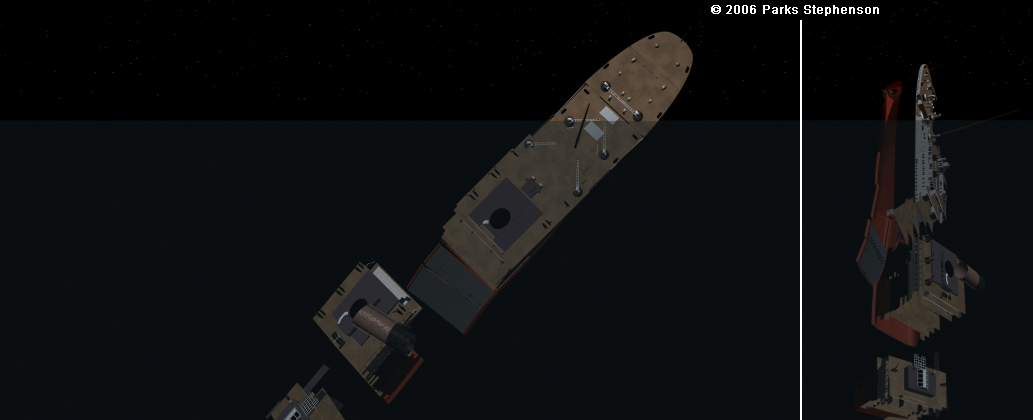
|
We can see from this image that the stern would only look as if it was upright when viewed from forward or behind (with respect to the original orientation of the ship). What about those witnesses to starboard, or looking at it from the right rear of left rear? They said it went upright. To them, it would have looked like the ship was on her side. Not one person said this. Also, Joughin's testimony of walking along the starboard hull is given weighty prominence here. But it ignores the two other people on the poop deck who never described such a huge list to port. Of course, their testimony is not as "sexy." It seems ludicrous to suggest that neither Dillon nor Prentice would forget to mention such a drastic list but this is what Parks suggests on the Titanic Historical Society Facebook page: "Not mentioning something does not necessarily mean that something didn't happen." With that in mind, one is obviously free to pick and choose the evidence that suits your theory. |
From the above accounts, some tentative conclusions can be drawn:
The first funnel
The Titanic undeniably had a huge list to port at the time of boat D being lowered and yet some ten minutes later, the first funnel fell to starboard. Why? Gravity decrees that the funnel should have fallen to port. This is not an easy question to answer. That the funnel fell to starboard is not in any doubt; Lightoller described it as doing so and Gracie, who was on the starboard side, was told that his head appeared above the water just after the funnel collapsed. This means that his impression that the ship was gone when he came to the surface was mistaken but he seems very clear on this point in his book: "When my head at last rose above the water ... [I looked] about me, [and] I could see no Titanic in sight. She was entirely disappeared beneath the calm surface of the ocean and without a sign of any wave. That the sea had swallowed her up ... was indicated by the slight sound of a gulp behind me as the water closed over her...when I came up there was no ship in sight." - but, to be blunt, he was more keen on saving his life that taking in the horrific vista on the surface. One may also wonder how long one can hold one's breath underwater, and whether his diabetic condition may have constrained his lung's ability to hold air whilst submerged. This points to an extremely rapid foundering of the Titanic.
An answer might be found in the account of Jack Thayer, jr.; just before he left the ship, he says that the ship straightened up on an even keel (note that, in 1940, Thayer said "It must now have been about 1:25 A.M. The ship was way down by the head with water entirely covering her bow. She gradually came out of her list to port, and if anything, had a slight list to starboard.") This contemporarily recorded "righting" phenomena might have been temporary as his companion Milton Long slid down the side of the hull. How could a ship with a list to port suddenly "straighten up" again? Remember that the Titanic herself was very unstable at this time. Edward Wilding, the Naval Architect for Harland and Wolff calculated how far the ship's list would improve based on the movement of people as they traversed a distance. But it seems likely that he did not include how "tender", or precarious the ship was at that point; after all, a large portion was under water. He may have underestimated the change in list as people moved from one side of the ship to the other. And we know that people were encouraged to move from port to starboard at this time; Gracie heard an order (just before "D" was launched), and both Hemming and Victor Sunderland also mentioned it too (albeit Sunderland seems to have got port and starboard confused). Lightoller also references an order but his recollections vary widely (between early on in the sinking and late on). And moments before the boat deck was awash, Gracie describes a mass of humanity surging up from below. From his vantage point, it would have been impossible for him to determine if anyone did indeed come up from below decks. More than likely, he was describing people rushing to the starboard side from behind the gymnasium or through the boat deck lobby of the Grand Staircase. Taken together, we have possibly a few hundred people (at least) moving from one side of the ship to the other. This could, this author posits, be responsible for the ship for the ship's list shifting from port to "even keel" or possibly to starboard. Certainly, not long before this, the ship still had a demonstrable list to port; those struggling with boat "A" report having to push it uphill, and Algernon Barkworth in the Hull "Daily Mail" of May 18th, 1912 said that when he jumped from the top deck, the distance to the water was about 30 feet, and that "the vessel had such a huge list that I thought she was going to turn turtle." He also notes that, "When I left the vessel there was no panic. Everybody seemed to be calmly waiting their end." This puts his observations well before the scrum observed by Gracie etc. (or perhaps too far aft to see the crowd) However, it is difficult to say for sure. Barkworth is clear that he didn't jump, but dropped into the water. If he didn't jump he would have contacted the hull of the ship if there was a list to port. Maybe the list was too small to be noticed at this point, and had dimished, like Thayer claimed?
There is some possible further evidence of the list vanishing. Gracie asked Lightoller about the fact that Edith Evans was not saved and whether a list might have hindered her escape, and this is what was said: "I have further questioned him as to whether there was an interval [ie gap] between the ship's rail and the lifeboat he was loading, but he says, "No," for until the very last boat he stood, as has already been described, with one foot planted on the ship's gunwale and the other in the lifeboat. I had thought that the list of the ship might have caused too much of an interval for him to have done this." Gracie is correct on this point, as boat 10 a little time before had a gap of at least several feet and it is implausible, if somewhat comic, to think of the 2nd officer with his legs stretched apart to that degree. As Bill Wormstedt says on his website, "Lightoller claimed that there was not a significant list at #4, but the fact that he had tied #4 to the coaling wire for stability earlier in the night meant that any list that developed as this boat was loading would not have been as apparent as it may have been at other boats." It should be pointed out that Lightoller's comments about the list and when he first noticed changed between the US and British Inquiries. But even if Lightoller's comments to Gracie are correct, then there was no, or little list at boat D some 15 minutes later. Does this indicate that during this time, the list had vanished, as noticed by and repeatedly commented upon by Thayer? As usual, when one searches for contrary evidence, one finds it. Hugh Woolner leapt into boat "D" from A deck. Normally, on an even keel, the boat would be practically flush against the hull, but he reports seeing the boat 9 feet out from the side of the ship. But, when he is asked whether anyone tried to leave the boat after he got in, he commented, "No. By that time we were bumping against the side of the ship." It is difficult to know what to make of all this, especially when one bears in mind that not so long before, boat C was launched and it rubbed along the ship's hull on its short journey down to the water's edge.
So, how can we reconcile these conflicting observations? One answer may be to consider that in the time between the boat being loaded and being lowered, the situation on the ship may have changed enormously. One cannot seriously believe Lightoller's leg span to about 9 feet (!) - assuming that he was telling the truth. Other areas of his testimony do leave lingering hints of doubt, and with good reason due to the various versions he told.
Further evidence possibly comes from steward Edward Brown who was asked about the efforts to launch boat "A"; he talked of the effort to push the boat to the davits, but when they got halfway there, the Titanic "then ... got" a list to port. A strange thing to say if the list was there all along?
Hugh Woolner gave an interview to the Omaha Daily Bee" of May 16th, 1912. After the scrum at boat "C" (where he says, probably inaccurately, that there was a step of four to five feet, forcing women and children to be lifted across), he noted: "...we turned about and went below to deck A. When I walked into those rooms [sic] with their glass portholes closed tight and saw the lights begin to turn red and glimmer, it gave me a sort of uncanny feeling. Then the ship began rocking a little bit and we could feel it list and move, We hurried out to the promenade. There was no one about." [my emphasis]
Regardless of this, could this suggested oscillation as recounted by Thayer and superifically by others, between the various stages of list have put tension on the 1st funnel's guy wires? Did it induce a "kick" that resulted in the funnel falling? And did it influence the side the side the funnel fell to?
A more obvious question, though is :why did the funnel collapse? Edward Wilding gave him impression at the London inquiry, where he said, "The funnels are carried from the casings in the way of the comparatively light upper decks - that is, the boat deck and a deck. When these decks became submerged and the water got inside the house, the water would rise outside much faster than inside, and the excessive pressure on the comparatively light casings which are not made to take a pressure of that kind would cause the casing to collapse; would take the seating from under the funnel and bring the funnel down."
But today, his explanation has been relegated to oblivion following Lightoller's assertion in his 1930s autobiography, "The terrific strain of bringing the after end of that huge hull clear out of the water, caused the expansion joint abaft No. 1 funnel to open up. (These expansion joints were found necessary in big ships to allow the ship to "work" in a seaway.) The fact that the two wire stays to this funnel, on the after part led over and abaft the expansion joint, threw on them an extraordinary strain, eventually carrying away the port wire guy, to be followed almost immediately by the starboard one. Instantly the port one parted, the funnel started to fall, but the fact that the starboard one held a moment or two longer, gave this huge structure a pull over to that side of the ship, causing it to fall, with its scores of tons, right amongst the struggling mass of humanity already in the water. It struck the water between the Engleheart and the ship, actually missing me by inches."
Let us look at Lightoller's claims. He testified in America that he could not see anyone on the decks when he was "in the water", so obviously his vision was limited. Secondly, the expansion joint was 2 inches across and covered with an 8 inch grooved brass plate, and it highly unlikely that Lightoller could see this tiny feature from tens of feet away. Thirdly, the lighting was highly reduced at the end (the lamps were described as glowing red) and this would not have helped visibility. Finally, when Gracie started aft after seeing the water strike the bridge, the forward funnel had not yet fallen. Within a very few seconds of this, the water had reached him and the cascading wave enabled him to reach the roof of the officer's quarters. As he later describes, he was less than 12 feet aft of the expansion joint. It seems patently clear that the expansion joint was probably under water when Gracie was picked up by the wave and reached the roof - and if the timing is right, the forward funnel had not yet fallen. So, Lightoller's description of the expansion joint opening is just speculation. And it has been accepted as fact.
The second funnel
Much has been written and spoken of the 1st funnel and its collapse, and also of Patrick Dillon who saw the 4th funnel cant aftwards towards the poop deck, but little has been written about concerning the 2nd funnel. There are a few account above of the 2nd funnel falling, but one not mentioned above is by Richard Norris Williams, whose account appeared in the May 11th 1997 edition of "Main Line Life": "The ship seemed to give a slight lurch; I turned towards the bow. I saw nothing but water with just a mast sticking out of it. I don’t remember the shock of the cold water, I only remember thinking “suction” and my efforts to swim in the direction of the starboard rail to get away from the ship...Before I had swam more than ten feet I felt the deck come up under me and I found we were high and dry. My father was not more than 12 or 15 feet from me...He started towards me just as I saw one of the four great funnels come crashing down on top of him." He doesn't mention the funnel in his interview with Walter Lord, partially repeated above. It should be pointed out that there are doubts about Williams's story. As George Behe says, "[he] never mentioned a falling funnel in any of his 1912 accounts. Instead, he merely said that he lost track of his father when the foredeck began to submerge. A close reading of Williams' modern-day account of the falling funnel reveals a number of serious contradictions that make me doubt its authenticity and wonder if he might have merely assumed that his father was killed by the falling funnel."
Lightoller says that, a little while before the forward funnel fell, the bridge and crow's nest were on the waterline, and from this, we can deduce the likely situation at this point:

Note from Norris's story that the wave that coursed along the boat deck washed him high and dry. From Lightoller, the blowers at the base of the 1st funnel were underwater, and shortly afterwards the stack fell near him after he managed to extricate himself from the gratings. The only place that would be "high and dry" would be well aft, somewhere near the 2nd funnel. It is difficult to envisage the 1st funnel falling so far aft that it could have reached the area of funnel 2. If one draws a circle with its centre at the rear base of the 1st funnel and its radius equal to its height, the funnel would still fall short of the 2nd funnel's area.
Thayer offers much more in the way of evidence for the fall of the 2nd funnel. He even says that it fell near him, on the starboard side of the ship. He even talks about the drop to the water being about 10 yards when he and his companion jumped from the doomed ship, "about abreast of the second funnel." It is unlikely that he was confused about the identification of the funnels; he even writes about water washing around the base of the first funnel, so he was about to differentiate between them. It may be prudent to mention that Thayer's opinion had changed over the years. I am grateful to Ioannis Georgiou for providing me with a copy of Thayer's account that appeared in "The New York World" newspaper on April 21st, 1912, in which Thayer is reported as saying that, after he had jumped, "I was clear of the ship, went down, and as I came up, I was pushed away from the ship by some force. I came up facing the ship, and one of the funnels seemed to be lifted off and fell towards me about fifteen yards away, with a mass of sparks and steam coming out of it. I saw the ship in a sort of red glare, and it seemed to me that she broken in two just in front of the third funnel [NB: which is exactly where the Titanic did split]." After being sucked down, Thayer came up to the surface again and found refuge on boat "B": "The stern then seemed to rise in the air and stopped at about an angle of 60 degrees. It seemed to hold there for a time and then with a hissing sound it shot right down out of sight with people jumping from the stern. The stern either pivoted around towards our boat, or we were sucked towards it, and as we only had one oar we could not keep away."
This is so very close to the account that appeared in print in "The Sinking of the Titanic and Great Sea Disasters" by Logan Marshall, that the newspaper account must have been the basis for the book. The only inclusion in Marshall's book is that, before jumping, Thayer stated that "about this time she straightened up on an even keel and started to go down fairly fast at an angle of about 30 degrees," and then stood by the rail about even with the second funnel.
It is tempting to speculate that Collins, and Gracie, who were nearby and were also sucked down like Thayer, has also been caught in the suction of the funnel falling. But why did Thayer not mention the falling funnel to the father of his shipboard companion? The answer may be one of tact. I suspect that Thayer did not want to give Judge Long the impression that his son was squashed to pulp in the last few minutes.
But why did no-one see the 1st and 2nd funnel falling (apart from Emily Ryerson in boat 4 and Sidney Daniels, on top of "B") The answer is uncertain but it may have to do with the timing. Lightoller was unsure of seeing the 2nd funnel when he was standing on boat B. He says it may have been immersed. Perhaps the reason is that the two forward funnels fell so close to one another in time that those washed off boat B by the wave generated by funnel one were more concerned with their own struggle for survival rather than making note of the tragic scene before them.
Are there any forensic clues from the wreck that describe the collapse of funnel 2? If there are, not much data has been alluded to. Roy Mengot writes "A large shard of funnel skin lies over the [Gymnasium] roof just below the number [on his plan]." A red herring is included in the 1991 IMAX expedition companion book, "Titanic In A New Light". A photograph is caption saying that it shows the collapsed boat deck on the port side, and its curvature indicates that it might have been hit by the 2nd funnel. Sadly, the photo is miscaptioned, as the photo actually shows the collapsed forward bridge bulwark on the starboard side which now sags not too far above deck A below. Parks Stephenson conjectures that the 2nd funnel fell to port in his wreck observation essay.
The Puzzle of Boat B
Overturned boat B was swept off the boat deck on the port side of the Titanic, but ended up as a refuge to people on the starboard side. With two exceptions, every individual on baots A and B were initially on the starboard side: Olaus Abelseth on the starboard side, ended up on boat A; George Rheims was on the starboard side near gymnasium, and he found himself on boat A after he swam back to where the ship had gone down; Rhoda Abbott had previously been awaiting departure near boat C and got on boat A; August Weikman was on starboard side (boat A), as was Richard Norris (boat A) and Eugene Daly (boat A). Jack Thayer was on the starboard side and ended up on boat B, as did Archibald Gracie and John Collins.
The only exceptions to this are Harold Bride, who swam from the port side of the Titanic, and then back again, finding boat B. The other one is Victor Sunderland and his story is interesting. In "The Cleveland Plain Dealer", on Friday, April 26, 1912 he said; "A lifeboat, bottomside up and evidently one of those which had overturned under its load, floated up to the rail and we grabbed for it. We climbed upon it and it drifted over the submerged part of the Titanic. We passed under the forward funnel and just as we were clear it fell. At that minute the Titanic broke in two just aft of amidships and the stern stood straight in the air." "'Make for the stern. It looks like she will float,' Lightoller shouted, but just as he spoke the stern plunged down."
The mention of "the rail" is interesting. The solid bulwark, sometimes called a rail, at the portside bridge wing was now underwater. The other solid rail, running amidships, was too far aft for the boat to reach it. The rail is probably the barrier between the 1st class promenade and the officer's promenade on the boat deck, and just mere feet from where the boat had been tipped to the deck.
Lightoller's statement about "making for the stern" does not tie in with his statements that the ship would sink. If he had not seen the ship split apart, then why implore others to "make for it"? If it was still attached to the rest of the Titanic, then it would only provide a temporary refuge before it went down. But Sunderland's account does not mesh with Lightoller's heroic brush with death. Sunderland recalls simply that Lightoller jumped over the port side, and was not, therefore on the roof as he claimed. Who was right? Was someone mistaken or telling lies?
The most interesting part of the account is the boat drifting over the submerged part of the Titanic, and that it passed "under" the forward funnel. It must have taken some very little time to do this, as Lightoller did not see the boat when he was swimming in the water, and then dragged against the flow into the vents in front of the funnel. This presupposes that he was underwater for a short amount of time and therefore missed the boat drifting by.
How did the boat end up on the starboard side? Was it caught up in the suction that had threatened to take Lightoller down? Unlikely, as many were thrust into the water when the bridge lunged down and none, as far as I can gather, reported any suction at that location. Lightoller reported that he was swimming for the starboard side of the Titanic when he was sucked against the vent. If he was hoping to swim for higher ground, then he may have swum very close to the vents just aft of the bridge. We do not know for sure.
A possible explanation is that the lifeboats, A and B, remained more or less in situ, but it was the Titanic that moved relative to them, as follows:

There are some objections to this. Quartermaster Rowe reported that the mystery light he was watching was 1/2 point on the port bow when he first saw it, and 2 points when he left the bridge (approximately 2am). The Titanic was therefore twisting to starboard, not to port at this time? A possible clue might be found in the writings of Thayer on April 23rd, 1912 to Judge Long, father of his companion, Milton Long. Thayer wrote that sometime between the departure of boat C, and him leaping from the ship, the "Titanic", which had a list of at least 10 degrees, "straightened up on an even keel." Yet, a very short time later, Long was reported to have slid down the side of the ship. How could he do this unless there was a list to port? The Titanic, if these two facts are accurate, must have become very unstable, perhaps leading to the twist to port?
Another conflict is the direction of the Titanic's bow on the sea-bed. It now faces approximately NNE. If the ship did twist to port, it would have pointed in a north-westerly direction. An obvious discrepancy. The "Discovery Channel" did tests on a model of the Titanic's bow in a watertank in the 1990s and determined that the ship's bow did not deviate from its heading on the surface. There are problems, though, one of which is the model was not tested with any port or starboard list. Without further testing it is impossible to say for sure if this would affect the trajectory of the bow on the way to the bottom.
Titanic researcher Sam Halpern is sceptical though; "With the bow submerged and still connected, there is no way that that could happen. However, with a list to port being carried, the bow plunging forward and downward might have produced a twist to port in the process especially is the break started on the starboard side. It does not seem so much as the boat moving over the submerged bow but the bow twisting somewhat underneath as it was breaking off from the stern. "
The final plunge
A number of survivors on boats A and B reported that the stern of the Titanic cork-screwed to port before it went under. There are also indirect suggestions that this happened too: Lightoller reported thinking that he saw the propellors, and Wennestrom wrote that he saw someone lowering themselves on the log-line next to the rudder. How could he have seen this if he now wasn't near the stern? (Cynics might argue that it was so dark, how could he see anything anyway?)
It is surprising that boats A and B, which started near the front of the boat deck could have wound up so far aft. Even the wash generated by the falling funnel(s) can't account for this. Thayer and others provide the answer: in addition to the Titanic plunging down, it was also plunging forward. The result of this was the huge wave that surged along the deck enveloping those rushing aft. When Thayer clambered on top of boat B, he was somewhere in the vicinity of the 2nd funnel. Gracie and Collins were also in the area of the 2nd funnel when they were sucked down. They wound up on boat B too. Another mechanism may have played a part for these boats drifting aft too: Frank Prentice once noted that debris from the ship had drifted to the stern; and Ricks, had injured himself by falling onto this floating flotsam.
Whether the "stern twist" is connected to the theory proposed above (that the Titanic herself twisted around in the water) is unknown. It is tempting to speculate that the bow, perhaps connected for a while by the double bottom, yanked on the detached stern, pulling it round. But by this time, the bow would surely have had so little buoyancy, it would not have lingered on the surface.
The stern "twist" (for want of a better moniker) would have a significant impact on the lifeboat occupant's view points. Boats that were once broadside (5 and 7) would now get more of a stern view of the ship, hiding the area of the break. This would explain why only one of the people from whom I have accounts (Olliver) mentioned that the Titanic had broken apart, and even then his language was cautious ("in my idea") perhaps indicating that he had deduced the splitting rather than seeing it. This tends to let Pitman "off the hook" in his non-break-up testimony; his rejection of the observation that the stern came back level with the sea, only to rise again can be attributed to the angle from which he saw the Titanic, plus the intense darkness.
Boat 4, which Lamp Trimmer Sam Hemming had seen on the port quarter, would now get a better broadside view of the Titanic. It would be interesting to find other accounts of boats that had seen the Titanic stem on (boats 8 and C, and perhaps boat 6) to see if they later on reported seeing things that previously had been invisible to them - such as port holes which could only be seen from the side, not the front.
"The Big Splash"
James Cameron's 1997 movie depicts the broken-off stern crashing down to the surface of the sea, generating a huge splash. None of the witnesses described here mentions seeing it, hearing it, or being soaked by it. Although the reasoning behind Cameron's imagery is logical, it simply did not happen. So, what happened? A massive structure, let loose and falling unhindered, can't simply fall back into the sea so gently that it passes without any mention of the noise etc. it would undoubtedly cause. That is, unless something happened to hinder its free-fall back to the sea. I believe that a restraining force, perhaps some last vestage of the shell plating or internal decks, remained intact long enough to prevent the stern falling back unhindered; then, after a while, the tolerance would be exceeded and these restraining structures would part.
The Rise of the Boatdeck
I am grateful to researchers George Behe and Tad Fitch for pointing one long overlooked aspect of the sinking, namely that before the big surge occurred that rushed along the boat deck, enveloping those people unfortunate enough to be in its path, the forward boat deck actually rose. I can offer no explanation for this. George Behe told me, "Whereas you suggest that Richard Williams was washed far aft by the wave that swept the Titanic's foredeck, I think the evidence shows pretty conclusively that the foredeck did indeed rise slightly after it first began to submerge and that the "big wave" came afterwards. Eugene Daly and William Mellors both described this same "rising" of the foredeck and made it clear that they were both still located beside the unlaunched collapsibles when this "rising" took place. I can't quite explain the reason for this rising, but I'm 99% certain that it happened just as these three men described and that Williams wasn't washed back to the position of the second funnel as you suggest."
Tad Fitch agrees; "I agree with George regarding Richard N. Williams, in as much as that his accounts seem to match up with the forward area of the Boat Deck, and not the second funnel. Williams mentions the Boat Deck plunging then rising again slightly. Eugene Daly mentions this in his account transcribed by Dr. Blackmarr on the Carpathia, and William Mellors also mentions it, and all three were near the Bridge/Collapsible A at the time."
While this is undoubtedly correct, we should also recall that in his unpublished memoirs, Williams said that when he jumped he was 2 1/2 or 3 decks above the water, which points to a location further aft, rather than close to the bridge.
Another one who observed this phenomena is Cecil Fitzpatrick (Western Daily Mercury, April 29th, 1912) who told of the ship "righting herself" ten seconds after the wave started rushing aft. And Algernon Barkworth related to the Evening Banner of 26th April 1912 "When the ship gave the first dip we all went aft."
It is interesting to speculate whether the boat deck rose, or the ship listed heavily to port, raising the starboard side out of the water?
There is one other interesting phenomena associated with the last few minutes of the boat deck. William Mellors wrote in a letter that a tremble seemed to run through the ship when she gave the first signs of going under. The next thing he heard were loud reports inside (the explosions as heard by everyone?) and there seemed to be "mountains of water" rushing through the doors. Mellors, however, clung on, experienced the deck rise and then was blown away from the ship by an explosion. Washington Dodge gave a speech about his experiences and mentioned that, in conversation to him, a survivor still on the ship related how explosions were heard, and the following the last, an "immense volume of water rushed upward within the vessel, above the level of the ocean, bursting the windows and doors outward." Was this un-named survivor Mellors?
How Long Did The Lights Remain on?
The majority of witnesses said that the lights went out before the ship sank, and some put the moment they extinguished simultaneously with her disintegration. How then, do we reconcile the statements of the few people who were sure that the lights remained on until the ship was going under? It is pure common sense to conclude that when the ship broke up, the electrical supply was disrupted; and this was a little while before she foundered. Some researchers have tried to crowbar this inconvenient "lights on until the end" data into a timeline, but this author's tactic is easier: the few who said the lights were on till the last were mistaken. After all, considering the minority as authoritative voices convinced many that the ship had sink intact for 73 years. The majority should also take precedent over the few who gave rogue accounts.
The huge list to port at the end
Focussing on the testimony of Joughin, quite a few of the simulations produced in the anniversary year showed the ship developing a huge list to port at the very end which threw people into a heap in the well deck. I am highly sceptical of this as it ignores Joughin's earlier comments that he jumped into the sea before the end; however, it is more dramatic and spectacular than the accounts of Dillon and Prentice, who were on the poop and described no such motion of the ship. In this case 2/3rds of the people who were there make no mention of the huge list to port which puts them in a majority. I do not include Robert Daniel in this discussion as there is still great controversy about his escape, even though Dillon and steward Walter Stamford "Richard" Halford (New York Call of April 20, 1912) place him on the poop at the end; to be fair, another account by Halford, in the New York Tribune of April 20th, says that he was in boat 5, which he said was a mile away. Therefore, he would not have been able to see anyone on the poop.
The observations of those in the lifeboats don't support the port list; it is simply not good enough to say that it was dark and they couldn't see. Indeed, many accounts are sufficiently detailed and none mention the list. It is also not good enough to say that perspective played a role; you would only see the Titanic go vertical if you were bow or stern on, which means boats 1 (perhaps), "C", 6 and 8. And yet many others from a whole variety of positions and angles saw the ship plunge vertically.
Let us return to Joughin and assess just how credible he was. In addition to the huge list to port, he also says that the ship went under fully lit which is incorrect. He also says that the only water he saw inside the ship was near his cabin, and yet he made his way up aloft at the end via the crew's staircase on the working alleyway - the alleyway that much have had an incredible amount of water coursing along it. He also says that the first boat on the aft port boat deck was No.10; which we know is wrong as it was actually the last. And then there is his incredible claim that he was partially submerged in ice cold water for hours after the ship sank; it is widely recognised that to even stand a decent chance of survival, one simply must get out of the water, as the heat depriving ability of freezing water is many times that of simply being exposed to cold air.
Then we must take into account his claim that his staff - 13 bakers - ferried provisions of bread to the lifeboats. But Charles Burgess, the extra 3rd baker, told his story to the Daily Banner for its May 16th edition, and he said, "I then went to the boat deck at my station, which was No. 13 boat on the starboard side. As we stood there awaiting orders someone told me to go and call the other bakers who were off duty and had turned in. I went down to our quarters and told them to get up and come up with lifebelts. They simply rediculed [sic] me and told me when the ship was sinking to give them another call. I went down again later, but they took no notice and only abused me for disturbing their sleep. I never saw them again." This clearly contradicts Joughin who not only said that he mustered his off staff "of his own accord" but also that he then claimed that all his men took the loaves up some little time before 12.30am. This is precisely when Burgess would have stood by his boat after the decision was made to abandon ship by Captain Smith. And he said that his colleagues were still in bed.
As controversial as it may be, I would propose that a great bulk of Joughin's story is fiction and despite how cinematically impressive it may seem, and how it may provide great visuals for Titanic documentaries and movies, it has no part in the Titanic story. I feel that he exagerrated portions of his tale for self-aggrandizement.
The Descent
For all the calamity of confusion while the Titanic was on the surface, what happened when the ship left slipped below the water? This is another instance where nearly all depictions of the sinking "got it wrong", for they show the bow section attaining a vertical orientation on its way to the ocean floor. For instance, see the screengrab from James Cameron's "Final Word":
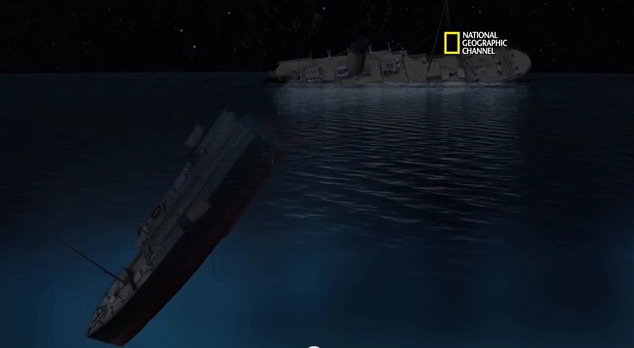
Of course, we can't say for certain that this didn't happen, but there are sufficient clues to doubt this interpretation. At the British Inquiry, Harland and Wolff marine architect was asked about the boilers becoming unseated, and he thought this would have happened if the angle was only about 35 degrees. The only boilers in situ in the wreck that can be easily examined are in boiler room 2, and they seem to be in exactly the same position that they were in in 1912.
And there is more evidence that a vertical posture was not attained, and it comes from a James Cameron production - "Ghosts of the Abyss" in 2001. While exploring cabin D-31, the dive team captured a surprising sight through the eye of their ROV. The wall to cabin D-27 had been eroded, and they could see the back of a wash stand. The most salient point about this is that on one of the shelves was a carafe and glass still in place. If the ship did plummet forward at a precipitous angle, why did these items not tumble from the shelf? The wooden "guard rail" was of insufficient height to hold them in place.
A schematic of cabin D-27 where the glass and carafe were seen; the bow is to the right of the picture. The blue rectangle indicates the location of the wash stand.
The State of the sea
I am grateful to George Behe for providing references to another overlooked state during the sinking: the "phosphorescence" of the sea. He notes that Edward Dorking wrote, "I had never seen phosphorus in the ocean until the night of the disaster, and I remember seeing the balls of fire all about me, coming up to the surface and apparently bursting into a blaze of yellow light. I did not know what they were, and imagined then that I was dying."
Lawrence Beesley wrote, "The sailor’s remark – 'It seemed like a bloomin' picnic' summed up the situation very well. The dead calm, the boat at rest on the quiet, phosphorescent sea, the brilliance of the stars all combined to create a peaceful atmosphere far removed from the imminent tragedy awaiting its culmination a few hundred yards away."
Alfred Shiers said, "I saw the phosphorous that was coming up in the water."
Richard Williams wrote: "The water was full of phosphorous sparkling like the reflection of a strong light through a prism; the little waves lapping the sides of the boat seemed to turn it momentarily into polished silver."
The "Towers"
Exploration of the wreck site has revealed the existence of two "towers", some distance from the main body of the wreck and which comprises the bulk of the area between funnels 3 and 4 which had previously been thought to have been shredded and lay in unrecognisable fragments on the sea-bed. These towers are described in the late Roy Mengot's essay.
Some of those in boat 4 describe what could be tower wreckage falling away. This needs more research as not everyone describes seeing anything untoward. I am not aware of anyone in a starboard boat seeing something similar (however, the aft tower would not, it seems, be visible from that side of the ship as it only extends to the deckhouses). Carrie Chaffee said (Evening Tribune, April 23rd), "it [The Titanic] seemed to writhe, breaking into the three parts in which it was divided. First the middle seemed to go down, lifting bow and stern into the air. Then it twisted the other way, throwing the middle up. Finally the bow went under, and it plunged, stern last."

The Aurora Borealis
The night was spectacularly clear, but there is one other phenomena observed that night, scarecely remarked about in Titanic literature: The Northern Lights.
Steward Alfred Crawford was asked but admitted that he did not notice the lights, but seaman Edward Buley did (likening them to "a searchlight") as did 1st class passenger Arthur Peuchen and saloon steward James Johnson. Lawrence Beesley also mentioned them in his book: "I see now that we must have been pointing northwest, for we presently saw the Northern Lights on the starboard ... Towards 3 A.M. we saw a faint glow in the sky ahead on the starboard quarter, the first gleams, we thought, of the coming dawn. We were not certain of the time and were eager perhaps to accept too readily any relief from darkness—only too glad to be able to look each other in the face and see who were our companions in good fortune; to be free from the hazard of lying in a steamer's track, invisible in the darkness. But we were doomed to disappointment: the soft light increased for a time, and died away a little; glowed again, and then remained stationary for some minutes! "The Northern Lights"! It suddenly came to me, and so it was: presently the light arched fanwise across the northern sky, with faint streamers reaching towards the Pole-star. I had seen them of about the same intensity in England some years ago and knew them again." Again Beesley gets his terminology wrong (he writes that his lifeboat and the Titanic were pointing northwest but the starboard quarter is on the right rear, not front of the boat - a mistake also made by Gracie), this is a perfect description of the Northern Lights. It is surprising that more people did not comment upon the lights especially once the Titanic had gone and there were little sources of light to disrupt one's night vision.
To go up to my Titanic pages click here.
Click on the covers
 |  2nd Edition |
 |  |