| To find details about my new book on the Titanic crew's return to England and the tales they told about their experiences, please look here |
"When the legend becomes fact, print the legend".
- from "The Man Who Shot Liberty Valance" (1962)
Love it or loathe it, you can't ignore it. Until Avatar, James Cameron's 1997 flick "Titanic" was the highest grossing film ever. Like Steven Spielberg before him, Cameron's movies have become the blockbusters of the age, films that you just have to see.
But is the film a true depiction of reality? Long after the sentimental fawning over the film had thankfully faded, historians poured over the film, devouring any mistakes. They were not disappointed. For many, this author included, the biggest "mistake" was the decision to focus on fictional characters rather than any of the other 2200 people on board, many of whom had lives just as interesting as Jack'n'Rose. James Cameron assured us that, where a scene did not feature these two lovers, and just on the ship, the film was "accurate" but the London Evening Standard's review, written by (I recall) a relative of Thomas Andrews, tells us that there is a substantial error in just about every scene. Which is right? With the film re-released in 2012 in 3-D and then again in 2017, a re-assessment is prudent...
(NB: This page only covers errors pertaining to the real Titanic, and not to whether the steam engine seen by the Southampton dockside was accurate, or how Rose's finger nails seem to grow between scenes etc.)
Please note: I have been accused of being unduly "picky" and to this charge, I plead guilty. When I started off this compilation, it was a tiny list and addressed only the major goofs (the lack of bulkhead in the engine room, the supposed "officers suicide" and so on); but over time, it has evidently grown. Some of the criticisms are trivial, but in my attempt to compile a definitive list, it seemed only fair to mention all mistakes, both trivial and gross. Lest anyone think that I am being harsh to James Cameron, I have performed similar analyses of "A Night To Remember" and Julian Fellowes's version, which can be seen on this site. Now, I regard this page, and others like it, as a resource for interested readers, and not evidence of an obsessive witch-hunt by myself.
Bear in mind that all the facts in this article have been known since the film entered production, unless otherwise noted.
To obtain bigger versions of the screengrabs (often annotated), or to follow links, click on the images.
|
The ROV "Duncan" is deployed down the starboard side of the wreck, but ends up going into the open gangway door on D deck on the port side |
|
Mr.Bodine assures us that the watertight bulkheads only go up to E deck. While this is true for the compartments in the amidships (middle) of the ship, other bulkheads went higher. |
|
The set built was not built full size, which explains the curious layout of the A deck windows and why the B deck cut-away ends prematurely. The modelmakers (right) got it correct though.
There are other problems with the scene too.
 The 2nd class entrance (the red area in the top left photo) isn't high enough, and it doesn't go far enough back to reach the correct area of the movie set. And the 1st class entrance (top right photo) is too far forward. Which means that the bow of the Titanic is too far forward, which means that the view as scene from the pub window is wrong. More of the ship should be obscured. And because the set is reversed, the arrangement of fans and ventilators in front of the 1st funnel etc. are in the wrong position too. The dock buildings (sheds) are problematic too, as there are some discrepancies between reality and the movie - not the least is the fact that the words "White Star Line" don't appear in the 1912 photo.
|
|
"I don't see what all the fuss is about. She doesn't look any bigger than the Mauretania," says Rose. Cal tells her that the Titanic is over a hundred feet longer. Actually the Titanic was 92 feet longer than the Mauretania and 95 feet longer than her sister, the Lusitania. Maybe Cal was trying to boast about the new ship, but it wouldn't have taken much extra screen time for Cal to say "she's nearly a hundred feet longer..." I just get the feeling that no-one cared to check. There is some debate over the Carter's Renault, seen being loaded in this scene. While some say that it would have been in a disassembled state, many agree that it would have been crated. |
|
No technically a goof, but I had to comment on this. Passports weren't is use in 1912, and tickets were not transferrable. There is no way, therefore, for a person to verify his identity. However, Fabriozi's appearance would betray the fact that he wasn't American; and, in fact, this scene was trimmed, and the omitted section has 6th Officer Moody eyeing the two boys suspiciously when he finds out their names are Scandinavian (the Gundersen brothers). He should, or could have turned them away, like the Slade brothers (late arriving stokers) were about this time. In the dining saloon, Ismay is told by Jack that he won the tickets thanks to a lucky hand at poker. This should have caused Ismay's eyebrows to raise. Jack's admission that he was from third class would have sent him back to steerage post haste due to the strict quarantine and segregation laws in place on immigrant ships. |
|
The movie depicts the Titanic leaving Southampton in bright sunshine with scattered cloud cover. On the actual sailing day, the weather was overcast, as can be seen in actual photographs (right and below) of the ship leaving Southampton. While it is true that Arthur Peuchen told the US inquiry that it was "a fine day", Adolphe Saalfeld described the weather as "calm and fine, the sky overcast" in a letter to his wife written on April 10th. Albert Mallet wrote, "We are landing in Cherbourg at scheduled time, the sad and grey clouds we had this morning vanished at once." There is also something wrong with the number of people waving goodbye from the poop. As Thomas Andrews noted after the Olympic's Maiden Voyage: "When docking & undocking 3rd class passengers should not be allowed on the poop or forecastle decks, as in the event of a rope carrying away someone would be sure to be killed." 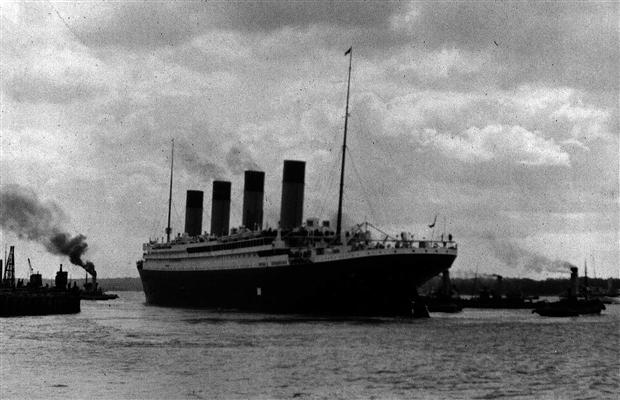 |
|
While the film correctly shows the propellors only starting up when the ship had been pulled away from the dock by a distance, the centre propellor would not have started up so soon. The turbine that powered it relied on exhaust steam from the reciprocating engines that powered the two outer screws, and there wasn't sufficient steam built up yet. |
|
On the way to the berths, Jack and Fabrizio pass a woman and her children. What were they doing there? Single men were stationed at the bow, women and families at the stern. We must presume that she was lost, despite the prominent signs and the assistance afforded by the stewards. As the Titanic goes through her death throes, the Irish lady takes her two children back to her cabin, where she relates the tale of Tir Na Nog. This cabin must have been in the stern, for the bow was completely underwater by this time. It doesn't matter. Jack and Fabrizio pass various signs, one of which directs passengers to "G deck" berths, rooms 40-58; our two heroes are looking for G-60. None of these cabins existed on the real Titanic. Incidentally, the actress playing the Irish woman is Jenette Goldstein, who played private Vasquez in another James Cameron film, "Aliens" and also John Connor's adopted mother in "Terminator 2" |
|
Cal's sitting room on the Titanic bears little relation to the one on the real Titanic and is certainly much larger. Incidentally, Cal's party occupies rooms B52-54-56, the ones occupied by J. Bruce Ismay in real life. Although the underwater interior shots of the wreck are (inaccurate) recreations, the firebox that is shown in the movie, with the white crab scuttling across it, is from the sitting room of B51, on the other side of the ship.
|
|
This is a beautiful picture, but it contains a few things that are inaccurate. Firstly, the Titanic arrived at Cherbourg at dusk; indeed a few pictures exist showing that the sky was still light; but then again, we do not know how long it took to transfer the passengers and mail to and from the ship. It may have been twilight. Secondly, only the ship's "anchor lights" would be lit, and certainly not the one on the foremast which can (just) be seen; thirdly, "Molly" Brown described the sea as being so choppy that it made most of the passengers to be ill. Fourthly, given that the Titanic was only 2/3rds occupied, would every single light be on in the ship?
Titanic researcher Art Braunschweiger says that a photograph shows that the first class passengers actually entered via the doors on E-door and not on D-deck. This is confirmed by Edith
Rosenbaum: "We drew alongside the "Titanic," the tender pounding against her sides with such violence that I thought
she would break in half. The gang-plank was held down by ten men on either side, as it jerked and swayed and pulled
in every direction. I was the last one to leave the tender...I then stood to one side and watched quantities of cooks and bakers carrying huge wooden boxes from the tender on to the "Titanic." I asked a steward what it all meant, and he said
that they were tinned vegetables of all sorts, and good things for our trip over and the return."
Some of my friends suspect that the Titanic is orientated wrongly with respect to Cherbourg harbour itself; the ship entered the harbour from the west, meaning that the town should be on the Titanic's starboard, not port side. A friend of mine, Joshua Noble, has remarked that, "The blueprints of the Nomadic indicate that the 2nd class passengers were kept in the aft area and the 1st class passengers were kept in the forward area. But the scene shows passengers going from the aft gangway doors of the 2nd class area into the D Deck doors into the 1st class area of the Titanic." |
|
"We all called her Molly." Except...no-one did. The nick-name "Molly" wasn't attached to Mrs.Brown until the stage play and film decades later, and was chosen because "Molly" sounded better than "Maggie" which would have been more accurate. "Molly" is shown to be hob-knobbing with quite a few of the more famous passengers. It is known that prior to the Titanic, she spent some time with the Astors and joined the ship with them. But she neglects these meetings with Andrews, Ismay, Captain Smith, the Countess of Rothes etc. in her lengthy newspaper account. Indeed, it even says that as her boat was lowered, she saw the Captain "(with whom I had crossed twice before - only three months previous, on the Olympic, our party sat at his table)." "Molly's" personality seems to be lifted straight from the 1958 "A Night to Remember" too. |
|
This was first noticed by Parker Chittenden on the "Titanic Inaccuracies" Facebook forum and I am grateful to him for allowing me to include it here. It shows another error that was missed by the experts who advised on the film. The elevator panel shows it going all the way up to boat deck. This is wrong, as the elevators only went as far as "A" deck; the elevator machinery was housed on the boat deck. I am advised that the set designers used the Olympic's plans, but if so, this raises another problem as the plans for that ship also showed the elevators only going to "A" deck too. No doubt the boat deck elevators also explains why we see people emerging on that deck when Jack meets Rose. The doors at the Grand Staircase lobby that the people come from would be the location where the elevators would stop if they went all the way to the top; as it is, the doors, on either side of the landing, only go into 1st class cabins aft of the officer's quarters - and only one was occupied as far as we know on the Titanic's first, and final voyage. |
|
This scene was supposed to be just a few hours after the photo was taken, and yet Murdoch's jacket show two stripes. Also, Murdoch's hours of duty were from 10am till 2pm. By the time the Titanic had left the coast of Ireland, he would have been off-duty, and probably asleep in his cabin, preparing for his evening watch at 10pm. |
|
In the first picture, a propeller shaft can be seen behind Engineer Bell. And then, a reverse shot shows the engines. Bell was therefore aft of the engines, and from a section of the ship's general arrangement plans, to be this far back from the engines, he would have to be in the next watertight compartment back. He wouldn't have seen a thing! By the way, contrary to what one ill-informed writer on imdb says, the "starting platform" containing the bridge order telegraphs and controls for the engines, was actually positioned at the bottom of the engine, between the legs of the cylinder housing susperstructure.

Plan of the engine room: the red rectangles indicate
Scott Andrews also assures that the Engineers would be dressed in dungarees and denim shirts, and not dress uniform as seen here. Steward Etches even remarked that Thomas Andrews wore "an ordinary blue suit" - an engineer's suit, the type worn by surveyors when he went below. |
|
I am grateful to Titanic authority Scott Andrews for this: "The upper door was a long counter-weighted "mail slot" through which the furnace was fired, and through which the fires were "worked" with slice bars, rakes and other implements; this slotted firing door was mounted on a larger vertically hinged swinging door which could be opened for thorough cleaning when the boiler was shut down. (The working of the fires was one of those things that Cameron did not portray correctly in his movie, as he showed the entire upper half of the furnace front opened for stoking; this was both dangerous due to possible "blow-back" of superheated combustion gas into the firing aisle, and was also wasteful of the heat being produced -- hence the small, quick-closing flaps.)" The scenes in the boiler rooms give the impression that they were lit by the furnaces; in actuality, they were illuminated by lightbulbs, which went out soon after the collision when the electricity supply faltered. Indeed, Fred Barrett went to collect some lanterns from the engine room but when he came back, the lighting had been restored. |
|
The real Titanic had two hawsers that attached to the fire mast abreast of the bell; when Jack and Fabriozi are on the bow we see that the film's set lacks these two wires. They are very hard to make out on the model "beauty pass" but they seem to be absent there, too. This is also clear when we see the close-ups of Fleet and Lee in the crow's nest before the collision. The weather in this scene is wrong too; April 11th was overcast with partly cloudy skies. The Titanic left Queenstown at 1.30pm, and would have arrived at the extreme south-west tip of Ireland some 3 hours later, if travelling at 20 knots. In the film, we can see the Titanic has left Ireland well behind, so the time is now some time after 5.00pm, or even later. Sunset was at 7.30pm, so the scene should have been set at dusk. Lawrence Beesley confirms this. And why wait till Ireland was cleared to build the ship up to full speed? |
|
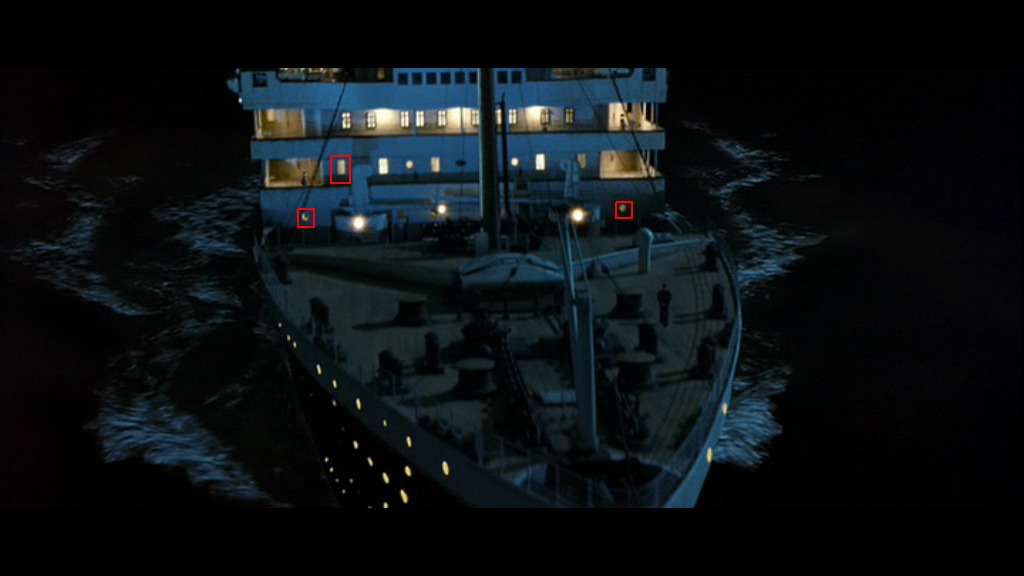
During the flyover scene, the ship has been flipped left-to-right. The crew's galley on the forecastle should be on the port side, and the gymnasium should be to starboard. The ship's logline should be seen trailing from the poop; a photograph exists taken at Queenstown showing the log device on the starboard side of the aft bridge. While the Titanic Modelling page says that the Blue Ensign was flown during daylight hours, and "Titanic: The Ship Magnificent: Vol 1" states that it is likely that this continued to be flown for the duration of the Atlantic crossing, an email correspondent says that, "as somewhat of a maritime buff, could I just point out, that traditionally a ship's Ensign is usually hoisted down when she is at sea and is only raised when she is near land or in port, therefore the lack of the Ensign in this section of the film would correlate with maritime practices. Indeed this can be observed in the attachment which I have sent with this email, which shows Titanic sailing from Queenstown without a Blue Ensign at her stern." Indeed, photos of the Titanic in Southampton and leaving dock show her with the ensign, as does at least one photograph of her at Cherbourg; similarly, she is garbed in her flag upon arriving and stopped at Queenstown - but not when she departs. |
|
Only one photograph of the Titanic's palm court exists, and is from the starboard side (the one in this scene is on the port side); however, we can say that (a) there were only square tables, not oval, circular or rectangular ones; (b) the tops of the tables were brown in colour; (c) the furniture was coloured white and (d) their should have been vines trailing up the trelliswork. Also, the palm court only served light refreshments and not main meals...but then how else could Jack get his first glimpse of Rose if Cal's party had taken their meal below decks? |
|
When Rose runs aft to attempt suicide, she is seen running on the 1st class promenade on A deck. Then, she is seen at the aft end of the second class promenade on B deck. There is no easy route between these two decks at this point. |
|
The extreme stern of the Titanic is far too flat. And the font used for her name is wrong, particularly the letter "C" as one can see from this picture of the tender used to service the Titanic, the Nomadic. |
|
Alerted by Rose's screams, the Quartermaster and comrades rush to the stern, where they see Jack and Rose and send for the Master-At-Arms...except that no QM would ever leave his post (the poop and aft bridge) for such a long period of time. To do so would be a serious dereliction of duty. Incidentally, scenes shot on the poop omit the log line, a device trailed out behind the ship which, when paid out, enables a determination of the distance traversed. |
|
|
|
Jack joins the wealthy in the 1st class dining saloon. Except that Ismay tended to sit at a small, nondescript table in an alcove on the port side of the restaurant. Also, the tables were not fitted with lamps. |
|
Leading Fireman Fred Barrett testified in London, that, on April 10th and 11th, 9 boilers were "out" (that is unlit, and unconnected to the propulsion system). On April 12th and 13th, 8 boilers were "out." This doesn't jibe with the "last four boilers" conversation in the movie. In the illustrated Titanic script book, Cameron was reported to have been "concerned" about showing events to which Rose could not have been a party. Its a shame that Cameron wasn't more concerned with getting the details of the scene correct. It seems to be "common knowledge" that Smith was going to retire after the Titanic's crossing. Actually, there is still some debate as to whether this is true or not. Incidentally, although Captain Smith's age on the crew register is 59, he was actually 62. The mandatory age of retirement in the White Star Line was 60. However, the retirement issue is not settled; a little while before the maiden voyage, Captain Smith visited the father of stewardess Sarah Stap, himself a master mariner and told him that this would be his last crossing, and he would be returning as a passenger. But was the "retirement" story known only to Smith and/or his employers? One other point: the backs, seats and side panels of the chairs were upholstered in green, not the patterned red panels we see here. |
|
That devious pesky Limey Lovejoy spies our hero and heroine in the 3rd class area on D deck, underneath the foreward well deck. Except that on the real Titanic, the stairs leading down from C deck were positioned the other way round; you would come down facing away from the room, and you'd have to turn around to see the room. The room also seems far too small as well. |
|
Captain Smith is shown leading the traditional sunday service in the 1st class dining room. The singing of the hymn "Eternal Father, Strong to Save" with the line "For Those in Peril on the Sea" was too good an opportunity to pass up. Except it didn't happen. One first class passenger, Martha Stephenson, bemoaned that it had been left out. It was sung in the 2nd class, as remembered by Lawrence Bessley and Edith Brown. Jack is seen strolling round the ship with ease. In truth, this would not have happened. There were very strict rules on segregation as this might prevent any communicable diseases from spreading. The concept of the whole film is a farce. A Titanic friend and researcher, Marcel Wolfgang, has emailed me to point out that the version of the hymn that is being sung is from 1940. |
|
Incidentally, the shadows in this scene are all wrong. They fall from starboard to port, but the Noordam's ice warning was received at 11.47am. With the sun to the south, the shadows should fall the other way. The whole film cannot seem to make up its mind where the sun is. The Titanic was heading mostly west or south-west, but many times the sun's position is wrong. This is because the large Titanic set was built facing north to allow the wind patterns to carry the false smoke from the funnels south. And Harold Bride, as seen in this scene, never delivered the Noordam's ice warning to the bridge; the only warning he personally encountered was the Californian's which came later on that Sunday. Phillips was probably on duty, by himself The morning of April 14th was described as rainy, and it is astonishing that none of the decks show any signs of dampness! |
|
Jack manages to get up to first class space by climbing up onto the aft end of A deck from 2nd class space on B deck (this is how Rose would have had to get down these decks before her failed suicide attempt). However, the main mast, as seen in this view, is missing the awning rafter, a horizontal beam of wood that connected the mast with A deck itself. When Jack scrambles up to A deck, he gets Tommy and Fabriozi to help him shin up, as we see in a deleted scene. However, there was a ladder only a few feet away that could have been used. One of the actors seen watching the boy spin his top in this scene is none other than researcher Don Lynch, a writer of Titanic books and a high ranking officer of the Titanic Historical Society, Inc.
The model of the Titanic, used in the flyover scene, does show the awning rafter. It also shows the forward facing bulkhead on the second class boat deck entrance (the upper red rectangle), which was missing from the full sized set (see later). |
|
The reasons for too few lifeboats are highly simplified. The Titanic obeyed the letter of the law for ships over 10,000 tons, which hadn't been updated in 18 years, even though ship sizes had increased drastically. The new davits could handle four sets of boats, nested inside one another and were fitted solely in case the regulations were ammended. An excellent discussion can be found in chapter 8 of Walter Lord's "The Night Lives On" entitled "I Was Very Soft The Day I Signed That." |
|
The temperature dropped drastically on April 14th, and many people noted that it was very icy. Jack and Rose's breath should be condensing in this scene. |
|
In their attempt to escape Spicer Lovejoy's pursuit, Jack'n'Rose find refuge in a small room that leads to the boiler rooms. However, such a room did not exist on the real Titanic. The escape ladders led directly up to the "Working Corridor" on the port side of the ship: these have been circled in red on the plan of E deck, to the right. |
|
An oft quoted goof, it is true that there was no way for crew to enter the forward cargo holds from the boiler rooms. However, an overlooked goof is that the deck where the car was stored (which would have been crated) was actually one deck above the tank top, where the exits from the boiler room were located! Also, just before Jack'n'Rose find the car, we can see a staircase in the distance. There were no stairs down to the cargo holds, only ladders. |
|
A fantastic shot, showing the ship ploughing through the flat calm waters. Except that the Titanic did not have a second mastlight, seen here on the main (aft) mast. |
|
In this shot, the Quartermaster at the helm is in the wheelhouse, directly behind the bridge. In reality, the shutters in front of the Quartermaster would be closed and the bridge would not be visible. This would be to prevent the lights in the wheel house from destroying the night vision of the Officers of the Watch. The next shot shows Captain Smith and 2nd Officer Lightoller discussing the weather. However, the end of the scene lacks Smith's parting instruction to his subordinate, that is, if the situation became doubtful he was to be called. |
|
The crow's nest is missing a weather cover at its rear (it was probably made of canvas and was removeable); one of the lookouts (George Hogg) who relived this pair made a mention of it as the American Senate Inquiry. Incidentally, neither of the lookouts nor Murdoch seem to be affected by what would be a biting wind chill! ...and.if Leslie Reade's interview with lookout Fred Fleet is any indication, Fleet implored his lookout, Reginald Lee, to desend from the nest after he had seen the berg, but Lee had clambered back in in time for the collision. The lookouts are in the wrong position, too. Fred Fleet, the man who warned the bridge, should be on the portside of the crows nest. And he should have a Liverpool accent. And it is Lee who testified in the UK that he could smell ice. |
|
There is still much debate to this day whether binoculars would have helped the lookouts to see the iceberg in time. In this scene, we are told that the binoculars intended for the ship's eyes in the crow's nest haven't been seen since Southampton. What we are not told is that the bridge officers had binoculars and they were seen using them. By none other than Fred Fleet, the man who saw the iceberg. We never see Murdoch or Lightoller carrying or using binoculars in the film. |
|
In the screengrabs, cabins that we know, or suspect to be occupied are highlighted in red. |
|
The fallacy of the ship's proximity to the berg is also compounded in the next screen grab. Murdoch orders hard-a-starboard and then orders the engines full astern. No more than a few seconds have passed, in which time the Titanic was travelling at 22.5 knots, or 38 feet per second. We are not sure how far the Titanic was from the iceberg when the latter was first seen, but estimates place it at about 1500 feet (The Titanic was 882.5 feet long). If James Cameron's version is to be believed, the berg was practically on top of the Ship of Dreams. The distances, and the speed involved would certainly hinder any attempt to turn and stop the ship. The ship looks like she would have collided head-on! |
|
The set for the wheelhouse is missing a door to the chart room. It should be located between where 6th Officer Moody enters the wheelhouse and the position of the crow's nest telephone. To the right of the telephone is the door through which Captain Smith enters the wheelhouse immediately after the collision. This actually the room where the pilot was based while on board. |
|
This indicator panel verifying that the watertight doors were closed, never existed on the real Titanic. Incidentally, the film depicts a comparatively large gap of time between the ship being given the order to manouever round the iceberg and the watertight doors being closed. In reality, the gap would have been just a few seconds. The exact location for the control for the watertight doors is not known, but it was known to be in the bridge, not the wheelhouse. Regarding the telephoned ice warning, there is no evidence of any significant gap between the phone being rung and then being picked up on the bridge. Certainly, 6th Officer Moody would not have nipped off to get a cup of tea. The control for the watertight doors had the following, ""In case of emergency, to close watertight doors on tank top, press bell; push for 10 seconds to give alarm; then move switch to 'on' position and keep it there. Note: Doors cannot, however, be operated mechanically whilst switch is on." In the movie, there is no discernible gap between Murdoch ringing the bell and operating the door control. Also: Murdoch is outside the bridge, on the starboard bridge when he yells "Hard a port." This is different from the story told by Quartermaster Alfred Olliver, who said that he entered the bridge and saw the officer (Murdoch) at the lever to close the doors, and then heard hard-a-port after he had got there. This is not where the film Murdoch is located. If you look in the background, you can see Moody in the doorway to the bridge. Obviously he would see the iceberg passing by! Yet 3rd Officer Pitman testified that Moody told him that he hadn't seen the iceberg, but did point the ice in the foreward well deck. |
|
Benjamin Guggenheim's mistress is Madame Aubart, not Aubert, as Rose tells Jack in the dining saloon. Also, according to steward Henry's Etches' account in The New York Times on 20th April, 1912, he went to Guggenheim's and his manservant's (Victor Giglio's) cabin and awakened them. This was probably about midnight. Furthermore, researcher Günter Bäbler informs us that Emma Sägesser, Aubart's maid, said that her employer was in bed reading when the collision occurred and a few minutes later, they went to Guggenheim's cabin, where he and his manservant were asleep. Also, Etches says that when he knocked on his door, Guggenheim "had apparently only gone to his room, for he answered the first knock" but then Etches says that he requested his charge to put some clothes on as he would be back in a few minutes. The lighting is completely wrong as well; lights on open decks and companionways would be extinguished by 11.00pm, and only red oil lamps hung in certain locations (e.g. the foot of stairways) to aid in navigation round the ship at night. These lamps would be lit until sunrise. |
|
Far more ice was deposited on the ship that is depicted in the film. Incidentally, one ill-informed writer at IMDB says that ice would not have been cast on to the real Titanic. Eyewitness testimony contradicts this. The remainder of the scene is bunkum too: in reality, the ship had almost stopped when the Captain rang the order for "Half Speed Ahead." He then goes to the 'corner of the bridge' with Murdoch and 4th Officer Boxhall. Boxhall, on his own volition, goes down below to assess the damage for himself. Quartermaster Olliver is told by the Captain to find the Carpenter and get him to take a draft of the ship. In Cameron's Version, the Captain orders "full stop" and another bridge officer goes off to the bridge to comply - presumably this is Moody. A second or two later, we hear the telegraphs ring. Smith and Murdoch go the bridge wing, and after seeing the ice in the well deck, Smith tells his first officer to find the Carpenter; Murdoch acknowledges this and walks off. (By the way, look at lifeboat No.1, swung out immediately behind Smith as he peers down the hull; it has a canvas cover on. The real lifeboats No.1 and 2, swung out at all times for emergency reasons (to rescue people who had fallen overboard) never had covers; obviously the would have to be deployed as fast as possible and removal of the covers would have hindered this.) Poor Joseph Boxhall! Left on the cutting room floor! In fact, according to the script book, there is no mention of Boxhall whatsoever. The only time I can ascertain when his character might have been given a line is "Bloody pull faster - and PULL!" as his lifeboat clears the stern of the ship, rising high in the air. And even this line doesn't appear in the script book!! And even this depiction of Boxhall and his boat isn't correct. When Boxhall implores his crew to row faster, the Titanic's stern is towering overhead. This is within minutes of her foundering. At the inquiries, two people estimated the distance to the Titanic, and the shortest one was approximately 1/2 mile. At this distance, the Titanic would be a tiny speck on the horizon. |
|
Although it is a standard part of the Titanic story that 3rd class passengers played soccer with the chunks of ice seen on deck, Dr. Washington Dodge reported this incident, and all he says is that the steerage were walking on the ice and kicking it about. Edith Russell wrote, "we noticed a number of stokers who were walking across the lower deck to go go down below - and we heard in walking there was a crunching sound - someone said, 'Why, they are walking on a ground of ice.'" |
|
Leading Fireman Fred Barrett testified at the inquiries that the water rushed into the stokehold about two feet above the floor plates. It is hard to determine where the water ingress is in James Cameron's version, but one source is above head height! Incidentally, if you look at the DVD and then freeze frame it at this point, you can see that the boiler room already has water in it! |
|
The film depicts Leading Fireman Barrett as helping others through the closing watertight door. But he testified that only he and an engineer by the name of Hesketh jumped through the door before it shut. The doors took 25-30 seconds to close, and then, in the last 18-24 inches, were allowed to drop by gravity, like a guillotine. Anyone clambering underneath would be likely to be injured! And, apart from water gushing through a hole in the coal bunker, boiler room 5, into which he entered, was dry. Looking at Cameron's film, it would have been drenched.
And to escape from boiler 6 to room 5 via the watertight door, you would
have to go down a small passage, flanked on either side by the coal bunkers. In the film,
the watertight door leads straight from one room to another!
|
|
A small point: the background of the small area containing the red and green sidelights should be the same colour as their respective lights (red for port, green for starboard). |
|
A steward asks the Countess of Rothes if she would like anything, as Thomas Andrews rushes by on the way to the bridge. He must have taken a peculiar detour. His cabin was on A deck, and to get to the bridge, he would not have had to pass any passenger cabins; passing through a corridor, and walking through the 1st class lounge, and traversing another corridor he would come out at the foyer of the the forward Grand Staircase which he would then ascend. The Countess's room was on B deck, so Andrews would have to descend one deck before resuming his mission to the bridge. Its believed that the sets were based on those for the Mauretania; as one can see from a real photograph from the Olympic's E deck, there were no carpets (just floor tiles), no grab rails and no light fixtures on the walls. |
|
If the recollections of stewards James Johnson and Annie Robinson are anything to go by, Captain Smith, Thomas Andrews and/or Purser McElroy used internal stairs (possibly the forward grand staircase) to view the affected area of the ship near the mail room. |
|
After surveying the damage, Thomas Andrews comes to the bridge and relays the shocking news to the bridge officers: the Titanic was going to sink. Except that it didn't happen. We don't know what transpired between Captain Smith, Andrews, Chief Officer Wilde, First Officer Murdoch or Sixth Officer Moody, as all were lost. Presumably the other officers in the background are engineers; also at the wheel is Hichens, who didn't report this meeting of Smith, Andrews, Ismay et al. at the inquiries. The room in which this meeting takes place is a peculiarity; it is obviously the "Navigating Room" to the starboard side of the bridge, but it should be more rectangular, and lacks a settee. There is also an extra door that goes into a room which did not exist in this location on the real ship; it was through this corridor that Smith entered the bridge after the collision. The door to the Captain's sitting room is also missing. Bear in mind that when Titanic was made, the plans for the Titanic were available for anyone to peruse. Why the bizarre layout is anyone's guess. Incidentally, for someone intimately acquainted with the ship, Thomas Andrews makes a very peculiar mistake: the iceberg had not ruptured five compartments, but six. Also, pre-disaster, Harland and Wolff had calculated that the Titanic could stay afloat with any three of her first four compartments breached, and this is what would have been known on April 14th, 1912. It wasn't until later when Edward Wilding, the marine architect for Harland and Wolff, and his team performed calculations which showed that the first four compartments could be flooded, and the ship wouldn't have sunk. Just a small point: when the aft boats were being prepared for lowering, Lawrence Beesley
noted, 'Just then an officer came along from the first-class deck and shouted above the noise
of escaping steam, "All women and children get down to deck below and all men stand back from the
boats." He had apparently been off duty when the ship struck, and was lightly dressed, with a
white muffler twisted hastily round his neck. '
|
|
Captain Smith then visits the wireless cabin and tells his operators to send out the call for assistance. He gives them the co-ordinates of the ship: 41o46'N, 50o14'W. Except that he didn't. When he visited the cabin, he actually gave out 41o44'N, 50o24'W; the famous (and incorrect) position was given to Marconi operators Phillips and Bride some minutes later by 4th Officer Boxhall. Incidentally, caveat lector: An IMDB correspondent insists that "CQD" was never sent out by the Titanic. It was. SOS was also used later on. |
|
The passengers have gone back inside, according to Chief Officer Wilde because "it is too damn cold and noisy for them." The funnels started discharging within a short space of time after the collision, and the film omits its version of when this happened. However, what is inaccurate is just how noisy the funnels were. Gracie, on C deck heard them, as did Martha Stone, Gladys Cherry and Mrs Hippach on B deck, and Mary Lines on D deck. And yet, inside the ship, we never hear a peep. (The noise also hindered Jack Phillips hearing transmissions from other vessels, and the Marconi office was directly below a funnel!). Beesley says that the noise of the steam was like twenty locomotives blowing off steam in a low key. All we hear is the harsh roar of steam in this movie. (To be fair, Mrs Warren says that she did not hear the "deafening roar of escaping steam, of which we had not been conscious while inside." She seems to be in a minority!) And did the passengers really go back inside because it was too cold? This was a theory that was bandied around in the mid-to-late 1990s and early part of the 21st century and while it is logical, read the accounts of the survivors themselves: they mostly all went on deck as soon as they had put on lifebelts. The cold, while intense, did not stop people going out on deck - and neither did the noise. Norman Chambers wrote, "We then ascended to the boat deck by the outside port companion and found no passengers on this side of the ship, although the crew were busy clearing away the forward group of lifeboats. At this time it was utterly impossible to hear any spoken word as the sound of exhausting steam which had appeared to us to be coming from the bow of the ship, was in reality from the forward exhaust pipe, and was well-nigh deafening. Thinking that perhaps the lifeboats would lower more easily from the starboard side, to which the ship was now listing more noticeably, we passed over the raised central deck and down on the starboard side. Here we found a number of passengers assembled and, joining them, stood and waited for orders." Constance Willard remarked, "When I reached the deck after the collision the crew were getting the boats ready to lower, and many of the women were running about looking for their husbands and children." Caroline Bonnell adds more to this; "When we got on [A] deck uncle and aunt both were there, and I went down to another part of the steamer and got my Aunt Elizabeth. When I got back crowds of people were standing about. No one seemed excited. Everyone was talking and it seemed the general idea that we would soon be ordered back to bed. Just then an officer came up to us and explained we should go up to the next deck, the boat deck. By that time nearly everyone was up ... There was no confusion here even yet, although we noticed that the boat was beginning to list toward the starboard...After we had been on the top deck for awhile, considerably more than an hour, the women were told to stand by in a group by themselves and to be ready to get into the lifeboats. The men drew back and the women stood at the railing." Mrs Helen Bishop also said, "...my husband and I went to the port side to see if there was anyone there. There were only two people, a young French bride and groom, on that side of the boat, and they followed us immediately to the starboard side ... About five minutes later the boats [ie No.7, the first at about 12.40am] were lowered, and we were pushed in. " From this, we can infer that only a few curious people were up when the order to uncover the boats was given. Crowds came out when they were told to put on lifebelts and head up. Margaret "Molly" Brown also gives another reason why there were so few people on deck: "On reaching the storm deck we found a number of men trying to unravel the tackle of the boats to let them down, which seemed at the time very difficult. We were approached by an officer and told to descend to the deck below. We found the lifeboats there were being lowered from the falls and were at that time flush with the deck." There was indeed confusion about which deck the boats were to be loaded from; boat 4 was lowered to A deck but due to the glass windows being closed, everyone was ordered back up to the boat deck. Hugh Woolner said that when the order was countermanded, "Very few people had moved, but the few that had gone down the companionway came up again, and everything went on all right." |
|
Note that we seen the orchestra playing, with piano accompaniment. There is no evidence at all that there was a piano in the lounge. |
|
The lifejackets in the movie have the wrong number of cork pieces. In real life each side had six pieces but in the movie there are twelve. The size and shape of the cork blocks are wrong, too. |
|
Harold Bride informs the Captain that the Carpathia is 4 hours away and making 17 knots, and that she is "the only one close." Firstly, the Carpathia would not know how fast she was making; if she did the 17 knot myth would have been exposed as a mechanically impossible fable that needs to be put to sleep; and secondly, the Mount Temple was actually closer. Also, in his report to the Marconi company, Bride says that he relayed the Carpathia's report to the Captain, who was superintending the loading and lowering of the lifeboats. In this scene, the lifeboats have barely been lowered to level with the boat deck, and Smith spent most of his time on the port side of the Titanic, not starboard. While it is true that Bride did say that Smith was on the starboard side, there is no mention of anyone else that he was in this location, helping to fill the boats. Bride also says that Smith returned with him to the wireless room. In the movie, Smith is left alone to survey the busy boat deck, muttering "My God." |
|
2nd Officer Lightoller is shown wearing a massive overcoat during the loading of the lifeboats, and even when he is struggling to climb aboard collapsible B. However, in his autobiography, Lightoller says, before launching the last two lifeboats, he was wearing "a sweater, no coat or overcoat...I had long since discarded my greatcoat" and remarked that he was in pants and sweater over his pyjamas. An article that he wrote for the Christian Science journal in October 1912 stated he was also wearing a lijejacket, as was Wilde. |
|
Boat 7 is shown as nearly tipping the passengers into the sea, but none of the passengers or crew who testified recalled such an event happening. Boat 5, the one immediately in front of boat 7 did have some mishap; as 1st class passenger George Harder said, the crew "lowered one side quicker than the other." |
|
Incidentally, on the real Titanic, there was a sign on the breakwaters that advised passengers that they were not allowed forward of that point. The starboard one is circled in a photograph taken by Francis Browne at Southampton. These signs have been studiously omitted from the 1997 version of the ship. With these signs in place, there would be no way for the "I'm the King of the World!" or the "I'm Flying!" scenes to have taken place. However, some people have noted that one photo was taken from a similar location on the Olympic's maiden voyage, so it might be possible. However, the photo did not become public until 2013, so Cameron can't use this as a defence. And indeed, we do not even know if this picture was taken by a passenger - the camera could have been loaned to a crewman. For in this album is a picture taken from a ladder in front of the funnels - and passengers certainly weren't allowed up there! (The photo can be seen on pages 10 and 12 of the Booth Family Archives The crew's galley skylight (on the correct side of the ship here) has changed size and position compared to the flyover shot.
|
|
Jack Dawson is held in the Master-At-Arms office; except that on the Titanic, it was an interior cabin with no porthole. |
|
"Molly" Brown is depicted as being one of the first in boat 6. But this contradicts her own statement, summarised in Archibald Gracie's book thus, "Mrs. Brown was walking away [from the lifeboat], eager to see what was being done elsewhere. Suddenly she saw a shadow and a few seconds later someone seized her, saying: 'You are going, too,' and she was dropped fully four feet into the lowering lifeboat." Far from being one of the first in the boat, "Molly" was one of the last! |
|
Thomas Andrews remonstrates with Lightoller for not filling the boats to capacity. While Lightoller claimed that he was unsure the davits and boats would not take the weight of the passengers, this meeting with Andrews is a fiction. If he had informed the 2nd officer of the loading problem, it makes Lightoller even more callous to then continue loading boats with "women and children only" leaving empty spaces. Also, Andrews was helping to load boats at the forward starboard side of the boat deck, and these boats left half full. Why did Andrews not insist that more people enter these ones, rather than waiting for a while and arguing with Lightoller? Andrews comment that the boats had been tested in Belfast with the weight of 70 men is a puzzle and seems to come from an off-the-cuff statement by researcher Brian Ticehurst for the Arts and Entertainment Titanic documentary in the early 1990s. No-one can verify this. What we do know is that the testing was done with 65 people, and the boats performed well; in fact, if Edward Wilding is right, the boats were tested with the weight of 68 people and wanted them certified to carry this number but he was overruled by the Board of Trade who put them down as being or 65 people (which is the number Wilding intially said in his 1912 testimony.) It seems that Cameron had done his research based not on documentation but by watching old TV shows.
|
|
Thomas Andrews directions as to how to get to the Master-At-Arms office bears no relation to E deck on the real Titanic. He says, "Go to bottom, go to left, take crewman's passage, go right and left again at the stairs, you come to a long corridor..." and then we are spared any of the overly long-winded directions. Fortunately, on the real Titanic, it was fairly simple. Look at the following plan with the elevators and Master-At-Arms office indicated:
When coming out of the elevators, there was no passageway to the left marked "crew passage." You would have to go right round the back of the elevators, past the base of the grand staircase, through the (open) emergency door, turn right, down the corridor and then turn right at the end. The only other way, going down the 1st class corridor on the starboard side of the ship would be blocked at the end by a door that was shut fairly early on. The whole geography of E deck is screwed up. After escaping from the office, Jack'n'Rose force open a door...open to still find themselves somewhere still on E-deck, this time free from water! They pass a foreign family, frantically flicking through a phrase book to translate a sign (and much to this author's disgust, this scene of the family, desperate to escape but encumbered by the language barrier, provokes giggles and laughter at the cinema). Another commentator has noted the confusion over ship's geography: "Rose and Jack retreat aft of the 3rd funnel while D deck (1st class dining salon between funnel 2 & 3) is being flooded. They go down to E deck, which floods then they come back up to D to the locked gate, then escape to C deck just as D floods to the top. The 1st class dining salon extended across the entire width of the ship, so D deck was flooded to ceiling aft of 3rd funnel at the time they escaped below decks. In reality, if the ship were flooded that high, only the stern would be sticking above water. The 'split' did not even show the water that high and far back in the ship." The film is also confused where Jack's temporary prison is located. The camera pans down after the first distress rocket is fired, to show how far the ship has sunk. In the very next scene, the camera tracks along the hull to show Jack peering out of the port. Oh, and incidentally, the foreign family is another bogus historical detail: the only black person on the Titanic was Joseph Laroche.
Just after boat 6 starts to descend, we see a view of a dangling rope used to lower a lifeboat . Since boat 8, the second boat on the port side that left according to the British Inquiry, and which we see next to Ruth's boat when she is calling for her daughter, is not yet in the water, this must be the falls (ropes) for boat 6. The camera then pans down into the water, and we see the window to Jack's cell. The downward angle (or "trim") of the Titanic was not so great at this point, and since ropes dangle vertically, the window of the room must be below boat 6. Which is much further aft than we saw before.
|
|
As can be seen, the Olympic's elevators bear little relation to those on Cameron's set, which include had plainer wall panneling and a mirror. Bill Sauder's excellent plans states that the Titanic's elevators actually had a bench that ran then width of the cab, with the control mechanism being on the same wall as the entrance gates (on the left hand side as you enter); he also has much smaller mirrors on either side of the cab, and denotes the dimensions as being 5.5 feet (width) by 5 feet (depth), which seems a different size than in Cameron's film. How many of these features by Sauder well known before Cameron's film is unknown; the Olympic elevator photograph certainly was. Incidentally, the elevator cabs would not start to move until the interior gate was closed, which is not what we see when Rose orders the attendant to take her down to E deck. |
|
When Boat 4 left the Titanic, water was up to "C" deck. This was at approximately 1.55am. In Cameron's Titanic, "C" deck at the position of boat 4 was already underwater at 1am, which is the time corresponding to this screengrab. Incidentally, many survivors describe the water as being flat calm with not a ripple on the surface, unlike the film's depiction. Boats 6 and 8, also started rowing for the strange ship's light way just off the port bow (and so would have rowed nearly parallel to the side of the ship, and not obliquely, as seen here.) |
|
These metal gates are called Bostwick Gates. If you believe Cameron's version, there were dozens of them used to separate the Third Class from the rest of the ship. In reality, the ship's plans reveal only a few sets of gates, both of them on E deck. The first was on a forward staircase that would have flooded soon enough the impact. The other set was near the potato storage area, aft on this deck. Surviving third class testimony may refer to small metal gates that led from the well decks to the higher decks, small waist-high barriers within the ship, or emergency doors (at least two of which were open that night). There does not seem to have been wholesale discrimination against the third class, but there are isolated tales of passengers being kept below. Admittedly there are a few references to locked gates inside the Titanic, as can be seen in the Centennial Reappraisal book, but these accounts are quite rare and some may be of dubious veracity; but the 3rd class areas certainly doesn't seem to have been festooned with these gates. Now, before the fans say that Cameron got this right; this information about the gates was only discovered in the last few years. It certainly wasn't known about in 1995-7 when the film was being written and produced. So, what's the justification? |
|
There are many problems with how the later lifeboat lowering are depicted; I shall give some examples. Firstly, as boats 13 and 15 are lowered, there are far too many people on the deck; secondly, as boat 15 reaches A deck, passengers and crew left behind struggle to reach out and climb aboard. Neither of these two events occurred as far as we know. It is hard to see, but both boats 13 and 15 seem to have between 20 and 30 people in them. Actually, they were among the most heavily laden boats of the night, with 60-70 people on board. Then there is the lighting. The boat deck was some 550 feet long, and was scarcely lit in places. If you were at the rear lifeboat stations, you would find it difficult to see the bow of the ship. In fact, this overlighting problem is endemic to the whole film. An example is given here and lighting levels for the Titanic's sister, the Olympic, are given here. One foot candle is the illumination that one candle would produce at a distance of one foot. While not a gloomy dungeon, the ship was not as brilliantly lit as is often depicted. |
|
2nd Officer Lightoller never ordered Lowe into boat 14; Moody, his junior "suggested" that he go in this boat. It was probably Lowe who said that he would shoot passengers "like dogs". |
|
Steward George Crowe says this about the shots fired at Boat 14: "There were various men passengers, probably Italians or some foreign nationality other than English or American, who attempted to rush the boats. The officers threatened to shoot any man who put his foot into the boat. He fired the revolver, but either downward or upward, not shooting at any of the passengers at all and not injuring anybody. He fired perfectly clear, upward or downward." 5th Officer Lowe said, "So, as we were coming down the decks, coming down past the open decks, I saw a lot of Italians, Latin people, all along the ship's rails - understand, it was open - and they were all glaring, more or less like wild beasts, ready to spring. That is why I yelled out to look out, and let go, bang, right along the ship's side," and he fired three shots horizontally along the length of the ship, one for each deck that he passed on which there were people eagerly spying the boat. The film's depiction is approximately correct. Incidentally, although Lowe could speak Welsh, he did not have a Welsh accent. While we're on the subject of accents; Colonel Archibald Gracie is depicted in the film as British. He was actually American. |
|
When Jack, Rose and their little gang come up on deck, they emerge from the 2nd class entrance on the boatdeck. It is lacking a forward partition as you can see (right) on this similar view of the entrance, albeit on the starboard side, on the Olympic. It is at this point that Jack'n'Rose meet Gracie, escorting Mrs.Brown and Mrs.Evans. But Gracie says he found them on the forward part of the starboard boat deck. What was he doing so far aft, and on the wrong side of the ship? Also, Gracie should be wearing a lifejacket. He tore if off and threw it into the sea after he got on board boat 12, and regretted that he did not save it as a relic. Practically everyone should have been wearing a lifebelt, except Captain Smith, Lamp Trimmer Hemming, Leading Stoker Fred Barrett and a few others. The crowds, like so many in James Cameron's version, are wrong. Crewmen Scott and Ranger lowered themselves from the davits of boat 16, which can be seen in this scene. Ranger said there was no one on deck when they went down the davits; Scott describes "a lot of firemen" there, but he is unclear as to where exactly they were. Incidentally, the actor who played Gracie, Bernard Fox, also played Fred Fleet in the 1958 adaptation of "A Night To Remember." |
|
The design of the distress "rockets" is wrong. They were actually "socket signals", small metal cylinders that were launched by pulling on a firing lanyard. When the Quartermaster in charge of firing them left the Titanic, he said there were "some" left in a box that originally held 12. |
|
Ismay is depicted as leaving the Titanic in a scene almost bereft of people. However, research by this author indicates that there was a sizeable crowd surrounding this lifeboat and that shots were fired to quell the crowd. |
|
Lightoller is depicted as firing a gun, but this only happened at boat D; this is actually boat 2 (see below). And Lightoller was not in charge at boat 2; Wilde was. Lightoller was below at No.4; Also, the officers seem intent on stopping passengers crossing from one side of the ship to the other via the bridge. What was the point at this stage in the sinking? And besides, they let Irene Harris and her husband do the same minutes after this scene is set. |
|
So, Rose decides that she can't leave Jack and leaps back on board the ship. However, many things are wrong with this scene. Initially, I thought this was boat "D", but researcher Chris Schrijvers informed me that the canvas sides of the collapsible are not pulled up. Looking at this scene again, I noted that when boat "D" was lowered, the water was almost at A deck, but here we see the windows of B deck (at least). This would indicate, as Chris says, that this is actually boat 2, even though he is not convinced this is an emergency cutter. A solution proposed by Chris is that, if this is boat 2, then the blooper above (where rockets are seen exploding above Jack) can be removed as the crew were still on the ship launching rockets when boat 2 departed. The problem now is that we have collapsible C and Ismay leaving before boat 2 (this is what the British Inquiry incorrectly determined in 1912) rather than some 15 minutes later. And boat 4, which was launched after No.2, should be hanging from the davits but it is absent. Who is to know what is right? A comment should be made about the lighting on A deck. Hugh Woolner went down and found three ladies whom he brought up to the boat deck but he could not be sure which class the ladies belonged to, as "it was not very light." |
|
As Jack and Rose flee from Cal's bullets, they rush into the 1st class dining saloon. Note how rapidly it floods (probably because a scene involving Jack dispensing some much needed revenge on Lovejoy was thankfully excised). But everytime we return above decks, the water level although having risen between scenes, is never seen to rise as quickly as in the restaurant. Its almost as if the inside of the Titanic is sinking, but the outside isn't. As stated above, We know from boat 4 that water was already up to "C" deck when that boat was lowered, and that the ocean was flooding into the open ports on that deck. This scene was probably set about the time No.4 was lowered, and yet this area of D deck is dry. |
|
Also, the design of the deck lights are wrong. As can be seen from the image below, the lights had a screen on their forward side.

The ship also seems to be missing the forward expansion joint; gaps in the superstructure that allowed the ship to flex while at sea. These gaps were covered in rubber and were located aft of the doorway that can be seen in these screengrabs. |
|
The International Press had a "field day" on this one. An officer shooting passengers, and then himself? Preposterous! But solid research has shown that the story has a basis in fact; more debate is presented here. In this author's eyes, the scene is inaccurate as it is slightly too serene and one witness said that shooting occurred as the last boat was leaving - which isn't the case in this scene at all. 1st Officer Murdoch's body was never recovered and no other bodies had bullet wounds. However, out of 1500 lost, only about 350 bodies were found later. The lifeboat is shown a few minutes later as being loaded on the deck, but, as far as I can ascertain, this did not happen: Colonel Gracie recalls that, when he heard the sound of the water gurgling up the "hatchway" (staircase?) forward, he saw "many ready to board [the boat]." As the boat deck became awash a couple of minutes later, there was a scrum for the boat, but an orderly loading as seen in the movie - no. In fact, from re-reading Gracie's account of who was in the area and what they were doing, it doesn't sound like the movie at all. |
|
The Kelvin Sounding Gear is missing from the set (it had a proective wooden covering on the real Titanic to prevent it from damage). It should be positioned behind of, and to the left of the davit here, where the tangle of ropes is located. There was also one on the port side in the same location. |
|
Research by George Behe indicates that, in the last few minutes, the bandsmen should either be wearing lifejackets, or have them close by. Hartley's body was reported to be wearing a brown overcoat when it was found; Jock Law's had on a light rain coat, and John Clarke had a grey overcoat. It seems that, based on the three (out of 8) bodies recovered, the band probably wore what was to hand, and not a universal coat design as shown here. |
|
Benjamin Guggenheim and his manservant watch as third class passengers struggle to reach the grand staircase and the boat deck. Where were the passengers coming from? There was no stairway forward of this point that would have allowed them access to this part of the ship and besides, this area of the ship was already flooded. And if they did get to this point, they would have to pass the grand staircase, or not notice that it went up another level! Another point: the famous line "We're dressed in our best and are prepared to go down like gentlemen" was indeed said, according to his steward, Henry Etches. But Etches left in boat 5, the second one to leave, so Guggenheim's famous line must have been before this. At a time when everyone else was unconcerned about the Titanic, was the rich playboy privvy to secret information about the state of the ship or was he just displaying gallow's humour? This same point applies to "A Night To Remember" too. Etches never said anything about this famous line when questioned at the US Inquiry; it only appears in the newspapers. |
|
It seems blasphemous to suggest this, but did this scene, or any version of it, actually happen?? It is from a book about Thomas Andrews written by Shan Bullock in 1912. In it, he quotes an unnamed witness: "Later, an assistant steward saw [Andrews] standing alone in the smoking-room, his arms folded over his breast and the belt lying on a table near him. The steward asked him, "Aren't you going to have a try for it, Mr. Andrews?" He never answered or moved, "just stood like one stunned."" However, this account, if it really happened, was not the final sighting of Andrews. Indeed, Bullock's book mentions sightings of him after this, and later on in the area of the bridge. The smoking room incident seems to have happened at about 1.30am, before boat 15 left. A newspaper account unearthed c.2011 confirmed the final sighting of Andrews; he was on the bridge with Smith soon before it was engulfed. Incidentally, Andrews is believe to have had a Northern Irish accent, not a broad Eire brogue. Oh, and the flooring for the set is wrong too. The film's smoking room seem to be carpetted, with some form of abstract patterning on it; the real Titanic had red and blue floor tiles. The dining saloon also had tiles rather than carpetting. This was well known after artefact recovery expeditions to the wreck had uncovered fragments showing the type and pattern for flooring in these rooms. So, why did Cameron decide to ignore the documented physical evidence? A carpetting company called BMK Stoddard claimed to have supplied the ships and that they still had the original patterns on file. So, Cameron, in his bid for accuracy, reportedly spent £100,000 on reproductions. It was only later that research showed that the company only had the patterns on file, not records, and while the carpet does look similar to the ones in the Olympic's lounge (albeit brighter, for the sake of the cameras), it is suspected that an ailing company saw a way to make money by hoodwinking Cameron. Also, Andrews would not have been able to walk straight up to Rose with the lifejacket; on either side of the fireplace were curved sofas that extended about 9 feet into the smoking room. |
|
Captain Smith watches on as boat B is prepared for its departure despite it being upside down. In fact, Captain Smith had already jumped overboard at this point and besides, the boat deck was flooded by a rushing wave within seconds of the boat being pushed to the deck below. There was not a scene of mad chaos as the film depicts. Watch carefully, as Lightoller superintends events while standing on top of the boat. In fact, he never left the roof of the officer's quarters (unless you believe Victor Sunderland, whose account is drastically different from Lightoller's). After boat B landed on the deck, he went to the starboard side to see if he could be of any help. The film shows Lightoller still on the boat deck as it goes under, and shows him cutting the "falls" (lifeboat ropes) and then limbering up one of the ropes (funnel stays?). Boat "B" was actually abandoned by this point, in reality; nothing could be done with it, and the water was on the deck anyway. |
|
From the moment he is told that his command will founder, Captain Smith is depicted as too stunned to perform effectively. This did not happen. |
|
The bridge is depicted in the movie as having its lights on; from a cinematic point of view, this makes sense as no one wants to squint at hazy figures moving through a shadow of murk. But the bridge should have been kept in darkness to prevent one's night vision from being disrputed and not seeing any vessels in the vicinity (such as the Californian). Furthermore, Lloyd's publications suggest the very sensible notion of dousing all lights in the vicinity of the morse lamps, which would otherwise be swamped in the glare of any other lights nearby. There is also ample eyewitness testimony that Captain Smith did not die shut up in the wheelhouse. Junior Marconi Operator Harold Bride saw him jump into the sea from the bridge towards the end. Although some claim that Smith managed to swim to a nearby lifeboat, refusing to clamber on board, we do not know what happened to him. His body was never recovered. |
|
Ismay testified that he was glad he did not see the Titanic go down. He only turned back once, after ten minutes; in other words, when the Titanic was quite close and not in the distance as shown here. Also, QM Rowe, in charge of the lifeboat, told his British inquisitors that his boat, containing Ismay, was "stem on" to the Titanic. In this view, the lifeboat is somewhere off the starboard bow. While we are on the subject, "Molly" [sic] Brown sees the same vantage point, but from the port side. But her boat had been diligently rowing for the lights of a nearby ship for quite a while; and if the inferences of those in Boat 6 are a hint, those in the flimsy craft were too far away to see the foundering as well as the movie depicts. |
|
J.J.Astor is depicted as being indoors at the boat deck level of the Grand Staircase when the glass dome implodes. He must have made his way outdoors at some point, as his body was later recovered. Additionally, there is a major goof in this scene. A few minutes earlier, we had seen the boat deck windows implode due to the water pressure, and Fabriozi nearly gets sucked in. So, by this point, the grand staircase foyer is flooding. When Astor views the dome collapsing, not only is the boat deck foyer level dry, but also it would have been underwater anyway; remember the water crashed in through the dome from above. The windows at boat deck level would not have lasted long under the mounting water pressure. This goof can be best described in the following image from the Illustrated Screenplay: 
Still, Cameron had his set-piece in the can. And as for those stunt-men? We paid for them- we're damn well going to see them! |
|
Similar to J.J.Astor, Ida and Isidor Straus must have been on deck during the final stages of the sinking. Isidor's body was later recovered, Ida's was never found. The Straus's stateroom was on C Deck, roughly above the entrance to the 1st class dining saloon. Given the rate of flooding of the saloon, and that the 1st class staircase lobby on A deck is seen to be awash a few scenes after we see the Straus's cabin, their cabin would be underwater by the time we see them holding each other. And doesn't their bed seem too small for a married couple? |
|
On the real Titanic, the boat deck seemed to rise, then took a sudden plunge, causing it to dip under suddenly and sending a wave rushing along the deck. At about this time, the boat deck became besieged by third class passengers who emerged from below decks. This does not resemble Cameron's view at all; the ship slowly slips under and the decks are crowded with people at all times. The film also shows boat A being hooked up to the davits for lifeboat 3; it was actually attached to the ones for lifeboat 1/C which were directly in front of it (and where Ismay escaped from). And no-one would be placed on a boat while it was on the deck. What were the crew expected to do, hoist the boat into the air, swing it out and then lower it with people in it? |
|
In the film, the first funnel is shown falling to port; eyewitness evidence points to the fact that it fell to starboard. The pipe on the left hand side of the funnel (next to the ladder) is wrong too; it was a simple u-shape without a kink at the top. |
|
This was apparently fixed in the 3D and Blu-Ray issue of the movie: the funnel is lacking its black topping. |
|
A brief insert shows a young girl floating, dead, inside the flooded 1st class lounge, silhouetted against the chandelier. However, a few minutes later, we see, from the outside, how far the ship has sunk, and the area of the lounge (in red) is almost completely above the waterline. |
|
Just a minor gripe, but Jack and Rose jump onto the cover of cargo hatch no.4, next to the second class library on B deck. This cover was actually a tarpaulin, tightly battened down. It should have registered their weight if they had jumped on it. |
|
Father Thomas Byles actually prayed with the masses at the aft end of the boat deck, not the poop. While he may have tried to reach the temporary safety of the poop as the water rushed towards him is not known. And according to a newspaper interview by Trimmer Thomas Dillon, there were only about 15 people on the poop deck before the ship took a plunge and then righted herself. Afterwards there were only 5 people left. Frank Prentice confirms this with his comment that it was "quiet" up there at the end. However, to be fair, one must also mention Thayer's impression in 1940 that "we could see groups of the almost fifteen hundred people still aboard, clinging in clusters or bunches, like swarming bees; only to fall in masses, pairs or singly, as the great after part of the ship...rose into the sky." This was just before the ship pivoted around, turning her deck away and hoisting her propellers over the heads of those in the boat ... and then slipped under the water. The verse Byles recites in the film is from The Book of The Revelation 21:1-4. By eyewitness accounts, Byles recited the rosary, and peformed acts of contrition and absolution to the doomed masses who congregated round him. |
|
Chief Baker Charles Joughin is portrayed as intoxicated. This is far from the truth; he only had half a tumbler of spirits when he nipped down to his cabin during the evacuation. His depiction in the film bears little relation to his testimony in London at the British Inquiry. He says that, just before the end, the ship took a massive plunge to port, throwing everyone but him in a heap. The ship never recovered from that list. He found himself walking along the starboard side of the ship, outside the railings, when the ship slipped away beneath him. |
|
Another correspondent on the internet writes, "When the ship begins to tear apart and the inside is seen collapsing, the room shown is a combination of the lounge's windows (already submerged as shown by the floating girl) and the smoking room's ceiling. Also according to where the ship breaks in the movie these rooms are not part of the tear." In fact, no ornate public room is near the tear. ...and, contrary to what an ill-informed commentator on IMDB has said, the fourth funnel was seen to crash aft, by a crewmember by the name of Dillon. The sound effects in this scene are wrong, too. All we hear is a deep groaning as the lights go out and then a splintering noise during the actual disintegration. Survivors actually heard what sounded like long, sustained explosions. The location where the tear occurs is wrong too. The bow section of the wreck shows that it broke apart from the stern near the front of the 3rd funnel. In Cameron's depiction, the break-up is aft of the funnel. |
|
The stern is seen creating a huge wave when it comes crashing down into the sea. No survivor reported such a huge splash. |
|
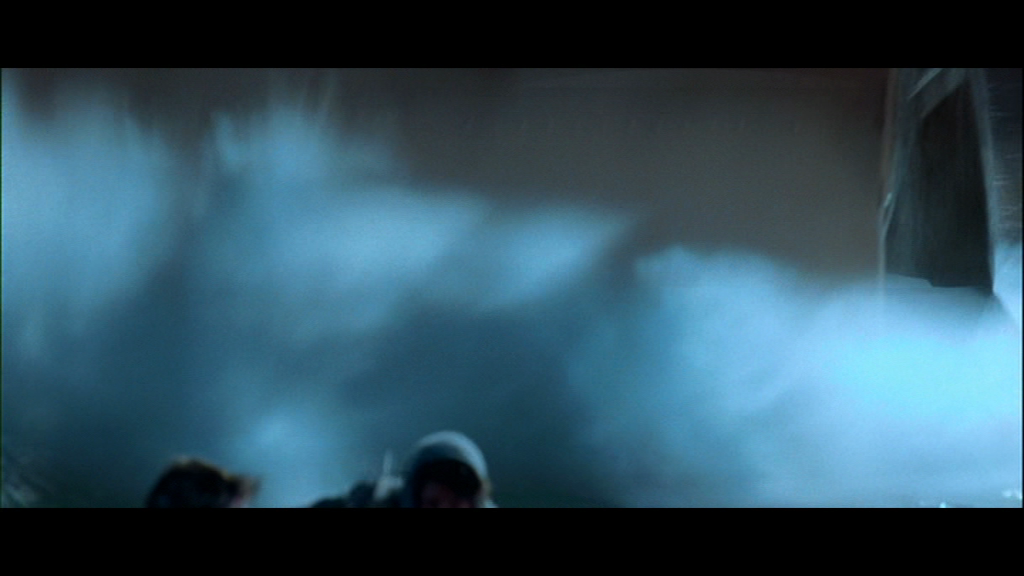
As the ship sinks, it creates a torrent of frothy turbulence that pulls Jack'n'Rose underwater. While it is true that there was suction when the bow sank, the stern's foundering was devoid of any such theatricality. We are told of a small wave that rocked debris. The film's version is bogus. |
|
This line, which sometimes raised chuckles from a cinema's audience, was actually said. Well, sort of; "If you don't stop talking through that hole in your face, there'll be one less in this boat!" It was also said in boat 8, not boat 6. Hichens accent is wrong too, as he was from Cornwall. |
|
The lifeboats were actually tied up nose-to-tail, and there were 5 of them in total, not the three as depicted in this scene. |
|
Believe him or not, Lowe claimed that he never saw one female body amongst the debris. |
|
Contrary to popular opinion, Lowe was given a torch by 6th Officer Moody before Lowe left the Titanic. It seems doubtful that his companions in the lifeboat in this scene would have, though. |
|
If Lillian Bentham is right, the design of the officer's whistle that Rose blows is wrong. |
|
According to the Encylopedia-Titanica website, boat 4 picked up 8 men, two of whom died, and boat 14 picked up 3 or 4, and one of those died; boat D picked up 1 person. However, Colonel Gracie's posthumous book corroborates Old Rose's number. The "6" include Rose herself and she does not seemingly include the 30 or so occupants of lifeboats A and B which provided refuge for people swimming in the water. These survivors were later picked up by other boats. Of course, the statement "Only one boat came back" is completely wrong; boats 4 and 14 came back to rescue some of the people. |
|
Caledon Hockley is shown having been rescued from the swamped collapsible "A" lifeboat. In reality, it would have been daylight in this scene. Incidentally, Rose had been saved and was in Lowe's boat (No. 14), and now Hockley had been saved by Lowe, who was towing boat "D" and had taken the survivors from "A" off in her. It is amazing that Hockley did not notice Rowe who was only a few feet away! |
|
Lowe did not use green, or any other coloured flares; the only person who did was 4th Officer Boxhall, and his boat was the first to be picked up. Also, when towing boat D to the Carpathia, Lowe was actually wearing what seems to be a white, (or at very least light coloured) scarf. |
|
Hockley goes to the well deck to look for Rose; he is told by a steward that he is unlikely to find his party as they're all steerage. The script is ambiguous on this point: was class discriminaiton in place, did the steerage tend to congregate here, or did the steward just assume that everyone there was 3rd class based on their clothing and so on? Evidence on this is confusing; there does seem to have been some form of segregation in place, but it does not seem to have been enforced rigidly. Lawrence Beesley went down into 3rd class on April 16th to make an inventory of names; some Titanic survivors were berthed in third class when suitable space in 2nd class couldn't be found; and those Carpathia passengers with cameras (so, not 3rd class!) entered steerage territory on the open decks where photos were taken of those in the lowlier classes. |
|
Cameron seems to have gone to some trouble casting actors who looked like their characters, so why did he cast such a portly actor as T.W.McCawley, who ran the gymnasium? | ||
|
If Marconi messages were sent to the wireless room by pneumatic tube, why is there also someone to deliver them too? There are other problems too: Harold Bride was actually asleep when the Californian's final ice message came in. And Phillips would have sent out the short-hand message "DDD" to indicate "stop transmitting" rather than keying out each letter. I'll let others comment on the accuracy of the morse code! | ||
|
Cyril Evans of the Californian later told those investigating the disaster that Phillip's message telling him to shut up was not intended, and was not taken as an insult. In real life, Evans did not shut down his wireless set immediately after the rebuke from the Titanic. He listened to some more of the private messages from the Titanic's crew being sent. And Evans was alone when this happened; 3rd officer Groves was on duty and it would have been a serious lapse of duty to leave his post on the bridge. With no-one to convey the details of the Titanic's rebuke to the audience, the only way for this scene to work would have been with subtitles. Another interesting piece of trivia: the actor playing Cyril Evans is Adam Barker, son of the late UK comedian, Ronnie Barker. Adam amassed a huge collection of child pornography on his computer and spent a great deal of time evading the police before he was finally incarcerated. So, I don't think this scene will be included in any "special edition." | ||
|
Groves steps out from the Marconi view to see the Californian surrounded by icebergs...except, it wasn't. The Californian was in loose ice, on the outskirts of a massive ice field. It was too dark to see the icebergs, which weren't seen till morning. | ||
|
From the Titanic script book, we know that James Cameron was divided on whether to leave this scene in the film as he thought it might be too whimsical, showing "Molly" Brown asking for more ice as the iceberg drifts by outside. Cameron admitted that the scene appealled to his mischievous sense of humour. Wrong answer, Mr.Cameron. The scene shouldn't have been filmed or even considered for one simple reason: Molly Brown was in her cabin when the 'berg struck. I am not 100% sure, but I suspect that the Palm Court where "Molly" is supposed to have been seen would have been closed by 11.40pm | ||
|
This scene indicates that SOS was sent out straight away. It wasn't; it was some little time before it started to be used. | ||
|
Ismay implores Lowe to be faster in lowering the lifeboat; the gist of the scene is correct, even if the language isn't. What is wrong is that, at the start of the scene, Ismay watches a rocket go up and then rushes aft to the aft davit of lifeboat 5. Except, the first rocket wasn't sent up until after boat 5 was departed. Also, from Ismay's vantage point, the flaming debris from the rocket seems to fall directly overheard. They were actually launched at an angle of 20 degrees from vertical to ensure that detritus from the detonation did not hit the ship. (Also, when the first rocket goes up, watch the view point of Rose, Lightoller etc. They are all looking off to the port side of the ship; the rockets were fired from starboard, which is correctly depicted in the Lowe/Ismay confrontation). Also, watch out when Ismay rushes up to the davit; in the background we see a deckhouse, beyond the grand staircase foyer. Although the deck lights are on, the windows in the house are out. First of all, this is the area where the gymnasium is located, and it should be flush with staircase foyer; and secondly, it should be open, with the lights on. Indeed, John Jacob Astor comforted his wife in the gymnasium by cutting open a lifejacket to show her what was inside, and other passengers went into the gymn to while away the time, or to stay warm. It is difficult to ascertain what is going on with the boats at this point, but certainly steam was still issuing from the funnels when boat 5 left; in the movie, all is quite. Also, the forward starboard boat deck is reported to have been relatively bereft of people. | ||
|
In this scene, Joughin is shown taking a huge swig from a flask. Once again, history portrays him as a drunk. Let us look at what he says in his testimony at the British Inquiry: he drank a half tumbler full of spirits while still in his room. Not on deck. If you're going to deviate from a man's testimony, at least give us a reason, Mr. Cameron. Putting in a set-piece to satisfy Titanic Anoraks isn't good enough. And the timing of the scene is bogus too. This is placed after the hails from the Captain for boat 6 to return to the ship. By this time, Joughin was engaged in trouping up to the boat deck with bread, and helping people into the boats. He didn't start throwing chairs overboard till later on. | ||
|
Picture the scene: nobody really believes the Titanic is sinking, and that taking to the boats is a precaution or a highly inconvenient drill. So what does McCawley tell people in his gymnasium: that he doesn't wear a lifejacket because it would interfere with his swimming stroke! That is tantamount to telling people that he knows the ship will sink and he'll be in the water. Of course, no professional member of the crew would do this. While it is true that McCawley did say this line on the real Titanic, it was much later when concerns about the ship and its occupants were heightened. | ||
|
The movie shows the Strauses as being in the vicinity of boat 10. In actuality, the Strauses were seen in the vicinity of boat 8 and other forward boats; there is one account of them being seen in the vicinity of boat 10 by 2nd class passenger Imanita Shelley, but her account has many gaping holes, the largest one being the Strauses, in 1st class, breaking class segregation rules to help the ailing Shelley on deck. Her US Inquiry affidavit is a truncated version of an account that she gave to a newspaper, which has so many deviations from the truth that we must question Shelley's version, which paints her as someone obsessed with causing trouble and pointing out the unfinished fittings and heating equipment on the ship rather than the horrendous loss of life. | ||
|
I could be mistaken but this scene's accuracy is bogus. I don't recall anyone saying that the dogs had been released and ran out on deck. All I have is, "First Class survivor R. Norris Williams recollected, that as he was struggling in the freezing water he found himself staring into the face of a bulldog he thought he had imagined it but later he met a fellow passenger [Robert Daniels?] on the Carpathia who explained that he had gone to the kennels and released the dogs, sparing them from being trapped in there cages as the ship went down". But Williams only seemed to have mentioned this story in later life. Madeleine Astor is supposed to have seen her husband with Kitty, their pet Airedale, on deck as she looked back at the Titanic but this story is questionable. Some suspect that Astor released the dogs, but, again there is no proof. | ||
|
In the DVD of the film, this scene, where Bride implores Phillips to escape is placed just after the moment when Cal gets into boat A. However, this is before boat B smashes onto the deck, upturned. In reality, Bride clambered onto the roof of of the officer's quarters, and helped to push "B" down, and he never returned to the wireless cabin after this. I am frankly astonished that James Cameron, knowing of his love for Titanic set-pieces through which he could allow his caricatures to run, omitted the instance when a stoker tried to relieve Phillips of his life-jacket and was left for dead on the floor of the wireless cabin; or that he failed to include a scene where the Captain releases the two Marconi men from their duties just moments before. | ||
|
Lord Duff Gordon replies "Its out of the question" when a crewman nearby suggests that they should go back and help. The whole matter is very confusing, with many in the boat suggesting that no-one said anything about going back. And of those who did comment on the matter, it was Lady Duff Gordon, between bouts of sickness and lying down, who may have suggested that it would be dangerous to go back. If Lord Duff Gordon did say anything on the matter, it was simply to uphold his wife's comments. | ||
|
The out-takes show the survivors on boat B. It wasn't quite like this. Colonel Gracie is seen lying down behind Lightoller; and he says that they were standing two abreast, facing the bow with water lapping over the keel. In front of Gracie were eight people, with some behind him; the boat was too delicately balanced to turn around and look. Baker Joughin never made it completely on to the boat, which he claims he got to when it was light. His legs and feet stayed in the water and held on with the help of a colleague called Maynard. In the out-take, Joughin is shown comfortably reclining on the boat. 
This is an actual photograph of boat B many weeks after the disaster. Compare it to the design in Cameron's movie.
|
A truly powerful moment...shame it didn't happen. Ismay never paraded himself before the disgusted eyes of survivors. He secured the doctor's cabin on the Carpathia and never came out until they reached New York. |
|
This image was provided by Titanic researcher William Barney and is from the DVD. This scene was deleted for pacing, but conceptual artwork was made for it. It shows Smith and Andrews coming down the steps to the Mail sorting room and find mail clerks scrambling to pull mail from the racks and hauling wet sacks of mail up from the hold below. Andrews climbs halfway down the stairs to the hold which is almost full, with sacks of mail floating, the lights being on below the surface, the car visible under water. As he watches, water covers his show and he scrambles back up the stairs. Thankfully this scene was never filmed, and it is odd that it was perhaps considered for filming. The room is a smallish approximation of the layout of the real "Post Office" on G deck, with the strange inclusion of a door in the distance, the lack of a letter cage in the middle of the room etc. The notion that the Titanic's lights were on under water is bizarre and untenable; as Cameron later shows what happens when cold water and hot lamps mix (though some survivors reported lights under water, this is due to unflooded rooms themselves being under water). The "motor car" cargo area in hatch 2 would not be visible from the "mail room" on the Orlop Deck. But the most bizarre aspect of all this is the timing. When Smith and Andrews visited this area, after about half and hour had elapsed, water was reported by stewardess Annie Robinson to be nearly up to E deck. Even 4th Officer Boxhall, who viewed this area about 10 or 15 minutes after the collision reported that the water was within a few feet of the deck upon which he was standing, G deck. So, everything below would be flooded by the time Andrews and Smith would have arrived; they would be unable to view the mail area at all. |
This YouTube video claims to have found the Californian in Cameron's version. I am sceptical. But if it is the "flickering masthead light", its in the wrong location. The Californian was almost directly ahead on the bows; this video seems to say it is off way off to the starboard side. And of course, the lifeboats that rowed for the mystery lights in the movie are going in the wrong direction!
Concluding comments: Although many of the flaws in Titanic are mostly superificial, overall they reinforce the view that the film is mostly of dubious accuracy. One almost feels that the film could have taken place on any suitably melodramatic backdrop; airship, skyscraper, earthquake zone or anywhere else visited by Irwin Allen in the 1970s. This is a shame as it makes this author feel that the historical aspects have been sacrificed and sledge-hammered into the narrative to make the film "work." We have Cal's party taking lunch in the Verandah Cafe (not possible, but how else was Jack going to catch his first glimpse of Rose?); then Rose attempting suicide (again, not possible, and taking a route at variance with the known geography of the real Titanic); then we have Jack being loaned a dinner suit by Margaret "Molly" Brown (how else was he going to get into the 1st class restaurant?); and then we have Jack, despite having a steerage ticket, seemingly having the run of the ship until Lovejoy reminds two convenient stewards that his presence is "not appropriate" (and incidentally, class segregation was strictly enforced, so 3rd class would not be allowed at the Sunday Service); then Jack and Rose form their union in an impossible location (the bow) and finally consumate that love in a spot that would have been impossible to reach on the real Titanic, and this is only after a chase scene reminiscent of the early Hollywood efforts. A chase scene which was, I recall, intended to show us as much of the ship as possible but only serves to remind us of the rum geography at work in James Cameron's Titanic (the ship, not the film). I find it absolutely impossible to believe that Don Lynch and Ken Marschall, the two historical advisers on the film, were blind to these and other flaws and must conclude that Cameron overrode them in favour of the old excuse "dramatic license." But how far can reality be sacrificed before "dramatic license" falls away and we are left with nothing but "fiction"? But, to this reviewer, the most irksome thing of this whole Cameron/Titanic business is the way that the film's contents have been accepted by neophytes as fact, and I am not necessarily talking about teenagers looking at the passenger list for Jack or Rose, but how these "newbies" lecture experts on "how the boat deck would look too cluttered with more boats, that why more weren't fitted"...or "the bulkheads only went up to E deck"...etc...etc... Much more blatantly, Cameron's nomenclature of the ship's name has overridden historical precedence. Pre-1997 practically everyone called the ship "THE Titanic". Afterwards, it is invariably just "Titanic" - so the director's own preference has foisted itself upon researchers. To refer to the ship with the definite article now makes one seem laggard and a maverick.
It is disturbing that the Titanic Historical Society, whom Cameron approached for help and who named him "Man of the Year" was not more strident in its condemnation of the film rather than sycophantically absorbing the mesmerising spectacle. Cameron's own duty had been fulfilled too: he had shown that he could tackle science fiction, adventure and horror with his first forays into film making. With "True Lies" he has demonstrated that could produce comedy-drama. All that was left was history and romance. And therein lies the true reason for the historical shambles that is "Titanic."
Proponents of the Cameron effort play two gambits; firstly, that the film introduced the Titanic story to many new people. This is true; it did, but only superficially. Membership of the Titanic Societies soared for a while, and then dropped off sharply when people realised that it wasn't a Jack'n'Rose film club. And the interest helped to inflate the cost of memorabilia out of the hands of most normal people. The second gambit is more pernicious; "if you don't like it, I'd like to see you do better!" I don't know about you, but most of the populace don't have the Hollywood clout of James Cameron or $200 million lying around.
But now we have a film whose inaccuracies will be repeated and believed for decades. Studies have confirmed that movies can be a wonderful boon for learning and retaining information - even if the data on screen is incorrect and contradicts doctrine: in this case, people "often" falsely recalled the movie's portrayal. This is all too evident when discussing the disaster on social networks, as people are far too prevalent to remark upon details from the film and the accurate sets", as opposed to the reality. Before 1997, the Titanic was remembered as a big ship that sank when it hit an iceberg and had too few lifeboats; now, it is all Celine Dion and that dratted "I'm flying!" scene which so many people feel compelled to recreate and post their efforts on social media sites. And a new "meme" has entered the mix; could Jack'n'Rose have fitted on that door after the ship sinks?
All this seeks to divert attention from the real story of the tragedy. The ship, its story and real-life personnel have now simply become cameos in their own story. It is said that the movie was "never meant to be a historical narrative," and while this is true, why is Cameron seemingly so keen to return to this 20 year work and tell us how accurate and authentic it is? Why is his reputation as a "perfectionist" repeated? I'm sorry, but the movie became a historical narrative when it used a real event with real people.
In 2012 to coincide with the 3-D rerelease of his movie, Cameron gave an interview in which he plays down the films inaccuracies, saying that in a few cases, "the set wasn't quite right...maybe glass was missing from a door." As we can see from the above list, the errors in many cases are more profound and more serious than tiny technicalities in the set. A friend at a US Newspaper says that Cameron talks of those who nit-pick (so called "rivet counters") with affection, but this is quite a put-down. Rather than addressing his mistakes, he prefers to gently dismiss those of us with a passion for history, and those who decry the diluted spectacle that Hollywood seems to demand. Why is the film being re-released now? The only reason is the driving force in today's world; money. I don't accept that the film is now being reintroduced to show a new generation Titanic. It is simply to make money from the 100th anniversary. And the same thing could be seen about the December 2017 re-release to tie in with the National Geographic documentary "Titanic: 20 Years Later with James Cameron."
Confirmation of Cameron's huge ego came when Don Lynch said that the director "told me he was ready to apologize [for the way his film depicted Murdoch as a murderer and a suicide victim] until the British Parliament issued a demand for it. He thought that was ridiculous that they would get involved, and their action virtually killed any apology on his part." I was sceptical; after all, Cameron has been caught lying in the past. In turns out the Parliamentary debate was actually an Early Day Motion, but this in itself is not proof that Parliament wanted Cameron's blood. The "Early Day Motion" was instigated by the Member of Parliament for Dalbeattie (Murdoch's home), Alasdair Morgan. These "Motions" were not a guarantee of a debate in the House of Commons; very few ever reach that stage, and indeed, this one didn't. It only garnered 22 signatures out of 659 MPs, and even then it took three weeks to get that many. After this time it was forgotten about and went no further. Rather than the whole British Government wanting Cameron's head, it was only about 3% of the House. Obviously Cameron, affronted by anyone demanding an apology, used this as an excuse; I don't believe he was ever going to give one anyway. And what did one Parliamentary archivist say about this? "James Cameron has always come across as an egomaniac and this story only confirms this, his actions sum up a truly awful film!"
We have further proof of Cameron's imperious attitude when he was refused permission from the copyright holders to include Picasso’s painting "Les Demoiselles d'Avignon" in the scenes in Cal's stateroom. Cameron went ahead and used an image of the work anyway and in the ensuing legal fracas, agreed to pay a fee for the rights after the fact. For the 3-D reissue, a shot of "Les Demoiselles" underwater was replaced by Edgar Degas's work "L'Etoile" - a painting in the public domain, but, like the Picasso work, never on the ship in the first place.
Cameron intially said that he hadn't changed one single frame for this new cash-in (sic - see above!), but later admitted that he had changed one small scene; its the sequence when Rose is lying on the wood panel and staring up at the stars. Famous astronomer Neil de Grasse Tyson sent a snarky email to Cameron who elected to fix the stars, which Tyson had said were wrong. Cameron felt compelled to do this because he has a "reputation as a perfectionist," to which all I can say is "[sic]"! And apparently, the footage of the collapsing forward funnel was altered to give it a black top. Not having seen the 3D or Blu-Ray version, I can't say for certain.
While I applaud Cameron's dives to the wreck and the marvellous footage generated, I am now wary of his forays into historical matters
and especially his association with discredited individuals, like Charles Pellegrino and his fictitious doctorate (at least Cameron didn't ally himself with Dan Butler!) and "friends" who lack subjectivity and the courage to tell Jim when he is wrong and indeed, regard Jim as an infallible father figure. I have refused to watch his "Last Word" extravaganza but comments by others have shown it to be severely lacking in
certain key areas (for instance, Sam Halpern discovered that the producers of that show exaggerated and distorted certain data to
bolster the claims that coloured rockets, and not white ones, were sent up by the Titanic that night.)
I now suspect that the following is true; throw a lot of money at a project, gloss over the inaccuracies
in your work, surround yourself with historian pals (or sycophants who like to casually namedrop their association with "Jim", "Don", "Ken" etc. into messages like Parks Stephenson just to remind you of their superiority), and arrange multiple dives to the wreck, and you'll be considered an "expert" yourself. [We should also remember that Cameron's identification of many pock marks and shell hits
identified in the hull of the Bismarck fell flat when experts in the ship identified many of them as wash ports, discharges and scuppers.]
If only life was so easy. What we have had to contend with is a growing list of people who claimed to have been "advisors" to Cameron - and yet whose names do not appear on the credits. Funny, that.
I have yet to view the 20th anniversary revisit by National Geographic but I do know that Cameron repeats another fable, namely that more lifeboats would have got in the way and caused many more deaths. Sadly, this is based on faulty logic and poor research by one of his cronies - as I have demonstrated here, if there were enough lifeboats (and the crew assembled correctly), everyone could have been saved in the time allowed.
Click here to go up a level.
 Special Edition 4k |
 Blu-Ray and 3D |
 3 Disc DVD |
 |
 |
 |
 |
 |